


Why Rigid Procurement and Supply Frameworks Slow Growth (And What Modern Executive Teams Are Doing Differently)
- Technology without strategy will fail. Retrofitting AI into a rigid process will still give you a rigid process.
- Competent leaders are rebuilding workflows, governance, and talent models with agentic AI at the architectural core.
- The result: procurement that thinks faster, acts smarter, and creates value at scale.
March 19, 2026 | Procurement Software 6 minutes read
The biggest threat to procurement's strategic relevance isn't market volatility or supplier disruption. It's the operating model you're still running on. Most enterprises today are making billion-dollar sourcing and supply decisions on frameworks built for a world that no longer exists, and the compounding cost of that misalignment doesn't stay invisible forever.
The organizations pulling ahead are now deploying agentic AI to fundamentally redesign how procurement thinks, acts, and creates value at scale.
Agentic AI is a paradigm shift from systems that respond to commands to systems that reason, plan, and execute autonomously across complex procurement workflows.
This article breaks down exactly why rigid procurement and supply frameworks stall enterprise growth, and lays out ten shifts that forward-thinking executive teams are making right now to stay ahead.
Procurement That Moves at Market Speed
Planning for a market that won’t sit still? Build a self-adjusting supply chain.
The Problem with Rigid Procurement and Supply Frameworks
Rigid procurement frameworks are built around fixed sourcing cycles. It could predetermine vendor rosters and sequential approval chains that move at the speed of bureaucracy, not business.
But when market conditions shift and commodity prices swing, coupled with geopolitical disruptions and supplier failures, these frameworks crumble like a house of cards.
Operational inefficiency causes the least damage. Firms miss out on strategic opportunities as they’re stuck inside a process designed to fail in adversity.
Siloed data architecture further keeps leadership flying blind. In most large enterprises, procurement data lives across a fragmented constellation of ERP systems and static tools, supplier portals, and data repositories that don't communicate with each other in any meaningful way.
Leadership ends up making high-stakes decisions based on incomplete and outdated information, which actively prevents procurement from functioning as the strategic business partner the C-suite needs.
Compliance-heavy frameworks stifle supplier innovation. When your procurement framework is optimized primarily for risk mitigation, you inadvertently screen out the most innovative supplier relationships. Suppliers with differentiated capabilities and next-generation solutions often can't navigate your process, or won't bother trying.
Over time, your supply base consolidates around incumbents who are safe but not transformative, leaving significant competitive advantage permanently on the table.
Manual contract lifecycle management creates compounding risk, as contract management in most organizations remains largely manual and reactive. Teams drafting them in silos, negotiating without real-time market benchmarks, and following clauses that were never designed to sustain profits or scale operations.
For an enterprise managing thousands of supplier contracts simultaneously, the revenue impact of this structural gap is both material and measurable.
Talent models built for transaction processing can't support strategic value creation. When teams are staffed and structured for operations rather than strategy, there's no capacity to invest in should-cost modeling, category-level market intelligence, or proactive risk sensing. Growth slows because the architecture around it keeps pulling talent back to low-value work that AI is now far better equipped to handle.
Check out GEP’s AI-orchestrated procurement platform
10 Things Modern Executive Teams Are Doing Differently
Most procurement leaders have either dismissed agentic intelligence as hype, confused it with basic RPA, or are evaluating it using criteria designed for legacy tools. And in doing so, they're asking the wrong questions while the underlying problems continue to pile up.
It’s time to rethink how intelligence should be embedded across every touchpoint of the procurement lifecycle, from spend visibility to contract execution to real-time risk sensing.
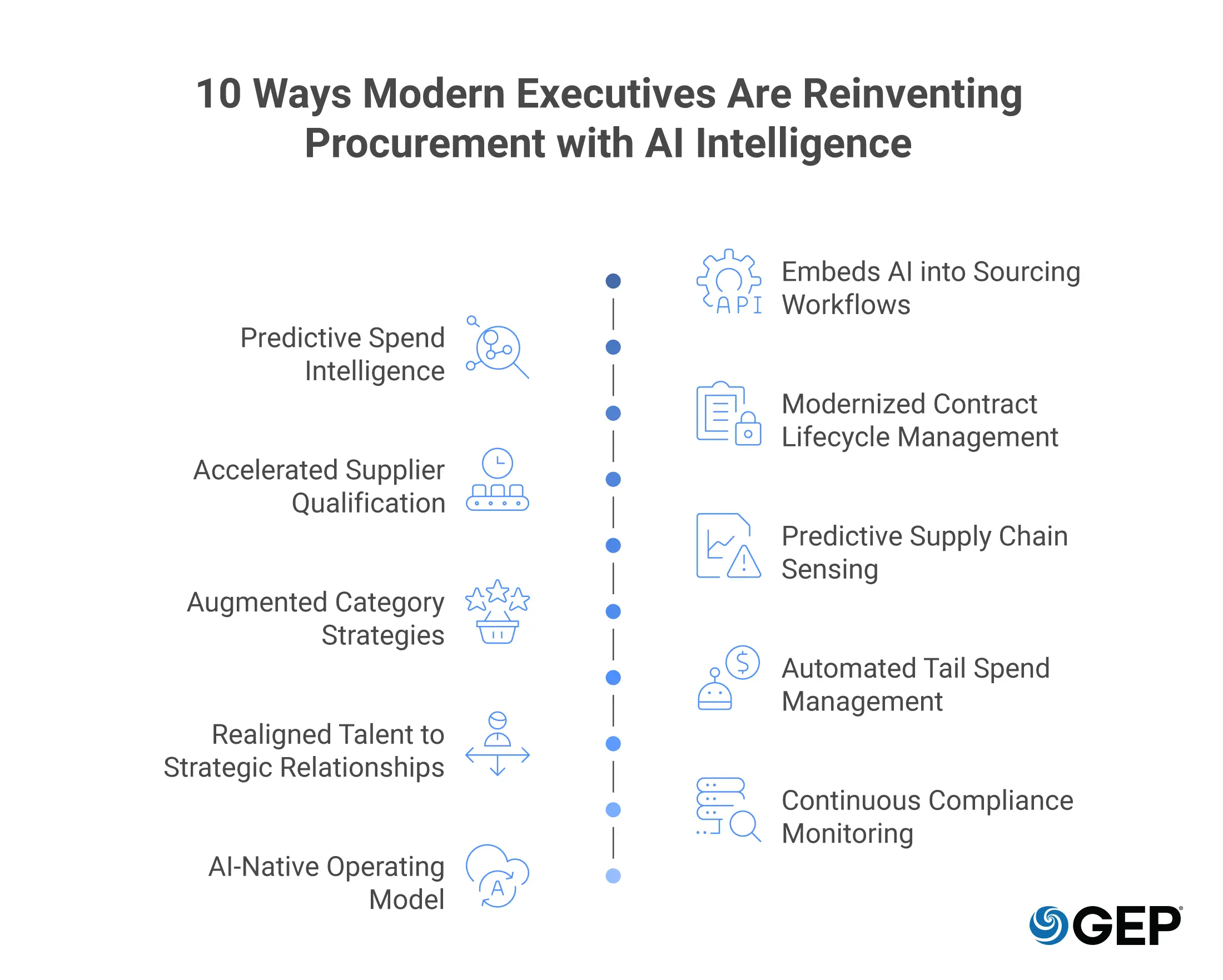
Infographic: 10 Ways Modern Executives Are Reinventing Procurement with AI Intelligence
1. Embedding AI agents directly into sourcing workflows
Instead of using AI as a reporting add-on, modern procurement leaders deploy AI agents that autonomously execute sourcing tasks like generating RFPs, evaluating supplier responses, and flagging anomalies in real time. The function doesn't break when key personnel are unavailable; the intelligence keeps moving.
2. Shifting from spend analysis to spend intelligence
Historical spend reports are replaced with continuous, AI-driven intelligence that surfaces patterns, predicts demand shifts, and triggers sourcing recommendations before a human would even recognize the opportunity.
3. Building agentic AI pipelines for contract lifecycle management
Agentic AI systems draft, review, redline, and track contract obligations at a speed and accuracy level no manual process can match, closing the compliance gaps and missed savings that quietly erode value across the contract lifecycle.
4. Compressing supplier qualification timelines with AI
What used to take weeks of due diligence can now be compressed into hours. AI agents aggregate supplier data, financial signals, sustainability metrics, and risk indicators across thousands of data points simultaneously.
5. Deploying predictive supply chain sensing
Rather than reacting to disruption, modern executive teams use agentic AI to continuously monitor geopolitical developments, logistics constraints, and supplier financial health—generating early warning signals that allow proactive mitigation before a crisis materializes.
6. Creating AI-augmented category strategies
Category managers are no longer working from static market reports. AI agents surface real-time market intelligence, benchmark pricing, and emerging supplier alternatives, enabling category strategies that are updated continuously, not revisited annually.
7. Automating tail spend management end-to-end
Tail spend, historically the most time-consuming and least strategically valuable portion of procurement activity, is increasingly managed through autonomous procurement agents that handle the full cycle without requiring human intervention.
8. Redeploying talent toward strategic relationship management
By automating transactional workloads, leading teams are freeing senior procurement professionals to invest in strategic supplier partnerships, innovation pipelines, and executive-level commercial negotiations, where human judgment still creates irreplaceable value.
9. Implementing continuous compliance monitoring
Instead of periodic compliance audits, AI agents monitor supplier activity, contract adherence, and regulatory exposure in real time, surfacing issues early.
10. Building AI-native operating models, not retrofitting legacy ones
The most important differentiator isn't which AI capabilities an organization adopts; it's whether leadership is willing to rethink the operating model entirely. Retrofitting AI into a rigid process still gives you a rigid process.
Organizations that are winning have redesigned workflows, governance structures, and talent models from the ground up with agentic AI as a core architectural component.
Is Your Category Spend Strategy Ready for 2026?
Respond to supply shifts faster with data-led, strategic guidance
The Future of Procurement Belongs to Those Who Build for It Now
Procurement is at an inflection point that only comes along once in a generation.
The convergence of agentic AI, real-time data infrastructure, and autonomous execution capability points to how much procurement is about to widen. The decisions you make in the next 12 to 24 months will determine your success in the future.
The enterprises that treat this as an incremental upgrade cycle will find themselves structurally outcompeted by those that recognize it for what it is: a fundamental reinvention of the function.
The path forward isn't complicated to understand, but it requires genuine executive conviction. You need to audit where your current frameworks are structurally slowing you down, identify where agentic AI creates the most asymmetric leverage, and commit to building the operating model around the technology, rather than forcing the technology to accommodate the model.
Getting it wrong is expensive.
The window for building a durable competitive advantage through intelligent procurement isn't open indefinitely. The teams moving with urgency and precision today are the ones who will define the standard everyone else chases tomorrow.




FAQs
Traditional procurement automation follows fixed rules to execute predefined tasks. Agentic AI operates at a fundamentally different level: it reasons across complex, ambiguous situations, makes judgment-based decisions, and orchestrates multi-step workflows autonomously, adapting in real time rather than following hardcoded instructions. Automation makes your existing process faster. But, agentic AI makes your procurement function capable of things it simply couldn't do before.
The highest return is typically where your procurement function currently incurs the most structural inefficiency, often in contract lifecycle management, tail spend, or supplier risk sensing. Rather than deploying AI broadly across all categories at once, leading organizations identify two or three high-impact processes, implement agentic AI in those areas with clear performance benchmarks, demonstrate measurable ROI to build internal conviction, and then scale systematically. The key is treating it as a strategic transformation with executive sponsorship. Don’t work in isolation.