


Supply Chain Intelligence: What It Is, How It Works and Why It Matters
- Supply chain intelligence turns fragmented data into decisions you can act on, not just reports you read after the fact.
- The real split isn't AI versus no AI. It's AI-native versus AI bolted on. Architecture decides how much a platform can predict versus just describe.
- Rolling it out works best in stages: connect the data first, prove the payoff on one process, then let automation take over.
September 08, 2026 | Supply Chain Strategy 4 minutes read
Supply chains don't fail quietly anymore. A port delay, a supplier default, or a demand spike can hit the P&L within days. Most teams find out after the fact, once the dashboard catches up. Closing that lag is the whole point of supply chain intelligence.
What is Supply Chain Intelligence (SCI)?
Pull data from sourcing, logistics, inventory, and supplier systems into one layer. Run analytics on top of it. That's supply chain intelligence in a sentence: fragmented information turned into decisions, not just descriptions of what already happened.
A regular report tells you inventory ran low last week. SCI tells you it's about to run low again next week, and where. Think of it as sitting on top of ordinary supply chain management, adding the predictive layer that raw operational data never gave you on its own.
Why is Supply Chain Intelligence Important?
Because volatility isn't the exception anymore; it's the baseline. Tariff shifts, weather events, and single-source dependencies hit together, not in turn, and manual review cycles can't keep up. Teams end up managing yesterday's data against today's disruption, and the bill shows up as expedited freight, missed service levels, stranded or short inventory. Supply chain intelligence closes the gap between a signal in the data and a decision on the ground.
Want the Full Picture on Agentic AI in Supply Chain?
See why most agentic AI pilots stall, and what top performers do differently
What Are the Core Capabilities of Supply Chain Intelligence?
A working SCI setup usually has five things in place:
- Data unification across ERP, transportation, supplier, and market feeds
- Real-time visibility into inventory, shipments, and orders
- Predictive alerting that flags risk before it becomes a disruption
- Scenario modeling to test contingency plans against live conditions
- Automated recommendations that route decisions to the right team
None of these do much on their own. Visibility without prediction just tells you about the problem sooner. Prediction without automation still leaves the response up to whoever sees the alert.
How does supply chain intelligence work?
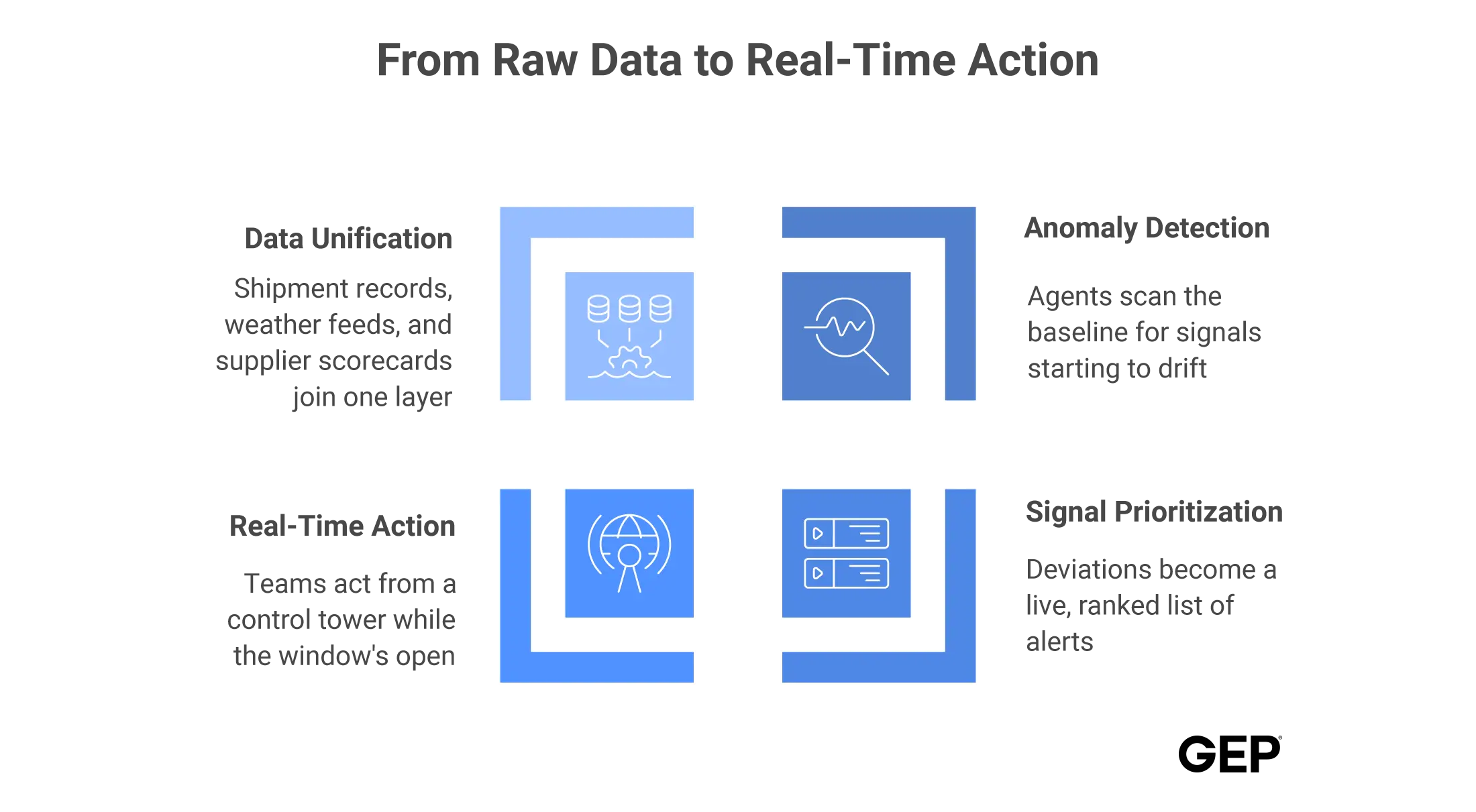
Data comes in from all over: shipment records, weather feeds, supplier scorecards. It lands in one shared layer. From there, intelligent agents look for anomalies against a baseline and flag anything drifting before it becomes a real problem. What comes out isn't a report someone reads Monday morning. It's a live, ranked list of signals, usually shown in something like a control tower, so teams act while the window to act is still open.
How can businesses benefit from Supply Chain Intelligence?
Cycle time, resilience, margin- that's where this pays off, not just cleaner reporting. GEP's own logistics visibility data shows inventory reductions of 20 to 30 percent tied to better planning and real-time visibility. There's a less measurable upside too: leaders can model disruption before it lands, protecting service levels and working capital in the same move.
The Role of AI, Machine Learning, and Predictive Analytics in Supply Chain Intelligence
This is where SCI stops being descriptive and starts being predictive. Instead of reporting that inventory ran short last month, an AI-native model pulls together demand, supplier lead times, and logistics data to flag where it's likely to run short next. Predictive analytics scores risk before it becomes real. Agentic AI goes further: coordinated agents plan, decide, and carry out routine fixes themselves, rebalancing inventory or rerouting a shipment, without anyone opening a dashboard first.
Industry Use Cases for Supply Chain Intelligence
Manufacturing: catching component shortages early, before they stall a production line
Retail and CPG: matching demand forecasts to point-of-sale data so shelves don't go empty
Life sciences: watching cold-chain and compliance-sensitive shipments for exceptions in real time
Ready to Build an AI-Native Supply Chain?
Talk to GEP about orchestrating your planning, logistics, and inventory data on one AI-native platform
How to Integrate Supply Chain Intelligence in Your Supply Chain
Start with the data, not the dashboard. Map which systems (ERP, TMS, supplier portals) actually hold what an intelligence layer needs and close the gaps first. Only then layer analytics on top. Pick one high-impact category, pilot predictive alerting there, and prove the speed gain before scaling everywhere.
From Visibility to Advantage: What Comes Next
None of this is really about the dashboard. It's about how fast a business gets from a signal to a decision, and that speed is turning into a competitive line item, not a nice-to-have. Companies treating SCI as a connected, AI-native capability, rather than a reporting layer bolted onto old workflows, are the ones turning disruption into something manageable instead of a quarterly surprise. If you want help operating this on a scale, talk to us.
Explore GEP’s AI-Native Supply Chain Management Software




Frequently Asked Questions
Traditional analytics reports what already happened. AI models correlate demand, lead times, weather, and supplier performance to forecast what's likely to happen next, turning a summary into an early warning.
Agentic AI acts on predictive alerts directly, rebalancing inventory, rerouting orders, or flagging exceptions without manual review, cutting response time from hours to minutes.
These models train on historical disruption patterns and score live data against them, so an unusual spike in lead times or a supplier risk signal gets flagged before it becomes a stockout.
No. The scale of the data layer changes, but connecting fragmented data to predictive decisions applies to any organization managing multiple suppliers or SKUs, regardless of size.