
How Leading Supply Chain Organizations Leverage Managed Services for Rapid Scaling
- Supply chain managed services are no longer just a cost-cutting tool—they’re a strategic lever for organizations that need to scale faster than their internal capacity allows.
- AI-powered supply chain services and outsourced procurement expertise let organizations access specialized capabilities on demand, without the time and cost of building them in-house.
- The most resilient supply chains combine internal control with external scale, and managed services are the architecture that makes this possible.
June 09, 2026 | Supply Chain Strategy 4 minutes read
Why Managed Services Matter for Supply Chain Growth
There’s a paradox at the heart of modern supply chain management: the more complex the environment gets, the more an organization needs to do, and the harder it becomes to do all of it internally.
Geopolitical disruption, tariff volatility and accelerating digital transformation have stretched procurement teams to their limits. Expertise in areas like AI-powered demand forecasting or multi-tier supplier risk management takes years to build. The business doesn’t wait.
According to IBISWorld, the U.S. supply chain management services market reached $16.5 billion in 2025, growing steadily as organizations recognize that the fastest path to operational scale isn’t always building it yourself.
Why Top Supply Chain Leaders Are Adopting Managed Services
Today's managed services model is a strategic partnership built around outcomes, not just a mechanism for offloading low-value tasks. According to Gartner's Future of Supply Chain 2025 survey, only 29% of supply chain organizations have developed the capabilities needed for future readiness, leaving the vast majority scrambling to close gaps in agility, resilience and technology adoption without the internal resources to do it fast enough.
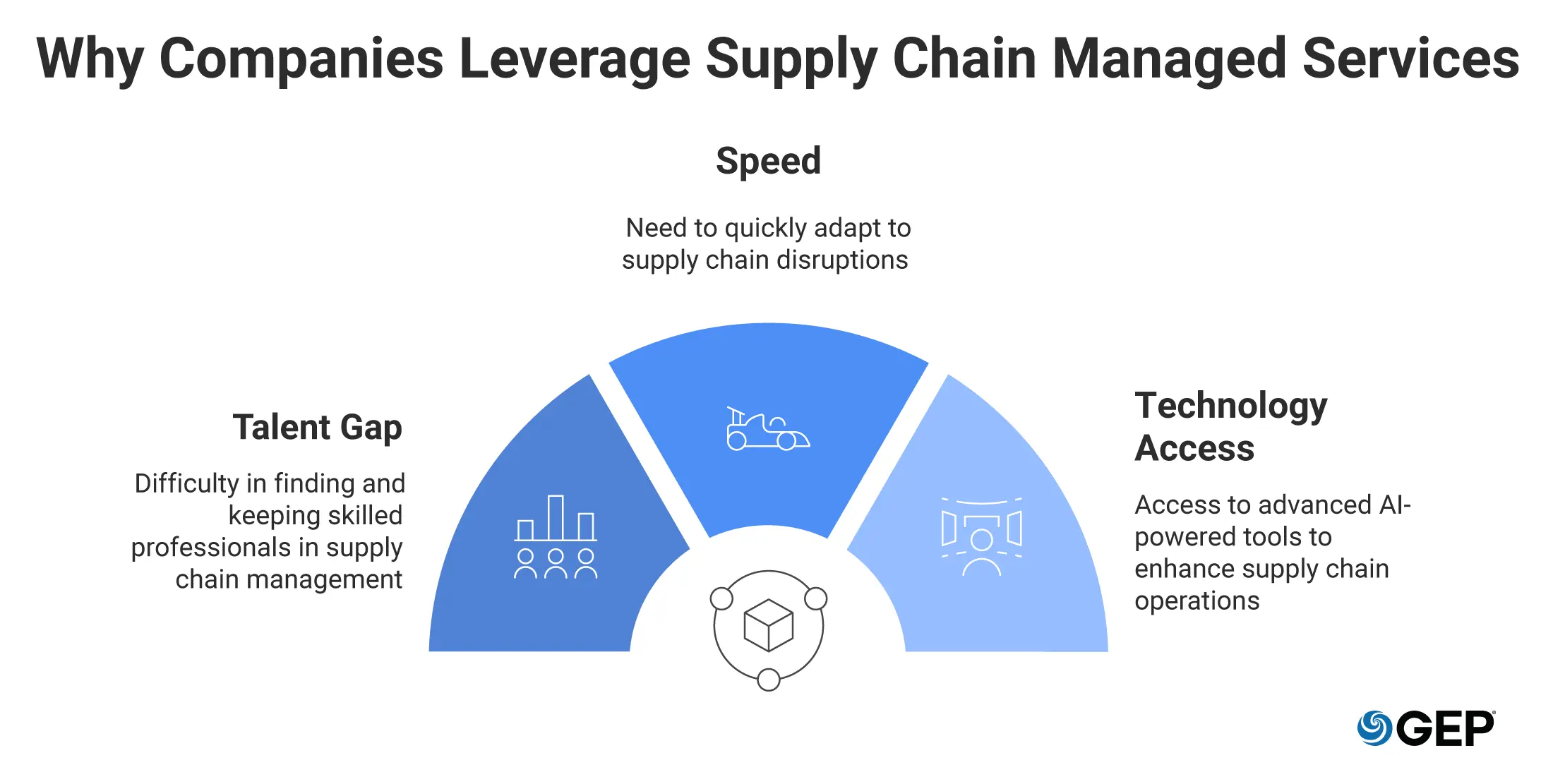
Three dynamics are driving adoption. The talent gap is widening: deep expertise in indirect spend, supplier risk and AI-driven analytics is difficult to recruit and retain at scale. Speed also matters: organizations with established managed services relationships can respond to disruptions in days, not months. And technology access has become a differentiator; leading providers bring AI-powered supply chain capabilities that would take years to develop internally.
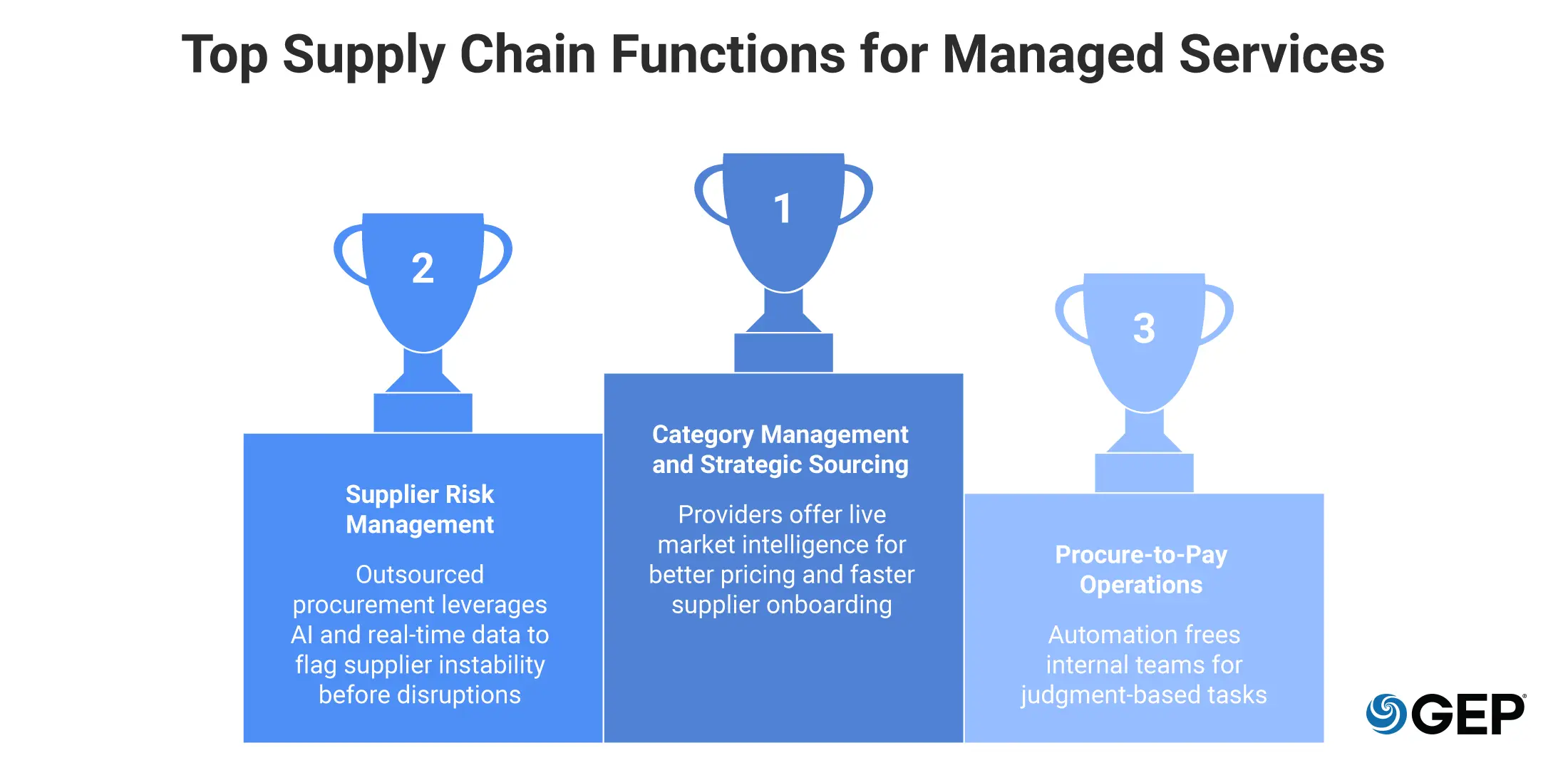
Key Supply Chain Functions Best Suited to Managed Services
Not every function belongs in a managed services model, but several areas consistently deliver the strongest returns.
Category Management and Strategic Sourcing
Providers maintain live market intelligence across commodity pricing, alternative suppliers and regulatory shifts that internal teams can’t replicate at scale, helping organizations capture better pricing and faster supplier onboarding.
Supplier Risk Management
Outsourced procurement services built around risk use AI and real-time data to flag supplier instability before it becomes a disruption event.
Procure-to-Pay Operations
High-volume functions like invoice processing and payment reconciliation are prime candidates. Automation frees internal teams for work that requires genuine judgment.
Sustainability and ESG Compliance
As sustainability requirements shift from voluntary to mandatory, providers with current cross-jurisdictional regulatory knowledge offer a significant advantage over building this capability from scratch.
The Managed Services Scaling Strategy: How Organizations Successfully Implement Them
The organizations that extract the most value treat managed services as an extension of their operating model, not a vendor relationship. It starts with honest assessment: which functions are genuinely differentiating, and which are consuming capacity without creating advantage?
Governance determines outcomes. Effective implementation requires agreed-upon performance metrics, regular review cadences, and internal stakeholders who own the relationship. When CFO, COO, and supply chain leadership align on what success looks like, managed services programs deliver. Technology integration matters equally; supply chain scaling strategies succeed when the provider’s platforms connect cleanly with existing ERP systems, creating visibility rather than new data silos.
How Managed Services Drive Cost Efficiency and Operational Agility for Scaling
The financial case goes beyond cost reduction. The procurement outsourcing market is expanding at 15.5% CAGR in 2025 because the deeper value is agility. When market conditions shift—a new tariff regime, a major supplier failure, an acquisition that doubles supply chain complexity overnight—organizations with managed services relationships scale their response immediately. Internal-only operations face hiring and technology cycles that can stretch six to twelve months.
There's also a technology adoption advantage. Most procurement organizations are being asked to take on significantly more: more suppliers, more compliance requirements, more data, without a corresponding increase in headcount or budget. Managed services relationships are built precisely for this gap, giving organizations access to the expertise and technology they need to scale without the cost and delay of hiring and training from scratch.
Stop Fighting Silos. Start Operating Intelligently.
See how top organizations are scaling agentic AI across the entire procurement lifecycle.
Harnessing Managed Services for Sustained Supply Chain Growth
The organizations winning on supply chain aren’t necessarily those with the largest internal teams. They combine internal capability with external expertise—scaling without being constrained by headcount. Supply chain managed services convert fixed costs into variable capabilities and give organizations the agility to respond to disruption rather than absorb it.
Want to learn more? Visit Supply Chain Managed Services to see how GEP helps enterprises scale with speed and confidence.
FAQs
Q. How do managed services help supply chain organizations scale quickly?
Managed services give organizations immediate access to specialized expertise, proven processes, and AI-powered tools without the time required to build these capabilities internally. When scale is needed fast, managed services relationships allow organizations to respond in days rather than the months it takes to hire and onboard internal teams.
Q. What are the key benefits of leveraging managed services for supply chain scaling?
The core benefits span four dimensions: cost efficiency (providers operate at scale, making expertise accessible at a fraction of internal cost); operational agility (flexible capacity that expands or contracts with business needs); technology access (AI-powered tools without the capital expenditure burden); and risk reduction (continuous monitoring and compliance management that compounds in value over time).