


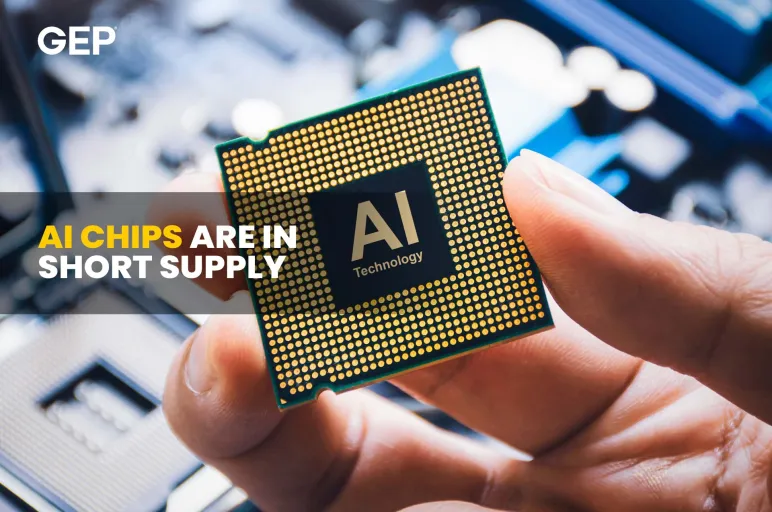
Why A Global Chip Crunch Can Derail the AI Boom
- Surging demand for AI infrastructure and data centers is reshaping semiconductor sourcing
- DRAM revenue is projected to rise 177% in 2026 as AI demand continues to outpace supply
- Allocation now goes to buyers with committed agreements and credible demand signals
September 24, 2026 | Procurement Trends 4 minutes read
The AI boom runs on physical infrastructure, and that infrastructure runs on chips. Every model trained and every query served depends on the same semiconductor capacity everyone else is buying from.
That capacity can no longer keep up. As hyperscaling tech companies pour hundreds of billions of dollars into data centers, sourcing the components has become a critical bottleneck. Competition now extends far beyond the AI sector.
For sourcing teams in high-tech, automotive, and manufacturing, securing critical components at a workable price is a major challenge.
The clearest read comes from the suppliers. Tech giants are optimizing their global supply chains for AI infrastructure components.
UK chipmaker IQE makes the wafer materials behind optical components used in data centers. The company returned to profit in the first half of 2026 after a loss a year earlier, and named AI infrastructure demand as the driver.
One supplier's results are a data point. The pattern behind them is the story.
Research firm IDC describes a memory market where demand is materially outpacing supply, a structural shift rather than the usual boom-and-bust cycle. It projects DRAM revenue up 177% in 2026.
Samsung, SK Hynix and Micron, which make nearly all the world's memory, have shifted capacity toward the high-bandwidth chips that feed AI accelerators.
Prices followed.
TrendForce raised its forecast for conventional DRAM contract prices to a 90 to 95% quarter-on-quarter jump early this year, among the steepest on record. This demand is setting the price for everyone.
The Squeezed Supply Chain
Competition builds in every industry that uses the same components.
The squeeze is sharpest in memory, but it reaches the power components in every server rack across voltage regulators, converters, and current sensors. These parts also go into vehicles, industrial equipment, and medical devices, so a carmaker's sourcing team competes directly with a data center build-out for identical hardware.
Allocation is the mechanism. As cloud providers lock in capacity through long-term agreements, even tier-1 manufacturers with secured supply are seeing inventory fall.
Chipmakers serve their largest, most committed customers first, and the AI buyers have moved to the front of the line.
The pandemic crunch was a demand spike that cleared once conditions eased. This shift is different. IDC frames it as a structural constraint, with meaningful new capacity years away.
A quoted price doesn’t guarantee execution anymore. Supply security is the harder problem now.
Is Your Supply Chain Ready for Agentic AI?
Learn why operational discipline decides whether AI delivers.
Building Visibility into Component Risk
Teams need to know where they stand in a supplier's allocation order, how capacity is shifting, and where exposure is building before it becomes a stoppage. This is how visibility creates leverage.
In an allocation market, buyers who share credible, committed demand move up the queue. The aim is to see a constraint forming while options still exist, not when an order arrives short.
Two Sectors Are Under Pressure, for Different Reasons
High-tech manufacturers compete for advanced parts head-on with data centers, since their products use the same newest memory and processing chips being diverted to AI. The defense here is qualifying alternate parts and suppliers early, before a single-source dependency halts production.
Automotive faces the same pressure from the other side. Vehicles carry more memory and power semiconductors every year, and the 2021 to 2023 shortage showed how fast a missing part can idle a plant. These are often mature, lower-margin chips that suppliers deprioritize when capacity is tight.
Both sectors should treat any component shared with AI infrastructure as contested, and secure it with committed agreements and qualified backups rather than spot buys.
Secure Your Components Before Allocation Decides for You
Get the supplier visibility and committed capacity to keep critical components flowing
What Sourcing Teams Should Focus On
The AI build-out has repriced and reallocated the semiconductor supply chain. The pressure now reaches every industry buying the same components.
This shortage runs deeper than a temporary spike. With meaningful new capacity still years away, tight supply and elevated prices are likely to persist well into 2027. That makes the next few quarters the window that matters.
The teams that act now will be better positioned to:
- Map their exposure to components being contested by AI infrastructure
- Secure committed capacity with critical suppliers
- Qualify alternate components and suppliers before they are needed
- Give suppliers firm, credible demand signals
Cash and speed no longer decide who gets supplied. Preparation does.




BLOG CATEGORIES
FAQs
Allocation mode is what happens when suppliers can't fill every order and have to decide who gets served first. Price alone won't secure your order anymore. Suppliers prioritize buyers with committed agreements and credible, verifiable demand. If you're not in that group, you move down the queue regardless of budget.
Move early and commit. Locking in long-term agreements signals real, sustained demand rather than a one-off order suppliers can deprioritize. Share your forecasts transparently and keep communication open as capacity shifts. Reactive buying, even at premium prices, puts you at the back of the line.
Start by mapping which components overlap with AI infrastructure demand, since those are the ones most likely to be diverted. Qualify alternate parts and backup suppliers before a shortage forces the decision. Treat any shared component as contested and secure it through committed agreements, not spot purchases.
Visibility lets you see a constraint building while you still have options, not after an order arrives short. Knowing where you stand in a supplier's queue and how capacity is shifting turns you from a reactive buyer into one who can negotiate. That's the difference between managing a shortage and getting caught by one.