Is Your SAP Migration a Warning Sign? Here’s What the Data From ISG Says.
- According to a new ISG study, nearly 60% of enterprise SAP migrations run behind schedule and over budget — not because of technology failure, but because of governance gaps baked in from the start.
- Organizations that are migrating to preserve existing processes are locking in yesterday’s constraints while paying tomorrow’s upgrade costs.
- Agentic AI-native orchestration has changed the equation: procurement teams no longer need to wait for an ERP overhaul to access intelligent, autonomous operations.
April 23, 2026 | Procurement Software 4 minutes read
The migration war rooms are full again. Project managers are pulling long days. Systems integrators are billing by the hour. And somewhere in the middle of all that activity, a critical question is going unanswered: what is this actually buying?
A new study by ISG, surveying 200 senior decision-makers, found that enterprise SAP migration has become one of the most expensive and strategically ambiguous initiatives in the enterprise playbook.
According to the research, nearly 60% of programs are running behind schedule and over budget, driven primarily by underestimated complexity, scope expansion and internal capacity constraints. These are governance failures, not technology failures.
This is not about ERP technology failing. It’s about enterprises pouring capital into preserving a model that no longer fits the demands of modern procurement — at exactly the moment when agentic AI is making a different path not just possible, but strategically superior.
Is It Time to Rethink Your Procurement Architecture?
Talk to our experts about moving beyond ERP constraints to a modern, agentic source-to-pay platform.
A Preservation Decision Masquerading as a Transformation
The ISG data reveals a striking gap between ambition and approach. Only 18% of enterprises in the study pursued a full greenfield re-implementation — the clean-slate migration that standardizes processes and prepares the data architecture for AI. The majority chose brownfield or hybrid approaches, migrating without re-engineering the core processes that have accumulated years of workarounds, customizations, and fragmented data structures.
The reasoning is rational in isolation: limit disruption, control costs, hit the support deadline. But the ISG research is direct about the consequence. Organizations that migrate without standardizing processes and governing data are far less likely to realize gains from automation, forecasting, and operational AI after go-live. The AI benefits used to justify the migration become conditional on a second transformation initiative that was never budgeted for.
The Governance Gap That Drives Overruns
Budget and timeline overruns in SAP migrations are, according to the ISG report, more often the result of weak governance than of technical execution challenges. Enterprises enter these programs with multiple systems integrators and professional services firms but without clear decision rights, acceptance criteria, or ownership across vendors. Scope creep and delays emerge from fragmented accountability, not from the technology itself.
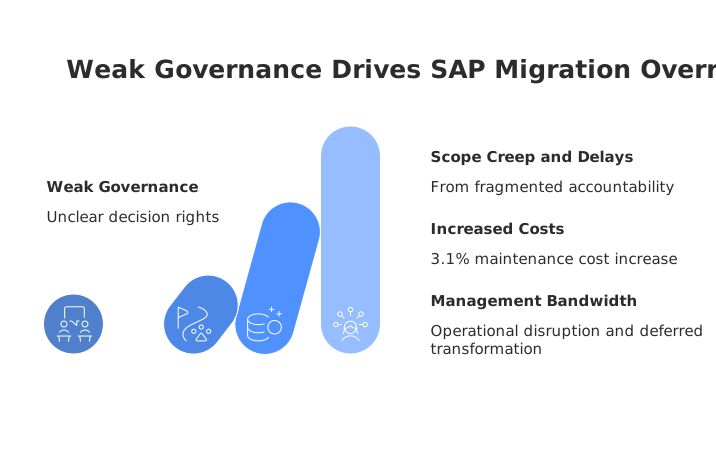
For C-suite leaders, this reframes the risk calculus. The question is not just “what will the migration cost?” but “what will the governance overhead of managing this delivery ecosystem cost us in management bandwidth, operational disruption, and deferred transformation?” For the largest organizations, the ISG research shows a mean post-migration increase in ongoing maintenance costs of 3.1% — on top of the investment already made to get there.
Agentic AI Doesn’t Wait for Your ERP to Be Ready
Here is what has fundamentally changed the procurement technology landscape: agentic AI does not require a modernized ERP as a prerequisite. Where earlier automation tools broke down the moment a process deviated from script, agentic AI reasons through ambiguity, adapts to imperfect data, and orchestrates work across systems without needing those systems to first be re-engineered.
In practice, this means a Market Intelligence Agent can surface supplier risk signals and pass them directly to a Negotiation Agent, which informs a Contract Creation Agent — all without manual hand-offs and without waiting for a clean ERP data foundation.
The agents do not need perfect data. They navigate the complexity that exists today and get smarter over time. For procurement leaders, this collapses the most common justification for delaying transformation: that AI capabilities depend on the ERP being upgraded first.
Purpose-Built Beats Retrofitted, Every Time
Modern AI-native source-to-pay platforms are not ERP modules. They are built from the ground up for procurement — trained on sourcing events, contract risk patterns, spend behavior, and supplier performance data. Their AI models improve continuously on procurement-specific inputs, not on generic enterprise data. And because they are designed to integrate with any ERP environment, they deliver intelligent procurement operations alongside existing systems rather than waiting for those systems to be replaced.
The organizations that will lead procurement in the next decade are not those that complete their migration fastest. They are the ones that recognize the migration as a waypoint, not a destination — and that pursue purpose-built, agentic procurement capabilities now, independent of other technology providers’ roadmaps and timelines. That decision does not require a greenfield re-implementation. It requires a clearer view of where the value actually is.
The Question Worth Asking
The ISG research closes with an observation every CPO and CFO should sit with: SAP migration outcomes are determined less by platform choices and more by how organizations sequence risk, govern execution, and align expectations for post-migration value. Those that treat migration primarily as a risk containment exercise tend to defer transformation rather than deliver it.
But does procurement transformation require the ERP migration at all? That’s a bolder question and one more leaders are beginning to ask. Agentic AI has made the answer a lot more interesting.
Get the Full Picture on SAP Migration Risk
Download the ISG State of SAP Migration report — research from 200 senior decision-makers on what’s working, what’s not, and what it means for your AI ambitions.
Source: ISG, The State of SAP Migration: Why Early Choices Matter More Than Technology, March 2026.