



Is Your Enterprise Procurement Implementation Built to Last or Just Built to Launch?
- Most enterprise procurement implementations fail not from poor software selection, but from workflow designs that ignore how procurement work moves across functions.
- Fragmentation between intake, approval, supplier management, and payment processing creates friction that erodes adoption and inflates cycle times.
- A structured implementation framework anchored in process governance, data integrity, and cross-functional alignment consistently delivers measurable gains in spend control and operational throughput.
August 04, 2026 | Procurement Process and Excellence 8 minutes read
Enterprises spend millions selecting and deploying procurement software. Evaluations are thorough, pilots are staged, and go-live timelines are tracked with precision. Yet a significant portion of these programs stall within 18 months. Not because the technology failed, but because the implementation treated software deployment as the destination rather than the starting point.
The real failure mode is familiar: processes are mapped to system capabilities rather than to business outcomes. Approval workflows are configured for compliance optics instead of cycle speed. Data taxonomies inherited from legacy systems carry years of inconsistency into a new platform. Intake channels remain fragmented, so business stakeholders route around the system entirely. Within months, adoption dips, maverick spending climbs, and the investment case built during the selection process quietly disappears.
This blog breaks down what a high-performing enterprise procurement implementation requires, covering workflow design, structural architecture, and the governance decisions that determine whether the program delivers lasting value or another expensive restart.
How Implementation Redesigns Enterprise Procurement Beyond Legacy Chaos & Fragmented Systems
Implementation is rarely the problem organizations think it is. Most enterprises approach it as a configuration exercise: map the existing process, replicate it in the new system, train users, and go live. The structural issues that made the old environment dysfunctional get carried forward, now embedded in a platform that costs significantly more to deploy.
A redesign-grade implementation works differently. It starts with the question of what procurement is supposed to produce for the business, and then works backward to determine what processes, data structures, and workflow logic are required to produce it consistently. The software becomes the enforcement mechanism for a better operating model, not a digitized version of a broken one.
That shift in framing changes what gets prioritized during implementation planning, what governance decisions get made before go-live, and what success looks like in the first year of operation.
Evaluate Agentic AI With Confidence
Get the buyer's guide to identifying enterprise-ready agentic AI for procurement.
What Legacy Procurement Chaos Actually Looks Like
Legacy procurement environments share a recognizable pattern. Requisition-to-order processes operate across multiple disconnected tools: some ERP-native, some bolted on, some running in spreadsheets that nobody will admit are load-bearing. Supplier data lives in three places simultaneously, none of them authoritative. Contract commitments exist in a repository that procurement manages, but the business rarely consults before spending.
The consequence is not just inefficiency. Fragmented systems produce fragmented accountability. When a purchase order mismatches a goods receipt and delays supplier payment, the investigation spans three teams and surfaces no clear owner. When a high-value contract auto-renews without review, the lapse is only discovered during a spend audit. These are not edge cases. They are the baseline operating reality for enterprises running procurement on legacy architecture.
What distinguishes a transformation-grade implementation from a platform swap is the decision to treat these structural problems as design inputs rather than post-go-live issues.
The Orchestration Shift: Designing Workflows Around Human Behavior
The most durable procurement implementations are built around a counterintuitive principle: the system should make compliant behavior easier than non-compliant behavior, for every user, every time. This sounds obvious. In practice, most implementations do the opposite. They enforce compliance through restriction, which generates workarounds.
Orchestration-first design rethinks intake as the primary leverage point. Rather than routing every request through procurement-managed channels that business stakeholders find slow, a well-designed implementation builds guided intake directly into the tools and workflows those stakeholders already use. A request submitted through a familiar interface, with pre-configured approval routing and supplier options, removes the temptation to go around the system.
The same logic applies downstream. Matching logic between purchase orders, goods receipts, and invoices should be automated for standard scenarios, with exception escalation routed to the right person with the right context already attached. Manual intervention should be an exception, not a structural requirement.
Structural Pillars of an Outcome-Driven Procurement Implementation
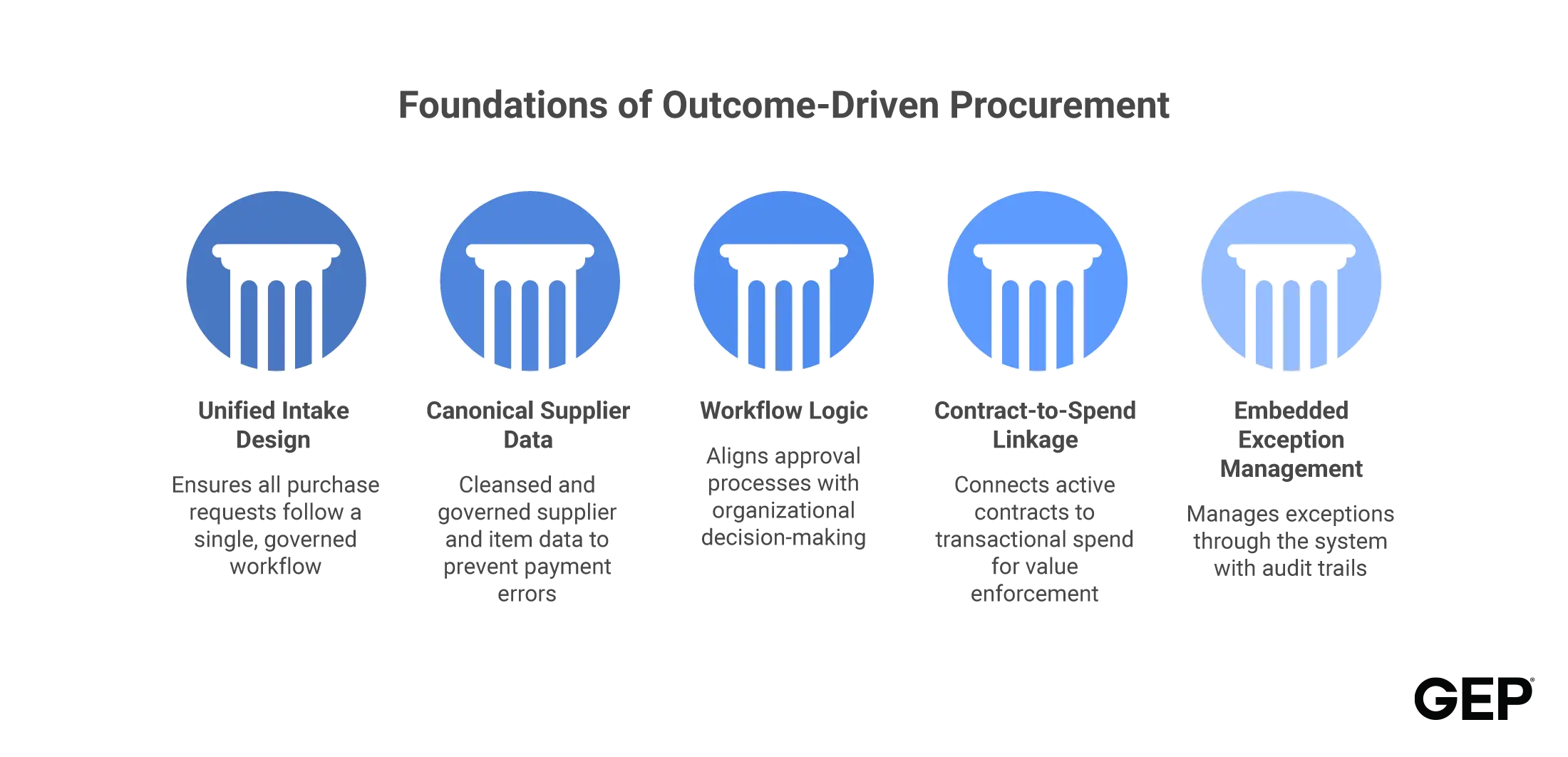
High-performing implementations share a common architecture, regardless of the platform chosen. These five pillars consistently separate programs that deliver from those that stall:
Unified intake design:
A single, intelligently routed intake layer ensures that every purchase request, regardless of category, value, or business unit, enters the same governed workflow. This is the foundation for spend visibility and policy compliance.
Canonical supplier and item data:
Supplier master data must be cleansed and governed before go-live, not after. Duplicate suppliers, inconsistent naming, and unvalidated banking details are the leading cause of payment errors and matching failures
Workflow logic aligned to decision rights:
Approval thresholds, escalation paths, and delegation rules must reflect how the organization makes spending decisions, not how procurement would prefer it to work in theory.
Contract-to-spend linkage:
Procurement platforms that cannot connect active contracts to transactional spend leave significant value on the table. Pricing enforcement, volume commitment tracking, and renewal triggers all depend on this connection.
Embedded exception management:
Every process has exceptions. The question is whether those exceptions are managed through the system, with audit trails and resolution tracking, or through email chains that are invisible to governance.
Explore GEP’s - AI-Native Procurement Software
The Strategic Dividends: Quantifying a Process Redesign
Implementation programs that address structural design, not just system deployment, produce outcomes that are measurable within the first operating year. Cycle time from requisition to purchase order consistently shortens when intake is unified, and approval routing is automated. Supplier payment accuracy improves when three-way matching is embedded rather than manually managed. Maverick spend decreases when the compliant path is faster than the alternative.
Beyond transaction-level metrics, the strategic impact compounds. Spend visibility, real category-level visibility across all business units, enables category managers to negotiate with accurate volume data. Contract compliance rates rise when the system surfaces out-of-contract purchases at the point of approval rather than during a quarterly review. Working capital planning becomes more precise when payment timing and invoice volumes are predictable.
These are not aspirational outcomes. They are the direct result of building implementation on process architecture rather than technical deployment.
Embedding AI and Agentic AI into the Implementation Blueprint
Agentic AI changes what is possible in procurement implementation, but only when the underlying process architecture is sound. Deploying agentic AI on top of fragmented workflows produces faster fragmentation. The sequencing matters: process design first, then AI as the execution layer.
Where agentic AI specifically alters implementation design is in three areas.
Intake automation moves beyond static forms and rule-based routing. An AI-native intake layer can interpret a request in natural language, classify it by category and risk level, identify the appropriate supplier pool, and initiate the correct workflow without human triage. For high-volume, lower-complexity purchases, this removes procurement from the transaction entirely while keeping it within governed parameters.
Exception handling shifts from reactive to predictive. Traditional implementations flag exceptions after they occur: a three-way match fails, an approval threshold is breached, and a delivery date is missed. Agentic AI can identify the conditions that precede exceptions and intervene earlier. A purchase order at risk of a matching failure based on supplier payment history can be flagged before the invoice arrives, not after it is disputed.
Workflow orchestration becomes adaptive rather than fixed. Static workflow configurations require manual updates when business rules change, a new approval authority, a revised spend threshold, or a new supplier category. Agentic AI can adjust routing logic based on real-time signals, such as contract coverage, supplier risk scores, or budget availability, without requiring a configuration change for each scenario.
The implementation implication is significant. Organizations designing procurement workflows today should build with agentic AI execution in mind: clean data inputs, structured exception taxonomies, and intake logic that can be interpreted by an AI layer, not just a human one.
How to Overcome Implementation Friction
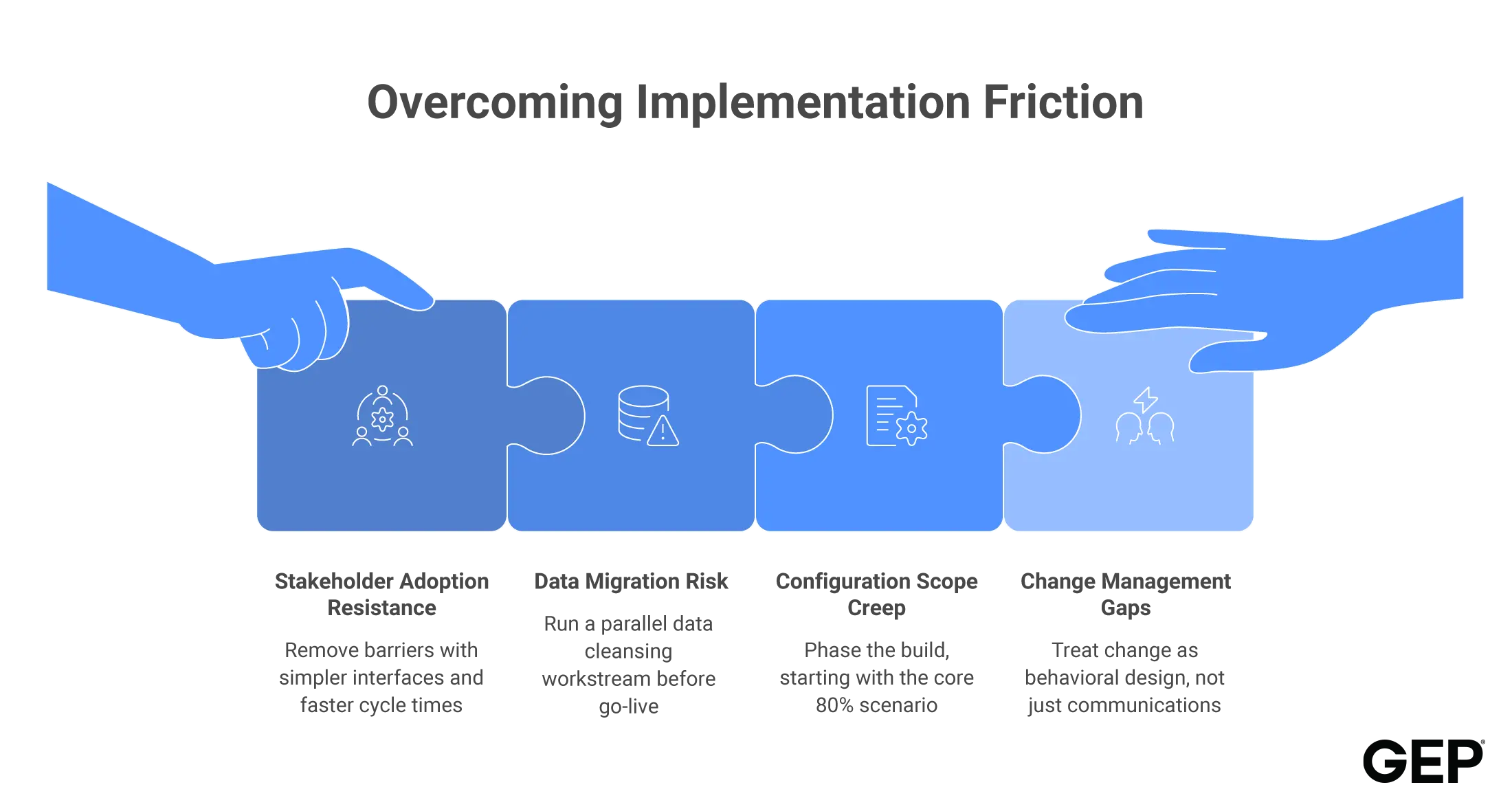
Even well-designed implementations encounter resistance. The sources of friction are predictable, and so are the responses.
Stakeholder adoption gaps:
Business users who have operated outside procurement systems for years will not change behavior because a new platform is available. Adoption requires removing barriers: simpler interfaces, faster cycle times, and visible value for the requester, not just for procurement.
Data migration risk:
Migrating supplier, contract, and item data from legacy systems without a governance process imports the errors of the old system into the new one. A parallel data cleansing workstream, run before go-live, is not optional.
Scope creep in configuration:
The temptation to configure every edge case during implementation delays launch and complicates the core design. A phased approach, building for the 80% scenario first and addressing exceptions in subsequent releases, consistently outperforms comprehensive upfront configuration.
Change management deficit:
Implementation programs that treat change management as a communications exercise rather than a behavioral design challenge consistently underperform. Effective change management identifies the specific friction points for each user group and removes them, rather than announcing that change is coming.
Build a Procurement Implementation That Lasts
Talk to our experts about designing workflows that deliver measurable results from day one.
Implementation as the Blueprint for Future Procurement
Enterprise procurement implementation is not a technology project with an attached change management workstream. It is a process redesign program enabled by technology. The distinction matters because it determines what gets prioritized, what gets measured, and what gets built first.
Organizations that treat implementation as a platform deployment typically find themselves planning their second implementation within three years. Those that treat it as a structural redesign, addressing intake, data governance, workflow logic, and exception management before the system goes live, build something that compounds in value over time.
The investment case for procurement transformation is not hard to make. The discipline required to implement it correctly is where most programs fall short. Getting that discipline right from the start is the decision that determines everything downstream.




BLOG CATEGORIES
Frequently Asked Questions
Most implementations are scoped around system deployment rather than process redesign. The software is configured to accommodate existing workflows, including their fragmentation and gaps, rather than to replace them. Compliance enforcement, intake design, and data governance are treated as post-go-live problems, which means they never get fully resolved. The result is a more expensive version of the problem the implementation was meant to solve.
The most reliable leading indicators are adoption rate by business unit, cycle time from requisition to purchase order, and the ratio of compliant-to-non-compliant spend in the first 90 days post-go-live. Lagging indicators, including contract compliance rates, supplier payment accuracy, and cost avoidance captured through structured sourcing, typically become visible in the first two operating quarters.
Fragmentation is primarily a design problem, not a technology problem. It persists when intake channels are managed separately by category or region, when supplier data is maintained in multiple systems without a master, and when contract commitments are not linked to transactional spend. The solution is architectural: a single intake layer, a governed supplier master, and a platform that connects contracts to purchase orders and invoices within the same data environment. Technology enables this. The design decisions must come first.