



How to Calculate Optimal Safety Stock Level for Enterprise Inventory Management
- Traditional mathematical formulas fail to adapt to unpredictable market disruptions.
- AI-native platforms continuously recalculate inventory buffers using real-time operational data.
- Dynamic inventory management lowers working capital while maintaining seamless customer fulfillment.
September 18, 2026 | Inventory Management 8 minutes read
Your safety stock number is probably wrong, and not because the formula is broken. It's wrong because the market moved faster than the assumptions baked into that calculation ever accounted for. Inventory management safety stock is meant to absorb exactly that kind of uncertainty, but most organizations are still running formulas built for a slower, more predictable era.
Most teams reach for a bolt-on AI inventory management tool layered on top of an existing system, never learning the nuances that real volatility brings into the equation. An AI-native platform works differently: built on procurement and supply chain data from the ground up, it produces recommendations that reflect your business values while solving issues in your supply network right now.
This article walks through what safety stock is, where most calculations go wrong, which formula fits your business, and how AI-native inventory management changes the accuracy equation entirely.
Why is Safety Stock Important in Inventory Management?
Safety stock is the extra inventory you hold beyond expected demand to protect against variability in supply and demand during the replenishment cycle. When your forecast and reality diverge, whether a supplier ships late or demand spikes without warning, this buffer is what keeps operations running.
Without it, a single late shipment or an unplanned order surge turns into a stockout. From there, you are missing service-level commitments and paying a premium for rushed emergency orders just to catch up. Safety inventory in supply chain planning absorbs that volatility before it reaches your customers, and that is why it belongs at the center of your inventory management strategy, not treated as a line item you revisit once a year.
Choosing the Right Safety Stock Formula Based on Your Supply Chain Volatility
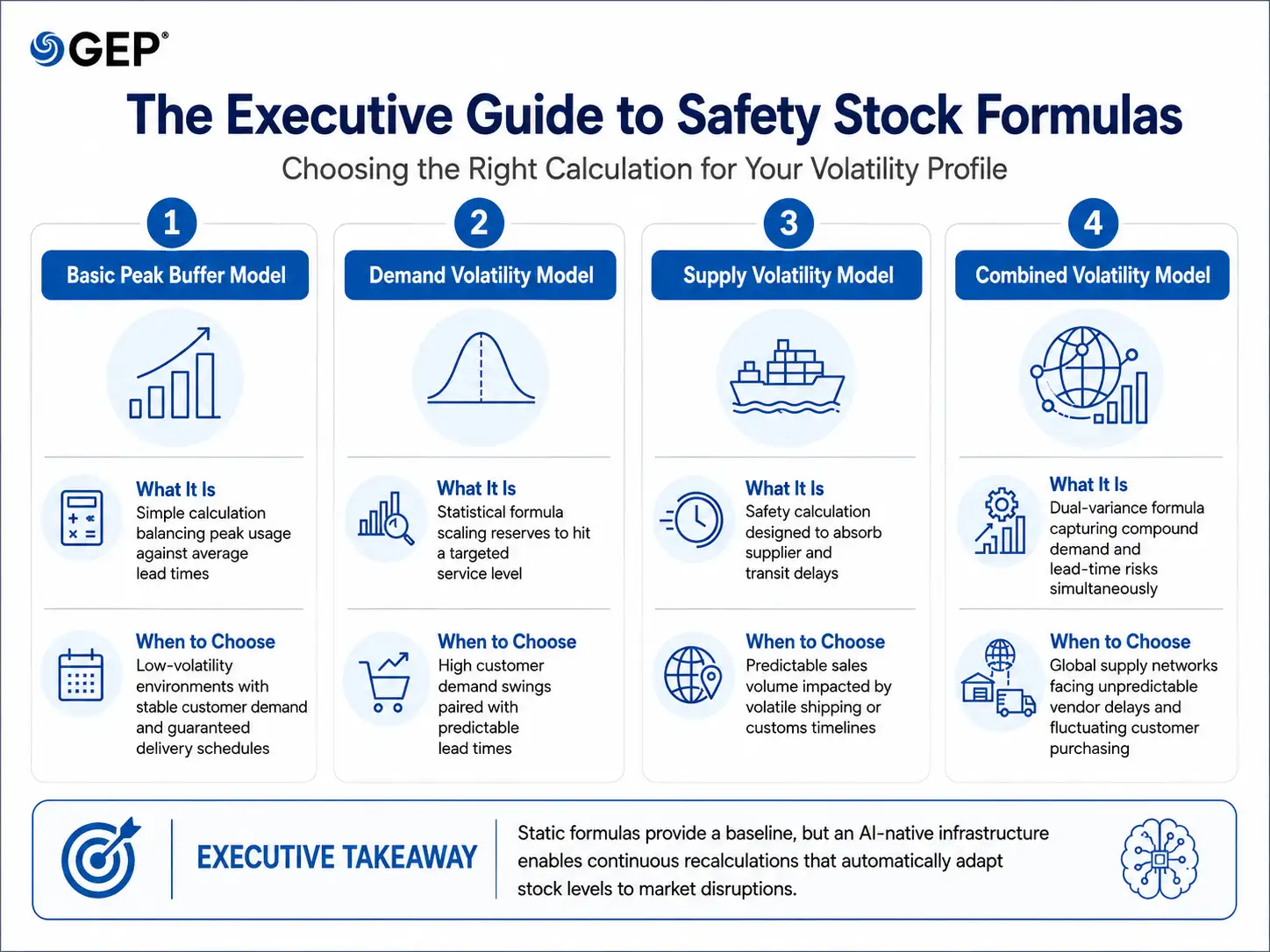
The right formula to calculate safety stock level depends on which variable in your supply chain actually fluctuates: demand, lead time, or both. Four methods cover most real-world cases, each suited to a different combination of stability and volatility.
Basic Safety Stock Formula
The basic safety stock formula applies when both demand and lead time are relatively stable and predictable. It compares your worst-case scenario against your normal operating baseline.
Safety Stock = (Max Daily Usage × Max Lead Time) − (Average Daily Usage × Average Lead Time)
Use this when your supply chain runs on stable local sourcing with minimal variance in either supplier fulfillment or customer purchase volumes. It is easy to calculate and communicate, which makes it a reasonable starting point before you have the data maturity for more advanced methods.
The Standard Deviation Method
This method applies when your supplier lead time is reliable, but customer demand fluctuates. It incorporates your target service level and the variability in daily demand rather than relying on worst-case assumptions.
Safety Stock = Z × σd × √L
Here, Z is the service factor tied to your target service level, σd is the standard deviation of daily demand, and L is your total lead time in days. This method produces a tighter, more accurate buffer than the basic formula whenever demand is the primary source of uncertainty.
The Lead Time Volatility Method
When customer purchase volumes stay flat but your supplier's transit or manufacturing time varies unpredictably, calculate safety stock based on the variability in lead time instead of demand.
Safety Stock = Z × Davg × σL
Davg is your average daily demand, and σL is the standard deviation of lead time in days. This method matters most for businesses sourcing internationally, where customs delays, port congestion, and manufacturing backlogs introduce far more uncertainty into delivery timing than into customer demand itself.
The Advanced Variable Demand & Lead Time Formula
This covers the scenario that most enterprise procurement teams actually face. It’s when both customer purchasing patterns and supplier transit schedules fluctuate at the same time. This formula accounts for both sources of variability in a single calculation.
Safety Stock = Z × √[(Lavg × σd²) + (Davg² × σL²)]
Lavg is your average lead time, σd is the standard deviation of daily demand, Davg is average daily demand, and σL is the standard deviation of lead time.
For complex global networks managing multiple suppliers across different regions, this formula serves as the operational standard, since it captures the compounding risk of demand and supply uncertainty happening together.
For most enterprise-scale operations managing thousands of SKUs across multiple categories and suppliers, no single method should be applied uniformly.
A high-value, long-lead-time component sourced overseas calls for the advanced formula, while a fast-moving, locally sourced commodity may only need the basic calculation. Treat safety stock as a segmented, ongoing exercise, where the method of calculation will matter less than the system generating the input behind it.
Is Your Procurement Platform AI-Native?
Use a practical framework to evaluate vendor claims with confidence
Common Mistakes When Calculating Safety Stock
Ignoring Demand Variance and Item Criticality
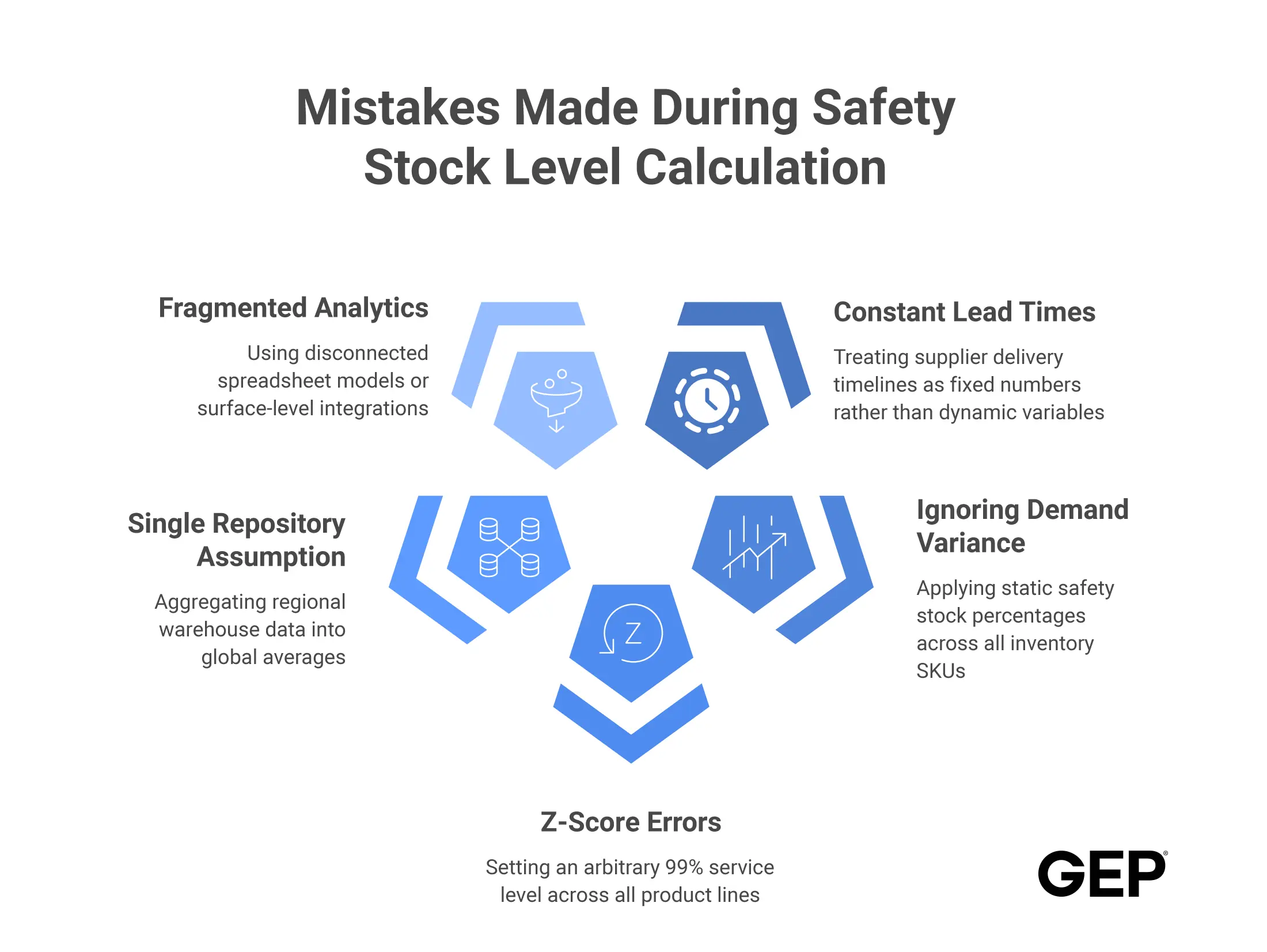
Applying a single formula, or a flat safety stock percentage, across your entire catalog ignores two realities: a high-volatility item behaves nothing like a steady one, and not every item carries the same consequence if it runs out. A component that halts a production line deserves a different buffer than a low-cost item with several substitutes. Treating them the same either ties up working capital you do not need or leaves you exposed where it matters most.
Ignoring Lead Time Variability
Many calculations account for demand variability but assume supplier lead times are fixed. Lead times actually swing based on capacity constraints, port congestion, and supplier performance, and a formula that only looks at demand will underestimate the buffer you need.
Working From Stale, Disconnected Data
Safety stock calculated from last year's demand patterns rarely reflects this year's conditions, and the problem compounds when it comes from disconnected spreadsheets or integrations that update on their own schedule. Seasonality shifts and changing customer behavior erode any calculation built on lagging indicators, leaving planners to decide with numbers that were already out of date.
Misaligning Service Level Objectives
Choosing a 95% or 99% service level without weighing it against the cost of a stockout versus the cost of holding extra inventory produces buffers that are either wastefully high or dangerously thin.
Treating Multi-Node Networks as a Single Repository
Aggregating regional warehouse data into one global average hides the stockout risk sitting at individual locations and prevents effective inventory pooling across facilities. A network-wide number can look balanced while individual nodes run exposed or overstocked.
Relying on Fragmented, Bolt-On AI Analytics
Using disconnected spreadsheet models or surface-level integrations that update asynchronously creates lagging indicators, forcing planners to make decisions using stale data.
How AI-Native Inventory Management Improves Safety Stock Accuracy
A regular inventory management tool, even a capable one, typically calculates safety stock from static inputs like historical averages, a fixed lead time assumption, and a manually chosen service level. It runs the formula you tell it to run, on the data you feed it, and stops there. Any bolt-on AI layered on top of that system is still working from the same narrow inputs, just producing recommendations faster.
An AI-native procurement and supply chain platform starts from a fundamentally different foundation. Because AI capability is built into the platform's core rather than added as an integration, it continuously ingests live signals, real-time demand shifts, actual supplier lead time performance, transportation disruptions, seasonal patterns, and market volatility, and recalculates safety stock levels dynamically rather than on a quarterly review cycle. This is where agentic AI orchestration changes the equation.
Instead of one AI agent handling a single task on its own, multiple specialist agents run in parallel: one watching demand forecasts, another tracking supplier risk, another optimizing inventory levels. These workflows run at the same time, and their outputs come together into one safety stock recommendation.
Orchestration executes against rules and compliance parameters you set upfront. What you get back is fewer calculation errors and no more waiting on someone to update the model.
- AI Agents: Specialist agents trained to autonomously perform distinct, targeted tasks within a narrow workflow (such as updating purchase orders or monitoring lead-time deviations).
- Agentic AI: The overarching orchestration layer that coordinates multiple specialist AI agents simultaneously across complex end-to-end workflows.
Because domain-specific procurement and supply chain knowledge is built into the platform itself, the system understands category-level nuances, like which SKUs are business-critical and which suppliers carry elevated risk. You’re not configuring that logic yourself from a blank slate.
What you end up with is a safety stock number grounded in what your supply chain is doing today, not what it did last quarter.
Ready to Move Beyond Bolt-On AI?
See how an AI-native platform supports procurement from the ground up.
What Procurement Leaders Should Do Next
Relying on outdated mathematical models or fragmented software stacks leaves your organization vulnerable to sudden market shocks and bloated carrying costs. A formula can perform well only when it is fed live, accurate signals from across your supply chain.
As demand volatility and supply chain disruption become the norm, procurement leaders who rely on manual recalculation will find themselves perpetually behind, adjusting buffers after the damage from a stockout or an overstock has already been done.
Because domain-specific knowledge is built directly into an AI-native platform, Agentic AI executes decisions with built-in compliance and minimal human intervention. It eliminates operational errors by autonomously rebalancing inventory based on real-time signals.
Once this is in place, your safety stock calculations shift the moment a disruption hits, not weeks later when someone finally looks at a report and flags risk.
That kind of responsiveness is hard to bolt onto an existing system after the fact. It must be built into the AI-native procurement platform itself, running as multi-agent orchestration across workflows rather than a single tool doing one job.
The same logic applies on the warehouse floor. An AI-native warehouse and inventory management solution runs that coordination directly where safety stock decisions get made, not in a report generated after the fact.




FAQs
People use safety stock and buffer stock interchangeably, but they're not quite the same thing. Safety stock is a specific calculation, built from historical demand data and a target service level, meant to absorb the normal ups and downs in demand and lead times during a standard replenishment cycle. Buffer stock is the broader term. It also covers disruptions you can actually see coming, like a scheduled supplier shutdown or a seasonal demand spike. Safety stock covers what you can't predict. Buffer stock covers that, plus what you can.
Safety stock earns its keep by cutting two costs at once: the cost of running out and the cost of holding too much just in case. Get the number right and you avoid rush-shipping premiums and keep production lines running, all without tying up capital in inventory you didn't need this month.
In a multi-location network, one safety stock number applied everywhere doesn't work, because no two locations face the same demand pattern, lead time, or transit risk. Spread inventory evenly and you'll overstock your stable hubs while your most volatile regional nodes still run short. The fix is pooling reserves centrally and tracking variance at the node level, so each location's buffer reflects its actual risk instead of a network-wide average.