




Global enterprises understand how much rides on timely purchasing, efficient sourcing and strong supplier relationships. Yet the day-to-day reality of procurement is often the opposite of efficient: manual data entry, paper-based approvals, email chains that stall for days, and processes that are tedious, slow and error-prone. This gap between what procurement should deliver and what manual processes actually allow is precisely why procurement automation has become one of the most sought-after capabilities for organizations that want to stay ahead of the competition.
This info guide explains what procurement automation is, why businesses need it, the strategic benefits it delivers, the features to look for in automation software, the growing role of AI, the challenges to expect, a step-by-step implementation strategy, and the KPIs that prove its value, along with a look at where the technology is heading next.
What is Procurement Automation?
Procurement automation is the use of next-generation technology to automate the procurement process from end to end. It covers the routine, repetitive tasks that consume most of a procurement team's time, including supplier selection, purchase order placement, invoice processing and payment processing, as well as adjacent activities such as data entry, supplier communication and contract management.
Rather than as a single tool, procurement automation is typically achieved through a combo of technologies working in sync. Robotic process automation or RPA takes care of repetitive, rule-based tasks, such as transferring data between systems or matching invoices to purchase orders. Furthermore, AI and ML add a layer of intelligence, enabling systems to classify spend, flag anomalies, score supplier risk and learn from historical patterns. Natural language processing (NLP) enables software to read and interpret unstructured documents like contracts, invoices, and emails. NLP further enables the software to extract meaning from them. And together, these technologies create an intelligent procurement system that can execute processes with minimal human intervention.
It helps to distinguish procurement automation from simple digitization. Moving from paper requisitions to electronic forms is digitization; it changes the medium but not the work. Automation goes further: the system itself performs the work, such as routing an approval, generating a purchase order, matching an invoice, releasing a payment, according to defined rules and, increasingly, learned intelligence. The procurement professional's role shifts from executing transactions to managing exceptions, relationships and strategy.
Procurement automation has been a genuine game changer for enterprises. It has actually simplified the entire procurement lifecycle, cutting costs, reducing errors, and improving the overall efficiency of the procurement function, freeing up time for domain experts to focus on the strategic work that machines can’t do.
AI-Native or Bolt-On Procurement Platform?
Find out what separates AI-powered tools from AI-native procurement platforms.
Why Do Businesses Need Procurement Automation?
The case for automation begins with an honest look at how manual procurement actually performs.
Manual Processes are Slow
A requisition that requires physical or email-based approvals can sit in an inbox for days. Purchase order cycle times stretch from hours into weeks. Suppliers wait on payments, and business stakeholders wait on the goods and services they need to do their jobs. In fast-moving markets, this latency is not just an inconvenience. It is a competitive liability.
Manual Processes are Expensive
Every touch adds cost. Industry benchmarks consistently show that processing a single invoice manually can cost several times more than processing it through an automated workflow, once labor, error correction and late-payment penalties are counted. Multiply that across tens of thousands of transactions per year and the overhead becomes substantial.
Manual Processes are Error-Prone
Rekeying data between systems introduces not just typos, but duplicate entries and mismatched records. It is understood that duplicate payments, incorrect quantities and misapplied pricing quietly erode margins. Errors also damage supplier trust and consume staff’s time in investigation and correction.
Manual Processes Create Blind Spots
When procurement data lives in spreadsheets, inboxes and disconnected systems, leadership has no reliable, real-time view of spend. Maverick buying thrives in the dark, weakening negotiated savings and expanding risk.
Manual Processes Strain Compliance
Regulatory requirements, internal policies, as well as third-party risk obligations demand consistency and documentation. People following ad hoc processes cannot guarantee either. Audits become painful archaeology exercises rather than routine checks.
Beyond fixing these deficiencies, there is a strategic driver — talent. Skilled procurement professionals did not build their careers to key invoices into an ERP. When routine work is automated, teams can redirect their energy toward supplier innovation, category strategy, risk management and sustainability, the areas where human judgment creates real enterprise value. Organizations that fail to automate increasingly struggle to attract and retain procurement talent, because the best people gravitate toward roles where they do meaningful work.
Finally, market volatility has made agility non-negotiable. Tariff shifts, supply disruptions, inflation spikes and geopolitical shocks demand that procurement respond in days, not quarters. Only an automated, data-rich function can move at that speed.
Strategic Benefits of Automating Enterprise Procurement
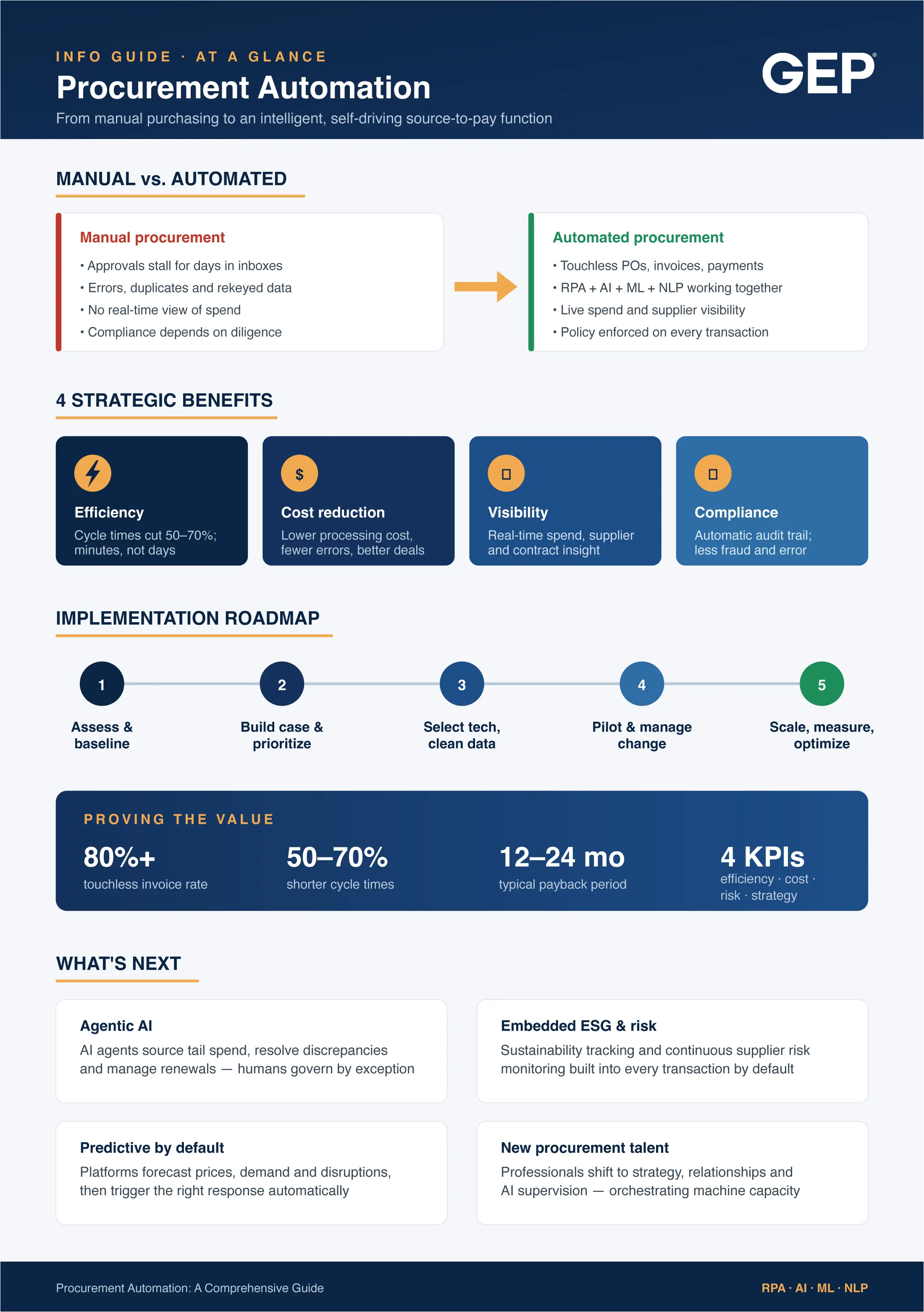
The benefits of procurement automation span efficiency, cost, visibility and compliance, all of which compound over time as the organization builds on its automated foundation.
Improved Efficiency
Automation eliminates most manual tasks, including time-consuming and error-prone data entry, dramatically improving the efficiency of procurement processes. Invoices and payments that once took days to process are handled in minutes, which in turn improves supplier communication and significantly shortens procurement cycle times. Requisition-to-order cycles that took a week can compress to hours; approvals route automatically to the right people with full context; and staff spend their days on exceptions and strategy instead of transactions.
Cost Reduction
Because automation sharply reduces the need for manual labor, it delivers direct cost savings. It also helps enterprises negotiate better prices with suppliers (armed with accurate, consolidated spend data) while reducing the probability of errors and duplicate payments and optimizing processes to eliminate waste. Savings show up in three layers: lower processing costs per transaction, recovered leakage from errors and off-contract spend, and better commercial outcomes from data-driven negotiation.
Improved Visibility
Real-time visibility into procurement activity is one of automation's most valuable payoffs. Enterprises can track every requisition, order and payment as it happens, monitor supplier performance continuously, and identify potential issues before they escalate into critical problems. With direct access to data analytics, procurement leaders make better, faster decisions, thus shifting the function from reactive reporting to proactive management.
Enhanced Compliance
Policies and regulations are a persistent pain point for enterprises, particularly where third-party risk management (TPRM) is involved. Automation enforces consistency: every transaction follows the same policy-compliant path, approvals are captured, and a comprehensive audit trail is generated automatically. This reduces the risk of fraud and error while making transparency the default rather than an aspiration.
Strategic Elevation of the Function
Beyond these four core benefits, automation changes what procurement is within the enterprise. Freed from transactional load, the function can lead on supplier-driven innovation, ESG and sustainability tracking, supply risk resilience and category strategy. Procurement moves from cost center to value creator — a shift boards increasingly expect.
Also Read- Agentic AI in Procurement: From Automation to Autonomy
Key Features of Procurement Automation Software
Not all procurement automation platforms are created equal. When evaluating solutions, enterprises should look for the following capabilities.
End-to-End Source-to-Pay Coverage
The strongest platforms span the full lifecycle, comprising spend analysis, sourcing, contract management, supplier management, purchasing, invoicing, and payments, on a unified data model. Point solutions that automate one step often just move the bottleneck.
Intelligent Intake and Guided Buying
Employees should be able to request anything through a single, intuitive front door. The system interprets the need, checks existing contracts and catalogs, routes the request appropriately and guides the buyer to the compliant, best-value option, without the need for procurement expertise.
Configurable workflow and approval engines
Approval chains, thresholds, delegation rules and exception paths should be configurable by business users, not hard-coded. Automation should mirror your policy, not force your policy to mirror the software.
Touchless Invoice Processing
Automated capture (including from PDFs and e-invoices), two- and three-way matching against orders and receipts, tolerance handling and straight-through posting to the ERP. Best-in-class organizations achieve touchless rates above 80% on PO-backed invoices.
Supplier Portal and Collaboration
Suppliers should self-serve onboarding, catalog updates, order confirmations, invoice submission and payment status, thereby cutting email traffic and call volume while improving data quality at the source.
Contract Lifecycle Management
Automated authoring from clause libraries, AI-assisted review, obligation tracking, renewal alerts and linkage between contracted terms and transactional spend so that negotiated savings are actually realized.
Spend Analytics and Reporting
Real-time dashboards, automatic spend classification, savings tracking and drill-down analysis. Data should be a byproduct of the process, not a quarterly project.
Risk and Compliance Monitoring.
Continuous screening of suppliers against sanctions lists, financial health indicators, cyber ratings and ESG criteria, with alerts routed to the right owners.
Integration Architecture.
Prebuilt connectors and open APIs for ERP, finance, HR and logistics systems. Procurement automation fails fast when it becomes another data island.
Mobile Access and Usability.
Approvals and status checks from a phone, with a consumer-grade experience. Adoption, which is the true determinant of ROI, depends heavily on ease of use.
Step Into the Future of Procurement
Empower your CPO strategy with agentic AI–orchestrated source-to-pay transformation
The Expanding Role of AI and Machine Learning in Automated Procurement
If RPA gave procurement automation its hands, AI is giving it a brain. The past few years have seen AI move from a marketing bullet point to the core architecture of leading platforms.
Predictive Analytics
ML models trained on historical spend, demand and market data forecast price movements, demand volumes and supply risk. Procurement can time purchases, hedge exposure and pre-empt shortages instead of reacting to them.
Intelligent Document Processing
NLP and large language models extract terms, obligations and risks from contracts and invoices in any format, in seconds rather weeks taken earlier.
Autonomous Spend Classification
AI classifies millions of transaction lines into accurate taxonomies continuously, keeping analytics current without manual cleansing cycles.
Conversational and Generative Interfaces
Users describe what they need in plain language; the system drafts RFPs, summarizes supplier proposals, compares bids, generates negotiation talking points and answers policy questions instantly.
Agentic AI
The most significant frontier is agentic automation: AI agents that don't just assist but act. Within guardrails set by the enterprise, agents can run a tail-spend sourcing event end to end, resolve an invoice discrepancy by querying the supplier, expedite a delayed order, or execute a routine renewal. Humans set the policy and handle escalations; agents handle the volume. Early adopters report that agents now handle a meaningful share of routine procurement decisions that previously queued for human attention.
Anomaly and Fraud Detection
ML models learn normal transaction patterns and flag outliers such as duplicate invoices, unusual pricing, suspicious supplier changes, far more effectively than static rules.
The direction of travel is clear: from automation that executes what humans decide, toward intelligence that recommends and, increasingly, decides within delegated boundaries, with human oversight concentrated where judgment matters most.
Also Listen to GEP’s Podcast - High-Impact AI Use Cases for Smarter Procurement
Key Challenges of Procurement Automation and How to Overcome Them
Despite the compelling benefits, some organizations remain hesitant to adopt procurement automation, mostly over concerns about cost and implementation complexity. These concerns are understandable but manageable, and in practice the benefits consistently outweigh the costs. Here are the main challenges and how to address them.
Perceived Cost and Unclear ROI
Automation platforms require investment in licenses, implementation and change management. Overcome it by starting with small-scale pilots in high-volume, high-pain areas (invoice processing is a classic first target), quantifying baseline costs before you start, and scaling only after the pilot proves value. Modern cloud platforms with subscription pricing have also lowered the entry barrier dramatically.
Implementation Complexity
Integrating with legacy ERPs, migrating supplier master data and reconfiguring processes can feel daunting. Overcome it by choosing platforms with prebuilt ERP connectors and phasing the rollout by process and geography. Where internal capability is thin, engage procurement consulting partners to guide the journey. The right tools and partners make implementation far smoother than the horror stories suggest.
Poor Data Quality
Automation amplifies whatever data it runs on; garbage in, garbage at scale out. Overcome it by investing early in supplier master cleansing, spend classification and data governance. Many AI-enabled platforms now assist with cleansing itself.
Change Resistance and Adoption Gaps
Employees may fear job loss or simply cling to familiar workarounds. Overcome it by communicating early that automation removes drudgery rather than people, involving end users in design, appointing visible executive sponsors and champions, and measuring adoption as rigorously as savings. Reposition roles toward analysis and supplier management so staff see a future for themselves.
Process Standardization Debt
You cannot automate a process no one can describe. Divergent practices across business units stall configuration. Overcome it by mapping and rationalizing processes before automating them. The idea is to automate the improved process, not the legacy mess.
Over-Customization
Bending the platform to replicate every historical quirk creates fragile, expensive-to-maintain systems. Overcome it by adopting the platform's standard best-practice workflows wherever possible and reserving configuration for genuine differentiators.
Supplier Enablement
Automation stalls if suppliers keep sending paper invoices and ignoring portals. Overcome it by segmenting suppliers, mandating e-invoicing where feasible, offering easy low-tech channels for the long tail, and communicating the benefits (faster payment) clearly.
Governance of AI Decisions
As AI takes on more decisions, organizations need clarity on accountability. Overcome it by defining decision rights explicitly, including what AI may do autonomously, what requires human review, and also auditing algorithmic decisions periodically.
Step-by-Step Implementation Strategy for Procurement Automation
A structured approach turns automation from a risky big-bang project into a controlled, value-generating program.
Step 1: Assess the current state
Map your source-to-pay processes end to end. Measure baseline metrics: cycle times, cost per PO and per invoice, error rates, spend under management, maverick spend, staff time allocation. Identify the biggest pain points and the data quality gaps. This baseline is what you will later measure ROI against.
Step 2: Define the vision and business case
Decide what automation must achieve, such as cost reduction, speed, compliance, risk resilience, strategic capacity, and rank the priorities. Build a business case with quantified benefits and secure executive sponsorship, ideally at the CFO/CPO level. Without a sponsor, automation programs starve.
Step 3: Prioritize processes and design the roadmap
Score candidate processes on volume, rule-clarity, pain and value. High-volume, rule-based processes (invoice matching, PO creation, catalog buying, requisition approvals) come first; judgment-heavy processes (strategic sourcing, complex negotiations) come later with AI assistance rather than full automation. Sequence the roadmap in phases of 3-6 months each.
Step 4: Select the technology
Issue a structured evaluation that covers functional coverage, AI capabilities, integration options, usability, security certifications, supplier network reach, total cost of ownership (TCO) and vendor viability. Insist on demos using your actual scenarios and data, not canned scripts. Check references with organizations of similar size and industry.
Step 5: Prepare the data
Cleanse supplier master records, standardize item and category taxonomies, digitize key contracts and classify historical spend. Establish ongoing data governance ownership so quality doesn't decay after go-live.
Step 6: Run a pilot
Implement the first process in a contained scope, that is, in one category, business unit or region. Configure standard workflows, integrate with the ERP, train users and run for a defined period against explicit success criteria. Capture lessons ruthlessly.
Step 7: Manage the change
In parallel with the pilot, run a deliberate change program: communicate the "why," redesign roles, train users in context, enlist champions in each function, and enable suppliers on the new channels. Budget genuine effort here, keeping in mind that most automation failures are adoption failures, not technology failures.
Step 8: Scale in waves
Roll out to additional processes, categories and geographies in planned waves, applying pilot lessons each time. Retire legacy tools and manual workarounds decisively; running parallel processes indefinitely destroys the business case.
Step 9: Measure, optimize, and extend
Track KPIs against the baseline continuously. Tune workflows, raise touchless-processing thresholds as confidence grows, and progressively delegate more decisions to AI within governed limits. Treat automation as a capability you compound, not a project you finish.
Measuring Impact: Key KPIs and ROI Framework for Procurement Automation
What gets measured gets funded. A disciplined KPI framework demonstrates value and directs continuous improvement. Organize metrics into four families.
Efficiency KPIs
Requisition-to-order cycle time; PO and invoice processing time; touchless (no-human-touch) processing rate for POs and invoices; approval turnaround time; number of transactions processed per FTE. Well-run programs commonly see cycle times fall by 50%-70% and touchless invoice rates climb past 80%.
Cost KPIs
Cost per purchase order and per invoice processed; procurement operating cost as a percentage of spend managed; realized savings (negotiated vs. actually captured); duplicate/erroneous payment value recovered; early-payment discount capture rate; working-capital impact from optimized payment timing.
Compliance and Risk KPIs
Spend under management contract compliance rate (on-contract vs. maverick spend); policy exception rate; audit findings related to procurement; supplier risk coverage (share of spend with active risk monitoring); percentage of suppliers with completed onboarding and compliance documentation.
Strategic and Experience KPIs
Share of procurement staff time on strategic vs. transactional work; internal stakeholder satisfaction scores; supplier satisfaction and query volumes; sourcing cycle time for competitive events; forecast accuracy for spend and demand.
Building the ROI Model
Compare total benefits against total cost of ownership over a 3-5-year horizon.
On the cost side: subscription fees, implementation, integration, data cleansing, training and internal program resources.
On the benefit side: (1) process cost savings — transaction volumes multiplied by the reduction in cost per transaction; (2) spend savings — improved compliance and negotiation lifting realized savings, typically worth several times the process savings; (3) error and leakage recovery — duplicate payments prevented, discounts captured; (4) risk avoidance — modeled conservatively, since avoided disruptions and fines are probabilistic; and (5) capacity value — hours freed and redeployed to strategic work.
Mature programs routinely report payback within 12–24 months, with spend-related benefits, not headcount efficiency, providing the largest share of value. Report results quarterly against the pre-implementation baseline to keep sponsorship strong and to justify each successive wave.
Case Study: Measurable Impact of Procurement Automation
Consider the experience of a leading retail company that implemented a procurement automation system and transformed its procurement operations. By automating routine tasks, such as purchase order creation, invoice processing and supplier management, the company streamlined its operations and substantially reduced the workload on its procurement team.
The gains went well beyond efficiency and cost. Data accuracy improved markedly once manual rekeying was eliminated, giving the company a trustworthy foundation for data-driven decision-making. The system continues to deliver real-time insight into spend analytics, supplier performance and contract compliance, enabling the company to spot cost-saving opportunities it previously couldn't see and to negotiate stronger deals with its suppliers from a position of information advantage.
The retailer's experience mirrors what enterprises across industries have found: procurement automation improves processes, reduces costs, and confers a genuine competitive edge in the market. The pattern is consistent: automate the routine, illuminate the data, and both savings and strategic capability follow.
Check Out GEP’s - AI-Native Procurement Software
The Future of Procurement Automation
Procurement automation is still early in its trajectory, and the next phase will look markedly different from the last. The defining shift is from automated to autonomous: agentic AI will execute complete processes, such as sourcing tail spend, resolving discrepancies, managing renewals, while humans govern by exception. Intake and orchestration layers will give every employee a single intelligent front door, platforms will forecast prices, demand and disruptions and trigger responses automatically, and ESG tracking and continuous risk monitoring will be embedded in every transaction. The procurement professional of the future becomes a strategist, relationship builder and AI supervisor, orchestrating machine capacity rather than competing with it.
The conclusion for enterprises is straightforward. Procurement automation, powered by RPA, AI, ML and NLP, delivers proven gains in efficiency, visibility, compliance and cost. The technology is mature, the implementation playbook is well understood, and the competitive gap between automated and manual procurement functions widens every year. Organizations that embrace automation now, starting with focused pilots and scaling deliberately, position their procurement function to streamline processes, reduce costs, strengthen the bottom line, and thus lead rather than lag through whatever volatility comes next.
Frequently Asked Questions
ERP purchasing modules are built primarily to record transactions accurately for finance — they excel at posting POs, receipts and invoices to the ledger. Dedicated procurement automation platforms are built to optimize the process and decisions around those transactions. They add capabilities ERPs typically lack or handle poorly: intuitive guided buying and intake, supplier portals and networks, sourcing and contract lifecycle management, AI-driven spend analytics, risk monitoring, and configurable workflow automation. They also offer consumer-grade usability, which drives the adoption ERP modules often fail to achieve. In practice the two are complementary: the automation platform manages the source-to-pay process and pushes clean, compliant transactions into the ERP as the financial system of record.
Reputable platforms are generally more secure and audit-ready than the manual processes they replace. Leading vendors operate certified cloud environments with encryption in transit and at rest, role-based access controls, single sign-on and multi-factor authentication, and continuous security monitoring. From a compliance standpoint, automation is a structural advantage: every action, including requisition, approval, change, payment, is timestamped and logged automatically, producing a complete, tamper-evident audit trail. Policy rules are enforced systematically rather than depending on individual diligence, and segregation-of-duties conflicts can be blocked by design. Auditors typically find automated environments faster to audit and materially lower risk. Buyers should still verify certifications, data-residency options and access-control granularity during selection.
It is increasingly viable, and valuable, for mid-sized organizations. Cloud delivery and subscription pricing have removed the heavy upfront infrastructure costs that once limited these tools to large enterprises, and modular platforms let mid-market buyers start with one or two capabilities (typically e-procurement and invoice automation) and expand later. Mid-sized firms often see faster payback than enterprises because they have fewer legacy systems to integrate, simpler approval structures and shorter implementation timelines. The keys for the mid-market are choosing right-sized solutions with strong out-of-the-box workflows, avoiding over-customization, and leaning on vendor-led implementation rather than building large internal program teams.
At minimum, look for: SOC 1 and SOC 2 Type II attestations covering security, availability and confidentiality controls; ISO/IEC 27001 certification for information security management (with ISO 27017/27018 for cloud and privacy controls a plus); GDPR compliance and equivalent regional privacy support (CCPA, and for India-based operations, the DPDP Act) including data-residency options; encryption of data in transit (TLS 1.2+) and at rest (AES-256); identity controls such as SSO/SAML, multi-factor authentication and fine-grained role-based access; PCI DSS compliance where payment card data is handled; and support for e-invoicing mandates and tax compliance in the jurisdictions where you operate (such as PEPPOL, country-specific clearance models). Additionally, verify penetration-testing practices, incident-response commitments, uptime SLAs. And as AI features expand, verify transparency around how your data is used in model training and options to opt out.