



Contractual Obligations: What Efficient Teams Track and Manual Processes Miss
- Signing a contract isn't the finish line. It's when the real tracking work starts.
- Manual methods hold up fine at low volume, then quietly fall apart once contracts pile up.
- A structured process, backed by CLM software, turns obligation management into something you plan for instead of scrambling to fix.
August 25, 2026 | Contract Management 4 minutes read
A signed contract feels like a finish line. In practice, it's the starting point for dozens of commitments that need active tracking long after the ink dries.
Payment deadlines slip. Renewal windows close without review. A compliance clause sits untouched until an audit forces the question nobody wanted to ask. None of this happens because the contract was poorly written. It happened because nothing was watching it.
This blog breaks down what contractual obligations actually involve, where tracking tends to fail, and how a structured process closes that exposure before it turns costly.
What Are Contractual Obligations and Why Do They Matter?
A contractual obligation is any duty one party agrees to perform under a signed agreement. Think payment terms, delivery timelines, confidentiality clauses, and service levels. Nothing exotic, just the fine print that both sides agreed to live by.
Why does this matter so much? Because a contract is only as good as the follow-through behind it. Miss a payment deadline and watch a supplier relationship cool off fast. Let a compliance clause slide, and a regulator will eventually find it before you do. The agreement on paper doesn't count for much without something keeping those commitments visible day to day.
See Where GEP Ranks in Contract Lifecycle Management
Get the Gartner Critical Capabilities report on evaluating today's leading CLM vendors
Key Components of Contractual Obligations
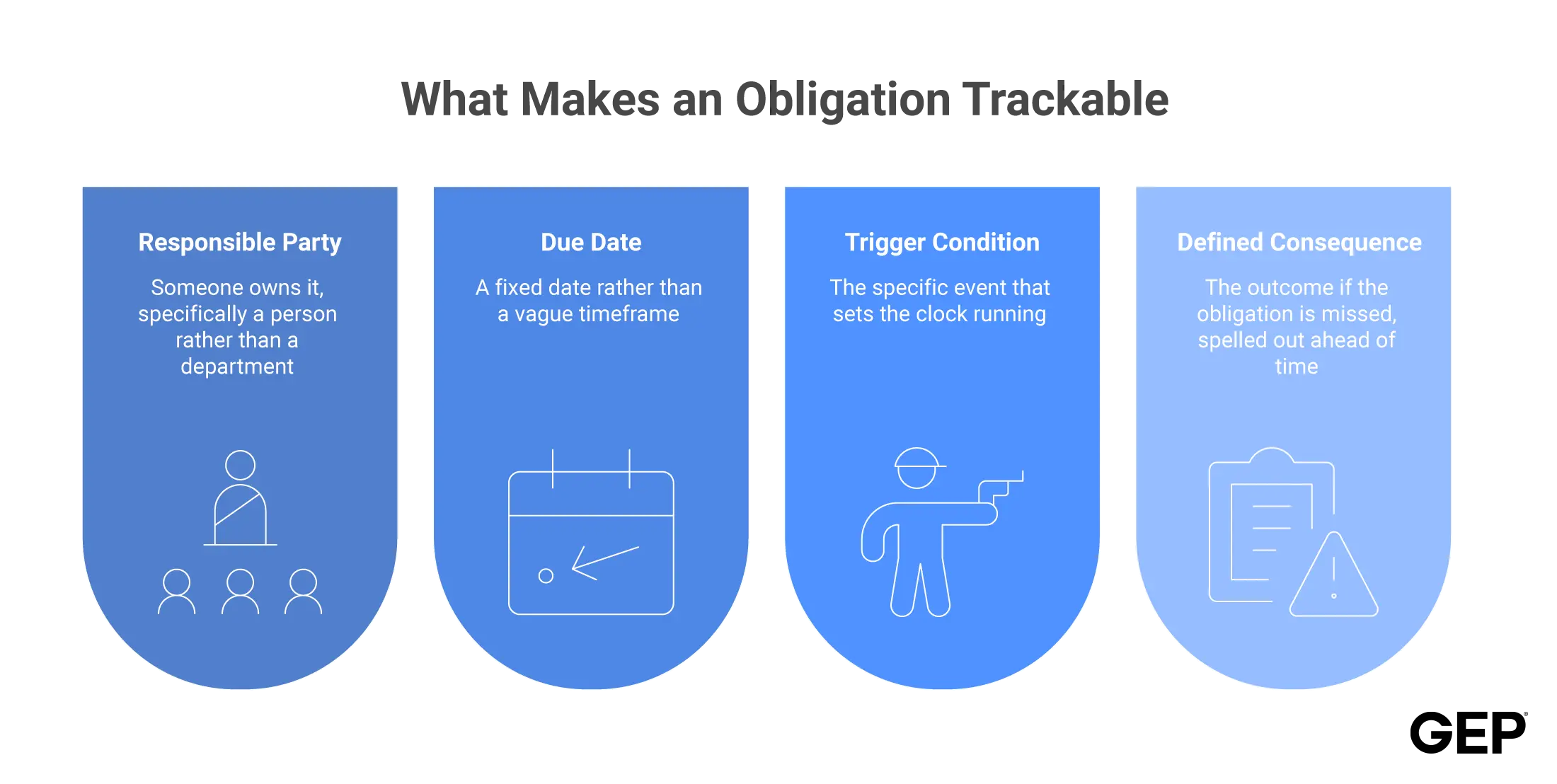
Four things make an obligation actually trackable, not just theoretically documented:
- A responsible party. Someone owns it. Not a department, a person.
- A due date. Fixed, not "sometime this quarter."
- A trigger condition. What sets the clock running in the first place.
- A defined consequence. What happens if it's missed, spelled out ahead of time.
Miss one of these and you've got an obligation nobody's really watching. It exists on paper. That's about it.
Common Types of Contractual Obligations
Obligations tend to fall into a handful of buckets. Financial ones cover invoice schedules, payment terms, penalty clauses. Performance obligations set delivery timelines and service levels. Compliance obligations touch data protection, industry regulation, and audit preparation. Then there's renewal and termination language, which decides how and when the whole thing ends, notice periods included (these get missed constantly).
Here's the thing: each type carries a different level of risk. Lump them all into one generic review cycle, and the ones that actually matter most won't get the scrutiny they need.
What Are the Challenges of Manual Obligation Management?
Spreadsheets work. Until they don't.
At low contract volume, a shared folder and some discipline can carry a team pretty far. Growth changes that math fast. Clauses end up buried across five versions of the same document. The person who signed a deal moves teams, and suddenly nobody's sure who owns what. Legal ends up re-reading entire agreements just to nail down one date. Business teams often learn an obligation exists only after they've already blown past it.
Audits make this worse. Proving compliance means digging through folders instead of running a report, and a routine check turns into a week nobody had time for.
Why Is Effective Contract Obligation Management Important?
A missed obligation rarely stays contained. Late payment strains a supplier relationship built over years. An expired compliance requirement invites scrutiny that spreads well past the one contract. An auto-renewal nobody caught can lock a business into terms it never wanted.
Get obligation management right, and that trajectory changes. Teams catch problems early enough to actually do something about them, instead of explaining after the fact what went wrong and why.
How to Implement an Effective Obligation Tracking Process
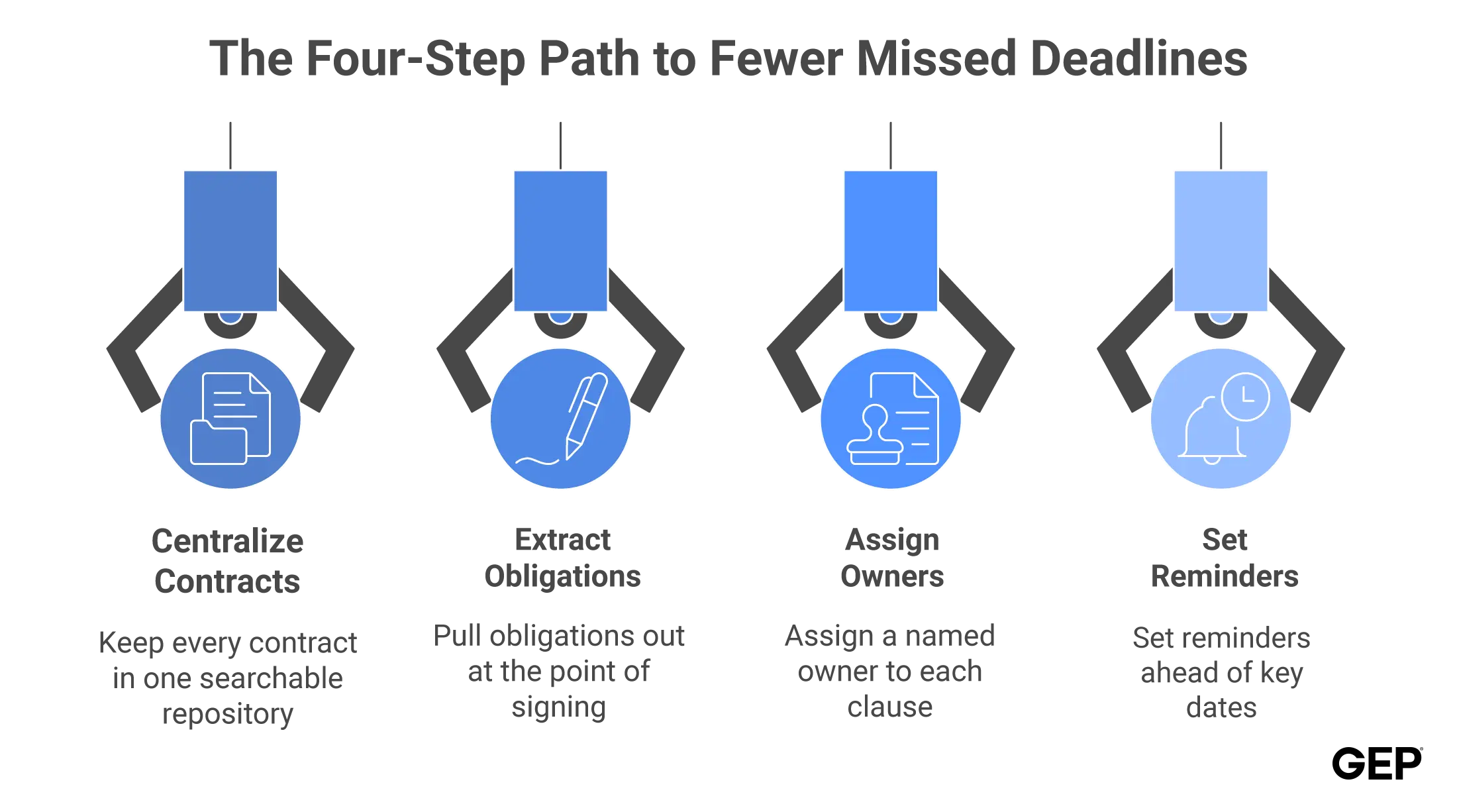
Four practices hold this together on a scale:
- Centralize every contract in one searchable repository
- Pull obligations out at the point of signing, not three weeks later
- Assign a named owner to each clause, never just a department
- Set reminders ahead of key dates, not the morning something's due
None of this needs a full overhaul on day one. Most teams start by centralizing contracts, then build ownership and automation on top once that foundation's actually solid.
How CLM Software Improves Contract Obligation Management
Contract lifecycle management software takes the guesswork out of most of this. Clause extraction, deadline tracking, approval routing- all running automatically instead of relying on someone remembering to open a folder.
AI-native tools flag risky language, surface deadlines before they hit, and route renewals to the right person before a window closes. What used to be scattered across inboxes and sticky notes becomes a documented process with an actual trail behind it, which makes audits faster and disputes a lot less painful to untangle.
Also Read: Contract Lifecycle Management Guide
Ready to Put Your Contractual Obligations on Autopilot?
Talk to GEP about building a tracking process that scales with your contract volume
Turning Contracts Into Active Business Tools
Contractual obligations touch cash flow, supplier relationships, and regulatory standing every single day an agreement stays active. A contract sitting untracked in storage carries roughly the same risk as one nobody ever reviewed in the first place.
Businesses that build real tracking, with the right software behind it, end up with something better than compliance. They get a repository that actually works for them, instead of one they're constantly working around.
Explore GEP’s AI-Native Contract Management Software




Frequently Asked Questions
Start with exposure, not alphabetical order. Financial penalties and regulatory clauses need the first look. Those are the ones that cost real money or trigger an investigation when they slip.
Who owns it, when it's due, what triggers it, what happens if nobody acts. Skip the risk rating, and you're building a to-do list, not a management tool.
Quarterly's a reasonable default for standard agreements. A high-value contract, or one in a regulated industry, needs more frequent eyes on it than that.
Whoever owns the relationship, in theory. In practice, it often falls between legal, procurement, and whoever requested the contract, which is exactly why things get missed.