


US-Canada Trade War: Tariff Risk Mitigation Steps for Procurement
- The U.S. and Canada failed to reach a trade deal, and Trump's 50% Section 338 tariffs on nearly $20 billion of Canadian imports are now in force, with Canada vowing to match them dollar for dollar.
- Procurement teams sourcing agricultural goods, chemicals, textiles, wood products, paper, machinery, and tools from Canada face an immediate and steep increase in landed costs and limited cross-border supply chain visibility into where that exposure actually sits.
- Tariff risk mitigation starts now. Map exposure, revisit supplier contracts for tariff contingency clauses, and evaluate near-term sourcing alternatives rather than waiting for a resolution.
August 25, 2026 | Procurement Strategy 5 minutes read
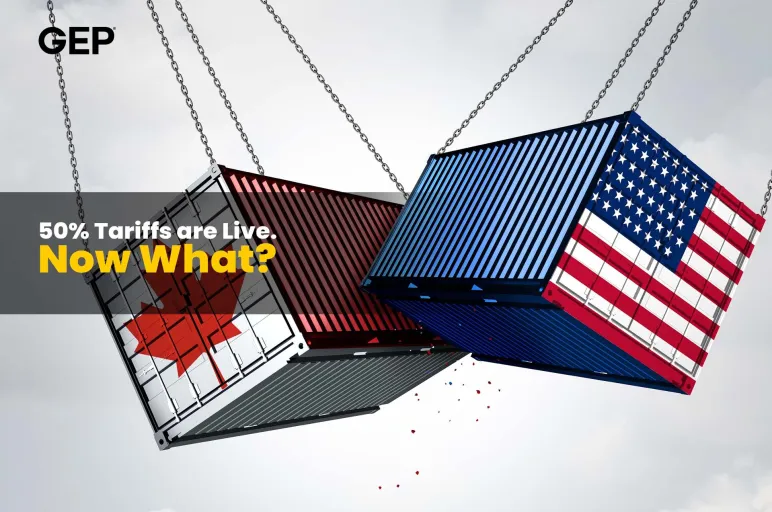
The United States and Canada have failed to reach a trade agreement before the August 21 2026 deadline, and the 50% tariffs President Donald Trump ordered in July on a range of Canadian imports have now gone into effect.
The Section 338 levies apply to roughly $20 billion worth of Canadian goods, including raw agricultural and natural materials, chemicals, textiles, consumer goods, wood products, paper, machinery, and tools.
Canadian Prime Minister Mark Carney said the proposed "last-minute changes" by the U.S. were "unfair, uneconomic" and suspended negotiations, directing Canada's trade team to return to Ottawa. He said Canada would "match those tariffs dollar for dollar," while the U.S. Trade Representative's office placed the blame on Canada for walking back prior commitments.
The breakdown adds another complication to the broader United States–Mexico–Canada Agreement (USMCA) relationship, which is now in an up-to-10-year annual review process after the U.S. declined to extend the trilateral agreement in July.
What This Means for Procurement and Cross-Border Supply Chain Visibility
For any company sourcing from Canada across the affected categories, this is a direct and immediate hit to landed cost.
It isn't a future risk to model but a live cost increase as of now.
Tariffs ripple through freight charges, customs fees, and lead times in ways that can make a sourcing decision that looked cost-effective on paper suddenly much more expensive in practice. A common blind spot when procurement teams evaluate unit cost instead of total landed cost.
The retaliatory dimension compounds the risk.
Canada has already signaled it will match the tariffs "dollar for dollar," and it has a track record of retaliatory action. It previously imposed its own tariffs on U.S. steel, aluminum, and cars.
That means companies with cross-border supply chains, or U.S. exporters selling into Canada, could face cost pressure from both directions simultaneously. Without cross-border supply chain visibility in both trade lanes, teams end up reacting to invoices instead of anticipating them.
There's also a resilience dimension beyond the immediate cost hit. GEP's analysis of tariff exposure notes that in environments like this, procurement's focus has to move from pure cost control to actively managing risk positioning across suppliers, regions, and categories in real time.
With talks suspended and no clear timeline for resolution, this isn't a short-term spike companies can simply wait out.
Tariff Risk Mitigation: What Procurement Teams Should Do Now
Here's how to mitigate U.S.-Canada tariff risks while the standoff plays out.
Map your exposure immediately
Identify every SKU, component, and raw material sourced from Canada that falls under the affected categories, and don't stop at direct suppliers. GEP's guidance on tariff risk management points out that most exposure hides further back in the chain, in the raw materials and components tied to your tier-two and tier-three suppliers. At that depth, manual spreadsheets stop working — this is what supplier mapping software is built for.
Revisit contracts for tariff contingency clauses
If your Canadian supplier contracts don't already define who absorbs a tariff increase, at what threshold pricing gets renegotiated, and how quickly either party can trigger that conversation, this is the moment to renegotiate. Locking into today's terms without that flexibility leaves you exposed regardless of how the standoff is resolved.
Model the total landed cost, not just the duty rate
A 50% tariff changes the math on freight, customs processing, and lead times all at once. Evaluate alternative sourcing regions or nearshoring options using total landed cost, not just the headline tariff percentage.
Build scenario plans for multiple outcomes
Negotiations could resume, stall further, or escalate with additional Canadian retaliation. Rather than betting on one outcome, procurement teams should have contingency plans ready for a range of scenarios, so a shift in either direction doesn't catch sourcing decisions flat-footed.
Take the manual work out of the response
Reclassification checks, country-of-origin documentation, and duty calculations all scale badly by hand. Automating tariff compliance in procurement and routing exceptions through automated procurement workflows keeps sourcing decisions moving while the rules keep shifting.
Get Multi-Tier Supplier Visibility With AI Software for Multi-Tier Supplier Mapping
With no clear signal on when, or whether, talks resume, the companies that come out ahead will be the ones that treat this as a structural sourcing question now, not a temporary disruption to ride out.
The 50% tariffs on Canadian imports call for immediate multi-tier supplier visibility.
You can get that visibility with AI-native procurement and supply chain platform GEP Quantum Intelligence that enables organizations to instantly map their supply chains, identify exposed components, and automate risk mitigation workflows with total agentic orchestration.




Frequently Asked Questions
A tariff mitigation strategy is a set of proactive measures a company takes to reduce the financial impact of import/export duties. Key components include re-evaluating product classifications, diversifying supplier locations to less-affected regions, establishing dual-sourcing frameworks, and using advanced analytics to model total landed costs under different tariff scenarios.
Nearshoring in North America, particularly to regions like Mexico or reshoring to domestic locations, becomes critical because it offers an alternative to tariff-laden cross-border supply chains. It allows companies to maintain shorter lead times and regional control compared to offshoring to Asia, while simultaneously bypassing the direct cost and complexity of new U.S.-Canada tariffs.
A North American cross-border supply chain functions as a highly integrated network where raw materials, components, and sub-assemblies move freely between the U.S., Canada, and Mexico. For complex products like automobiles, parts may cross borders multiple times for different stages of manufacturing and assembly before being installed in the final product, a system that is now under pressure from tariffs.
The first steps are to map your entire supply chain to identify every component and raw material crossing the U.S.-Canada border. Next, quantify your exposure by calculating the total cost impact of the new tariffs on your bill of materials. This data-driven assessment allows you to prioritize the highest-risk areas for immediate action, such as qualifying alternative suppliers or exploring product redesigns.