Procurement Has Four Types of Compliance. Many Companies Monitor Only Three.
- Procurement compliance covers four areas: policy, invoice, legal, and agreement.
- Agreement compliance has no systematic owner, allowing negotiated value to leak after signature.
- Reading contracts against every transaction lets teams identify leakage before payment.
November 04, 2026 | Procurement Strategy 5 minutes read
Ask a procurement leader whether their organization is compliant, and the answer is usually yes. Approvals are routed. Invoices are matched. Sanctions lists are screened. Auditors sign off.
Yet somewhere between the contract and the payment, negotiated value slips away.
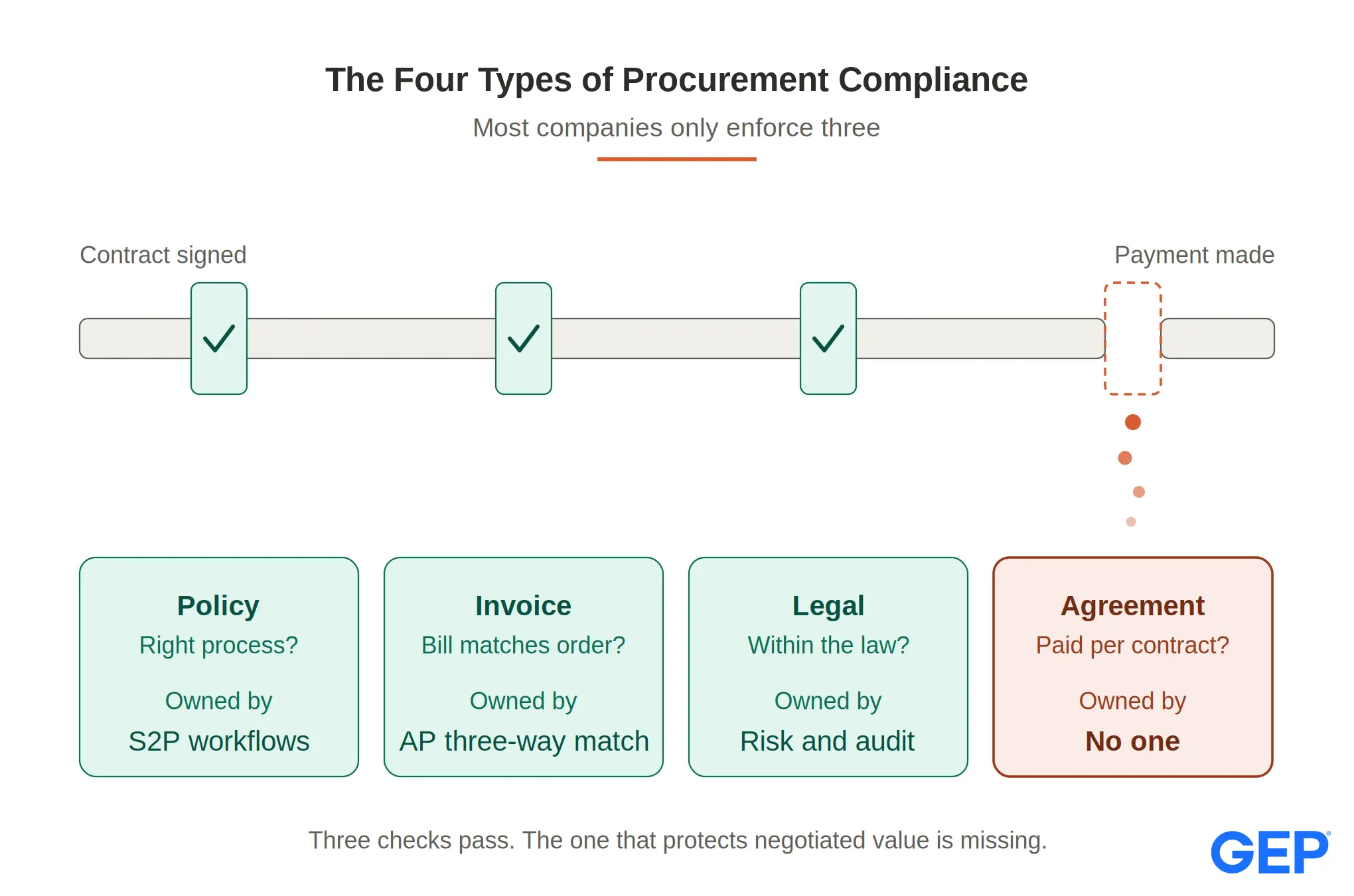
That’s because “compliance” in procurement isn’t one thing. Most enterprise stacks are built to check the first three of them well. The fourth, the one that decides whether negotiated value actually turns into cash, usually has no systematic owner at all.
1. Policy Compliance: Was the Right Process Followed?
This is where most compliance conversations begin. Did the requester use an approved supplier? Did the purchase go through the right approval chain? Was a purchase order (PO) raised before the work started?
Source-to-pay (S2P) workflows handle this reasonably well. They block unauthorized spend, flag maverick buying and prevent people from skipping steps. What they don’t check is whether the price on a perfectly approved PO matches what the contract says it should be.
2. Invoice Compliance: Does the Bill Match the Order?
Here, accounts payable (AP) takes over. Three-way matching compares the purchase order, goods receipt and the invoice. If a supplier bills for 120 units but only 100 are received, the system catches it. Duplicate invoices and overbilling against the PO get stopped too.
It’s a solid control, but with limitations. It compares three documents to each other, but not to the contract. If the PO was priced wrong at the onset and the invoice matches it, the overcharge goes through with a green tick.
This is where the documents agree, but the commercial terms do not.
3. Legal and Regulatory Compliance: Are We Within the Law?
Risk, tax and audit teams typically own this one. They track sanctions, trade controls, supplier certifications, VAT requirements, and environmental, social and governance (ESG) disclosures. With regulatory exposure and potential penalties at stake, these controls often receive significant attention and investment.
Its focus is external legal obligations, though, not commercial terms. Nobody gets fined for forgetting to claim a volume rebate, but it’s nonetheless a financial loss.
4. Agreement Compliance: Did We Pay What the Contract Says?
This is the question the other three don’t answer. Did we get the tiered discount once spend crossed the threshold? Was the rebate claimed? Was a Net-90 invoice paid on day 45? Did the reseller stay inside its 5% markup cap? Was the CPI adjustment applied correctly, or at all?
Every one of these questions is answered in a signed agreement. Almost none of them is checked systematically.
The result is a gap between what the organization negotiated and what it actually receives.
Why The Fourth One Has No Owner
The problem starts with how responsibility is split. Procurement is measured on savings negotiated before signature. Finance is measured on processing invoices accurately and on time. Legal focuses on risk and enforceability. Once the contract is signed, each function steps back, assuming someone else is watching.
Nobody is.
The deeper problem is technical. The terms that decide value, such as rebate thresholds, price sheets, index clauses, markup caps, and payment terms, live inside unstructured contracts. Orders, invoices and payments on the other hand sit in separate systems. Nothing in the typical stack reads a clause and lines it up against the transaction it governs.
So, agreement compliance falls to manual review, often a periodic sample. By then the money is gone, and recovery means chasing supplier credit notes months later.
What the Gap Costs
The loss rarely arrives as one big failure. It builds a line at a time: an unclaimed rebate, a missed early-payment discount, a unit price above the contracted rate, a markup slightly over the cap, a duplicate invoice.
Each looks insignificant on its own. But repeated across suppliers, business units and payment cycles, they compound. Independent research shows up to 11% of contract value is lost after signature. The longer the gap goes unchecked, the harder that value is to recover.
None of the losses registers as a failure in the other three types: the process was followed, the invoice matched, and the supplier met legal requirements. The leak becomes visible only when someone compares the contract clause to the cash.
Why This Gap Can Finally Be Closed Now
For decades, organizations have tolerated this leakage as a cost of doing business. That wasn’t because they didn’t know about it. It was because there was no practical way to fix it. Contracts are long, unstructured and inconsistent. Reading thousands of them against millions of transaction lines was work no team could staff, and rules-based automation couldn’t help because clauses don’t arrive in neat, fixed fields.
Agentic AI changes that. AI agents can now read contract language the way an expert would, interpret what each clause means commercially, and act on it across systems, at a scale and speed manual review never could. A problem that was economically impossible to solve has become a solvable one.
Giving Agreement Compliance an Owner
Most organizations now increasingly rely on recovery audits. Someone samples last year’s transactions, finds overpayments and chases supplier credit notes. The approach is reactive by design, and the value it targets decays by as much as 23% a year while it waits to be found.
Closing the gap doesn’t mean replacing the controls that already work. What’s missing is a layer that reads contracts the way a procurement expert would and checks every transaction against them.
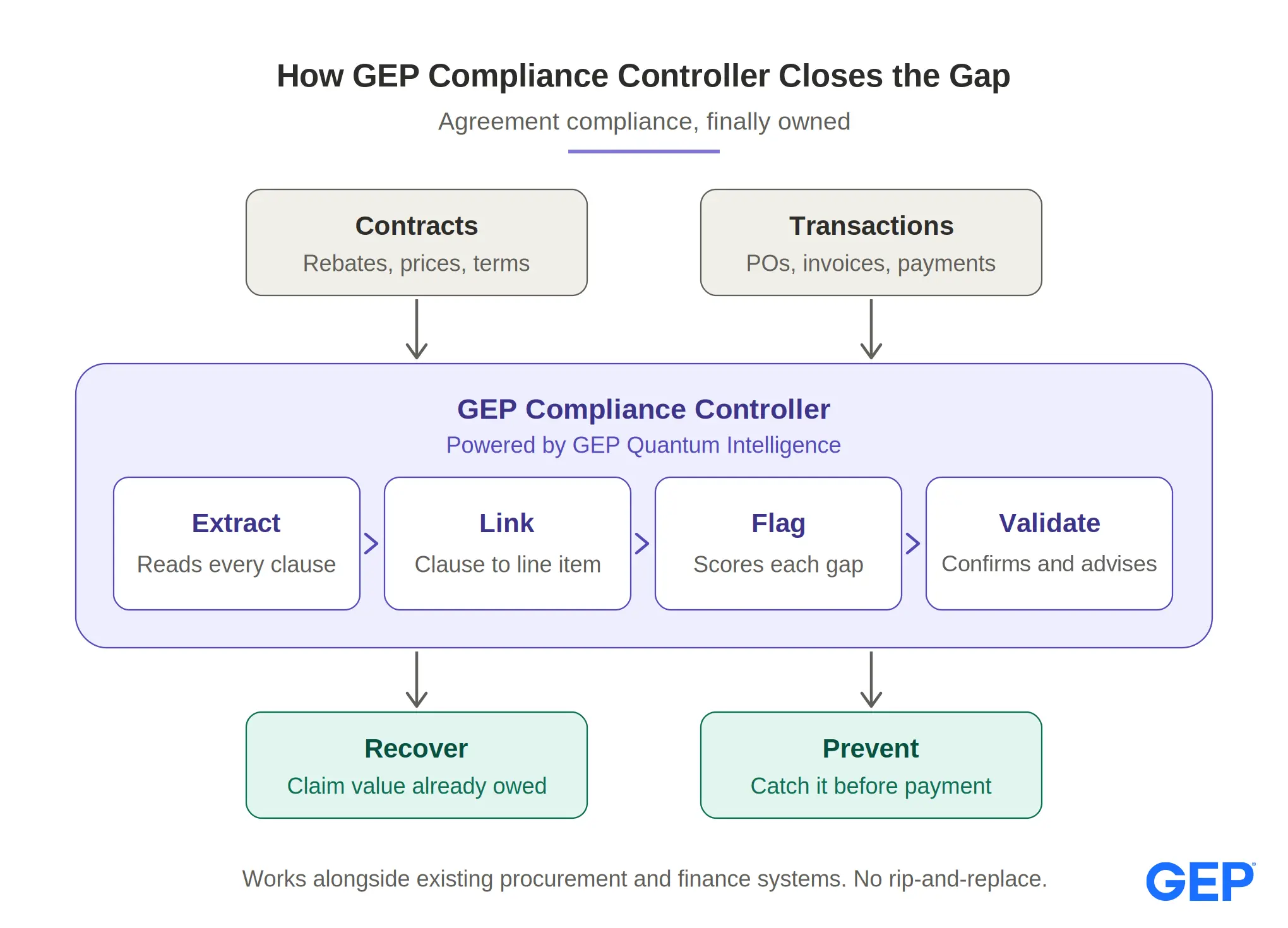
That’s the job GEP Compliance Controller, powered by GEP Quantum Intelligence, was built for. It’s a multi-agent AI platform. Specialized, domain-trained agents each handle extract more than 100 commercial fields from unstructured contracts, match supplier identities across systems, and link each PO, receipt, invoice and payment to the right agreement at the line level. An orchestration layer coordinates those agents and unifies data from siloed S2P, CLM and ERP systems into one connected view. That is what separates it from point AI tools that handle a single step in isolation. And it runs alongside the systems a company already has, with no rip-and-replace.
Because the checks can run continuously, deviations can be caught before the payment goes out, not a year later.
Most organizations have already done the hard part: negotiating good contracts. The fourth type of compliance is simply about getting what was negotiated.
Ready to see how much value your contracts are leaving behind? Learn more about GEP’s Compliance Controller here.