


Scaling Enterprise Procurement with Agentic AI and Orchestration: A Guide for Procurement Leaders
- The most persistent challenge procurement leaders face is the inability to act on intelligence fast enough to change outcomes.
- The intelligence gap in procurement isn't a data problem, rather an architecture problem that you can close with agentic orchestration.
- Without orchestration, even the best AI tools operate in silos, generating more noise than clarity.
June 02, 2026 | Procurement Software 7 minutes read
Agentic orchestration deploys autonomous agents that plan, execute, and adapt across your entire procurement operation in real time. But most organizations experimenting with AI in procurement are solving the wrong problem. They deploy point solutions, a contract analyzer here, a spend classification engine there, and then wonder why transformation never scales.
The reason is a lack of understanding about what orchestration actually means in procurement.
Orchestration is the ability to coordinate multiple AI agents working in parallel, each specialized for a distinct task, governed by a layer that routes decisions, manages exceptions, and keeps human authority precisely where it belongs.
This guide gives you a clear-eyed look at what AI orchestration is, how agentic AI works within it, the compounding benefits it delivers for enterprise procurement operations, and how to implement it in a way that actually sticks.
What AI Orchestration Actually Means for Procurement
AI orchestration is the architectural layer that coordinates multiple AI agents, each specialized for tasks like spend analysis, supplier evaluation, contract review, or demand forecasting, into a unified, goal-driven workflow.
Rather than standalone tools that produce outputs in isolation, orchestration ensures those agents communicate, hand off tasks, escalate decisions, and adapt in real time based on changing inputs.
With agentic AI orchestration, procurement leaders gain a system that executes actions, triggers approvals, flags exceptions, and learns from every cycle. That is a fundamentally different operating model from what most enterprises are running today.
Make Procurement Decisions Faster With Agentic AI
Orchestrated teams act on real-time sourcing intelligence across volatile global markets
How Agentic AI Works Inside Procurement Orchestration
Agentic AI takes a fundamentally different approach than traditional automation or early-generation machine learning.
Instead of following rigid rules or waiting for a human to interpret outputs, AI agents operate with defined goals. They autonomously plan the steps required to achieve them and execute across integrated systems without requiring manual intervention at every stage.
In procurement, an agent can monitor a supplier's financial health, cross-reference it against contract exposure and SLA terms, trigger a risk-threshold alert, and initiate a mitigation workflow. The human receives a decision point, not a data dump.
What makes this powerful for procurement leaders is the compounding effect of AI agents working in concert. Strategic sourcing, for instance, becomes a dynamic and continuous process rather than a periodic exercise. One agent scans market conditions and alternative supplier landscapes, another benchmarks your current contract terms against live market alternatives, and a third prepares scenario analyses for your negotiating team.
Every use case that once required days of analyst effort collapses into an automated, auditable loop, freeing your procurement team to focus on decisions that genuinely require human judgment rather than information gathering.
The orchestration layer is what ties these agents together and makes the system trustworthy at scale. It governs which agent has authority to act autonomously, when human approval is required, and how conflicts between agent outputs are resolved.
CPOs who invest in getting this governance architecture right early avoid the fragmentation that derails most AI adoption journeys, where individual agents multiply, but enterprise coherence collapses.
Five Ways Agentic AI Transforms Enterprise Procurement
End-to-End Process Continuity
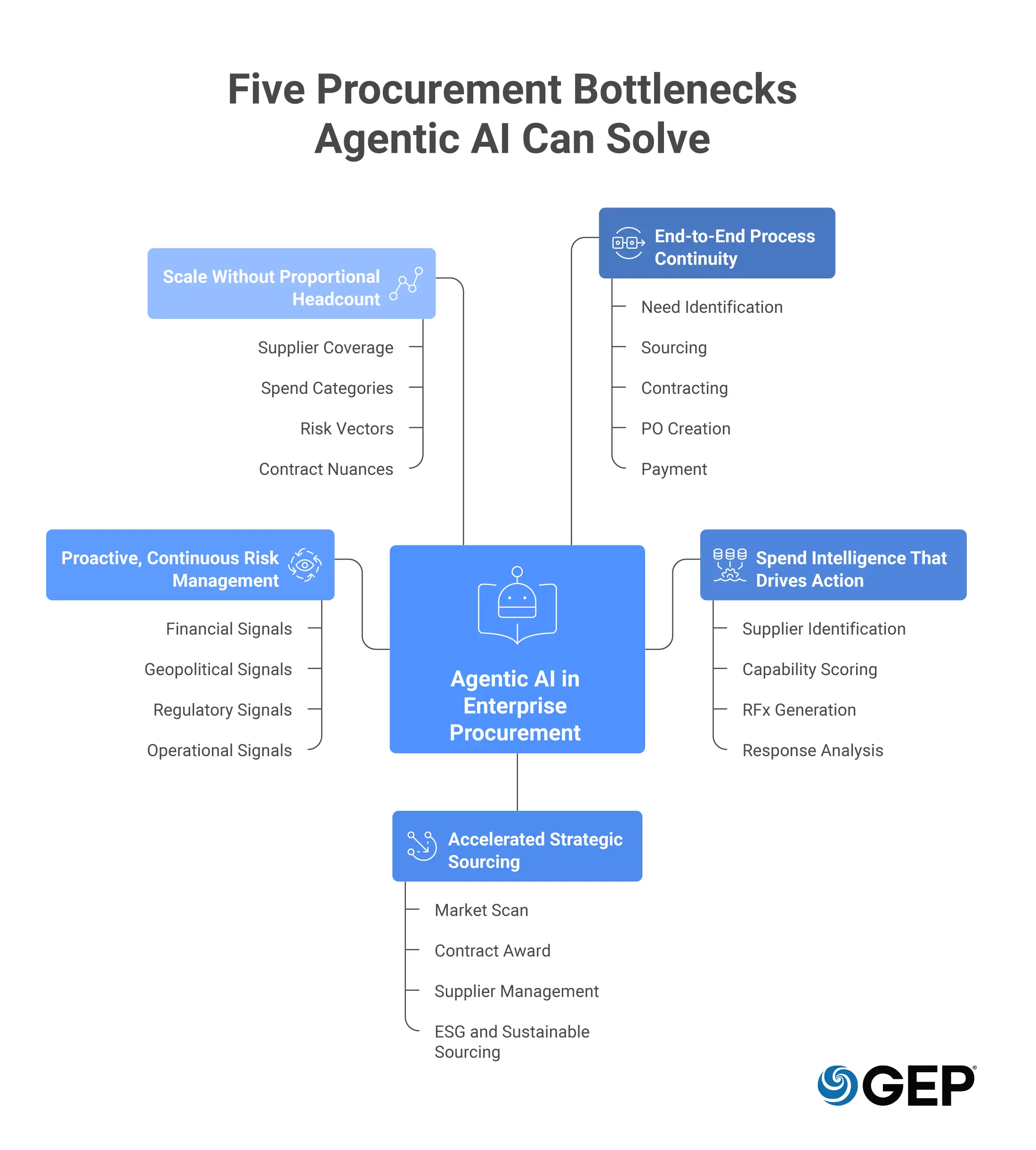
Traditional procurement automation digitizes individual steps. Agentic orchestration automates entire value chains, from need identification through sourcing, contracting, PO creation, and payment, while maintaining a single thread of logic across all steps.
Every handoff is intentional, every exception is routed intelligently, and every outcome is fully traceable and auditable.
Spend Intelligence That Drives Action
AI in procurement has long promised spend visibility. Orchestrated agentic systems deliver something more valuable: continuous, contextualized spend intelligence that feeds directly into sourcing and negotiation workflows.
Instead of a quarterly dashboard review, procurement executives get a living picture of spend that triggers consequential actions, not just alerts that require someone to react manually.
Accelerated Strategic Sourcing
Strategic sourcing traditionally takes weeks or months from market scan to contract award. Agentic AI compresses this cycle by running supplier identification, capability scoring, RFx generation, and response analysis concurrently, and surfacing only the decisions that require senior judgment.
As a result, you get dramatically faster cycle times with no reduction in analytical rigor. This is one of the highest-ROI use cases available today.
Proactive, Continuous Risk Management
Rather than reacting to supplier failures after they occur, orchestrated AI agents continuously monitor financial, geopolitical, regulatory, and operational signals across your supply base, matching those signals against your specific contractual exposure.
For procurement leaders managing global supplier networks, this capability alone justifies significant investment. The cost of a single major supply disruption almost always exceeds years of AI infrastructure spend.
Scale Without Proportional Headcount
One of the most tangible benefits for CPOs is the ability to expand analytical coverage without scaling headcount at the same rate. A well-orchestrated agentic system can process the equivalent of dozens of analyst-hours per day, enabling your team to cover more suppliers, more spend categories, more risk vectors, and more contract nuances than would ever be achievable through human effort alone. You are not replacing analysts. You are making each of them exponentially more effective.
Can Procurement Cut Ratepayers' Electricity Costs?
Learn how utilities protect affordability through procurement strategy
How Procurement Leaders Can Implement AI Orchestration Successfully
The single biggest implementation mistake is treating orchestration as a technology project rather than an operating model redesign.
Before evaluating capabilities or building agents, define which workflows benefit from autonomous execution versus those that require human-led decision-making.
Map your highest-value procurement processes end-to-end, identify where delays, errors, or data gaps consistently occur, and prioritize use cases where agentic AI delivers compounding returns, not just one-time efficiency gains.
The goal is to automate intelligently, so that human judgment is reserved for decisions that actually change outcomes.
Data readiness is non-negotiable and almost always underestimated. Orchestrated AI agents are only as effective as the data environment they operate in.
Procurement leaders who fast-track implementation without addressing fragmented ERP data, inconsistent supplier master records, or siloed contract repositories will find their agents amplifying existing problems rather than solving them.
Invest in data governance before agent deployment, not as a parallel workstream, but as the prerequisite it actually is.
Finally, build for organizational trust from day one. AI orchestration in procurement fails most often, not because of technical failure, but because procurement teams and business stakeholders don't trust agent outputs enough to act on them without manual verification.
Design your orchestration architecture with full auditability. Every agent action, decision rationale, and output should be explainable and logged in plain language. Start with high-volume, lower-risk processes to build institutional confidence, and expand the autonomy envelope only as demonstrated accuracy earns it.
The organizations that scale fastest are the ones that earn trust incrementally, not the ones that deploy ambitiously and then spend 18+ months rebuilding confidence after an early failure.
The Procurement Operating Model of the Next Decade Is Already Here
Enterprise procurement will increasingly be defined by the intelligence architecture that supports it.
Procurement leaders building orchestration capabilities, equipping teams to work alongside AI agents, and establishing governance frameworks designed to scale, will create a structural competitive advantage that compounds over time. Those who wait for the technology to ‘mature further’ will find themselves closing a gap that grows wider every quarter.
Expect the next wave of AI in procurement to push into supplier co-innovation, autonomous contract lifecycle management, and real-time scenario modeling that spans entire supply chains.
AI agents will progressively take on more complex, judgment-related tasks, not to replace procurement executives, but to make their strategic impact measurably greater.
CPOs who design human-AI collaboration with intention, clear boundaries, clear accountability, and a clear mandate for continuous improvement will be the ones whose functions are seen as strategic growth enablers rather than cost centers managing risk. The distinction between those two roles has never been more consequential.
Ready to see what orchestrated intelligence looks like at enterprise scale? Talk to an expert today.



FAQs
Start where pain is highest and data is cleanest. The most effective entry points for AI in procurement tend to be spend analytics, purchase order exception handling, and supplier risk monitoring, processes where the workflow is well-defined, the data is relatively structured, and the business value of faster, more accurate decisions is immediately measurable. Resist the urge to start with the most ambitious use case; orchestration compounds in value as agent coverage expands, so building credibility early with contained, high-ROI deployments creates the organizational mandate to scale into more complex workflows. CPOs should also ensure that every initial deployment has clearly defined success metrics established before go-live. This is what converts a pilot into a program and a program into a permanent operating model.
The most common governance failure is ambiguity about where AI authority ends and human authority begins. When agents are allowed to operate without clearly defined escalation triggers, decision boundaries, and auditability requirements, errors compound silently, and by the time they surface, they've already touched downstream processes and supplier relationships. A second major pitfall is treating governance as a one-time compliance exercise. As agentic capabilities evolve, governance must evolve with them, or it becomes a bottleneck rather than a safeguard.