


AI Contract Orchestration: How Procurement Teams Close Deals Faster Without Losing Control
- Manual contract processes cause delays that make the onboarding cycle longer, increasing the risk of losing money and lowering negotiating value even before a contract is signed.
- Contract orchestration that is based on AI automates clause extraction, obligation tracking, and approval routing. This lets procurement teams quickly and easily carry out deals.
- Integrating contract intelligence into a larger procurement orchestration setting links agreement data directly to sourcing results, regulatory requirements, and supplier performance.
June 16, 2026 | Contract Management 5 minutes read
Most contract delays don’t originate in legal. They start with procurement, where review processes seem to never end, approvals bounce from inbox to inbox, and no one is entirely certain which version is the right one. Often, the business context has changed by the time a contract is ready to be executed, and the value agreed originally is already under pressure.
This is not a people issue. It is a question of business model.
This blog breaks down what AI contract orchestration really means, where traditional review processes fall short, and how procurement teams can leverage an AI-native intelligent operational environment to transition from fragmented review to structured, end-to-end contract execution.
Turn Your Contracts Into a Strategic Advantage
Discover how AI-native CLM reduces risk and drives value from every agreement.
Understanding AI Contract Orchestration
AI contract orchestration is the intelligent automation of the complete contract lifecycle from clause analysis and risk identification to approval routing, obligation management, and renewal tracking.
It’s not a document storage enhancement. It’s not a search tool grafted atop a repository.
AI-native contract orchestration makes the contract a living data asset that integrates procurement decisions, supplier commitments, compliance requirements, and financial obligations into a single controlled workflow. This is important because an isolated contract evaluation results in isolated outcomes. Orchestrated contract management for connected, auditable value.
Why Manual Contract Review Goes Beyond Legal Time?
The idea is that the legal department gets handed delayed contracts. Reality is more scattered and more harmful.
With manual review, procurement teams are exposed to each stakeholder having a different view of the document at a different moment, whether it is the category manager, legal counsel, finance lead, or compliance officer. Version conflicts pile up. Redlines are gone. Approval chains are halted when one stakeholder is unavailable.
The downstream impacts multiply swiftly. Onboarding delay for the supplier. Pricing windows are negotiated and close before contracts are signed. There is no visibility into committed deliverables after signature, hence obligation milestones are missed. And when auditors or regulators request documentation, the process of retrieval is manual, inconsistent, and slow.
The issue isn't review time in isolation. It is the absence of a standardized operational model that connects contract data with procurement results.
Also Read: How AI Agent Expedite Supplier Onboarding
How AI Contract Orchestration Streamlines Supplier Contract Reviews
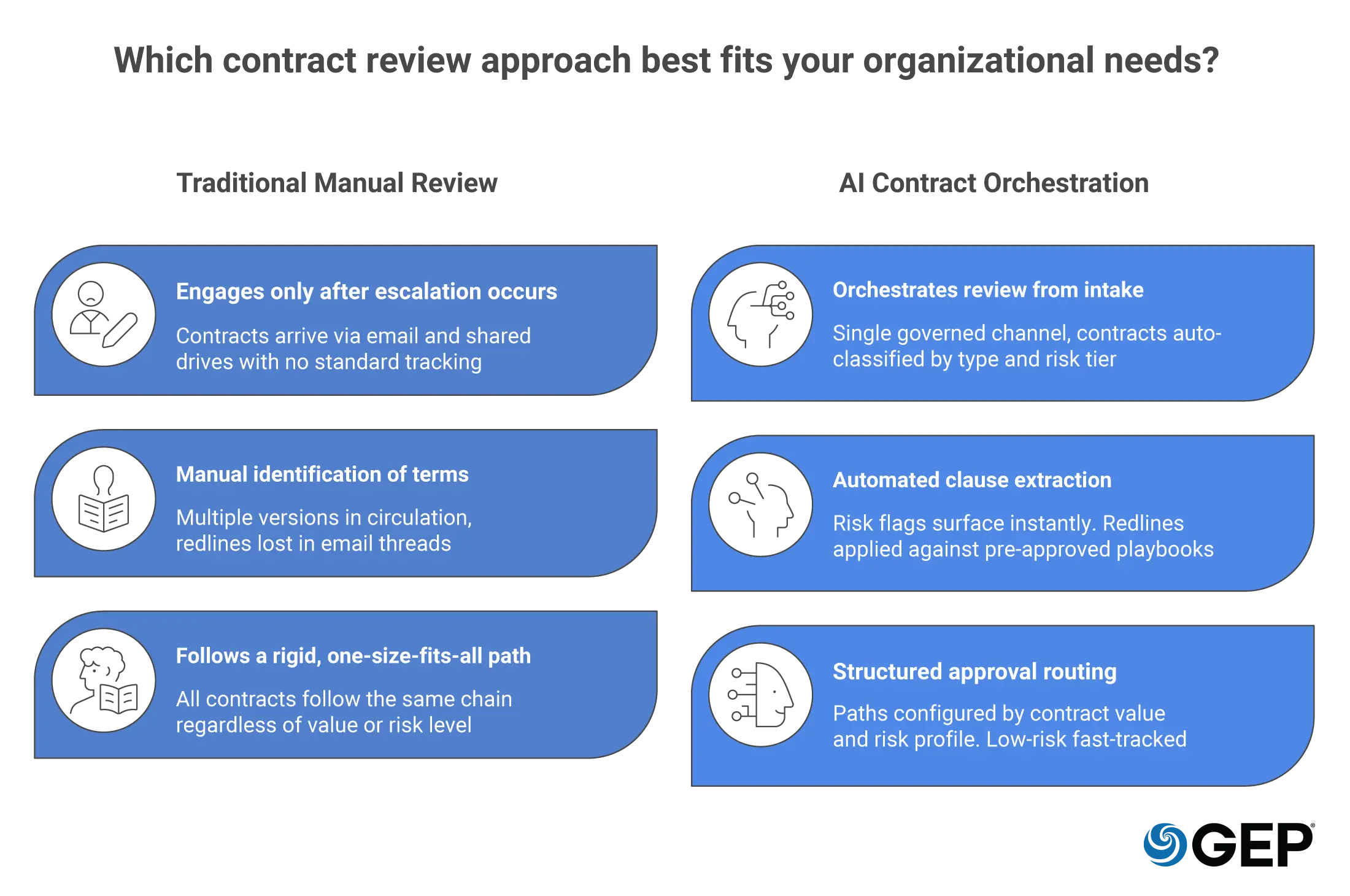
An AI-native intelligent operational environment transforms the contract review process at intake, not at escalation.
So, when a supplier agreement is entered into the system, clause extraction will automatically pull out key clauses, payment terms, responsibility thresholds, termination rights, etc. Risk flags are generated before a human reviewer has ever seen the material.
Fallback clauses are recommended to avoid pre-agreed legal positions and eliminate back-and-forth between procurement and legal on standard provisions.
Approval routing is customized to reflect contract type, value, and risk profile, so a low-risk renewal does not flow via the same review channel as a high-value multi-year strategic agreement. All actions are time-stamped and traceable.
This means not simply faster review. It is a review that is uniform, controlled, and linked from the beginning to the larger procurement procedure.
The Impact: Faster Contract Cycle Times
Speed is important, but the better metric is cycle time per contract type and exception rate.
Procurement teams that use AI-native orchestration often experience substantial reductions in time from contract initiation to execution. More crucially, they have fewer post-signature exceptions because obligation milestones, renewal windows, and compliance checkpoints are maintained automatically rather than via manual reminders and spreadsheets.
The commercial value here is particular. Faster cycle times mean earlier supplier activation and quicker access to negotiated savings. Lower exception rates lower the legal and operational cost of contract disputes. Automated obligation tracking helps to mitigate the risk of missed SLAs and uncontrolled renewals that revert to unfavorable terms.
Not just efficiency for efficiency's sake. It's working capital and risk exposure controlled with smarter contract operations.
Procurement Orchestration Powers AI Contract Orchestration
Contract intelligence does not work well alone. Its value gets multiplied when it lives in a procurement orchestration context.
The contract is the point of convergence when sourcing decisions, supplier records, spend data, and compliance requirements are all joined together in a cohesive, intelligent operating environment. The contract approval threshold is based on the risk profile of a provider from the sourcing event. Committed price goes immediately into downstream procure-to-pay without human re-entry. ESG commitments identified during supplier onboarding are built-in trackable obligations, not aspirational footnotes.
This is the distinction between a contract management tool and AI-native contract orchestration within an end-to-end procurement paradigm.
From Review to Execution: End-to-End Contract Orchestration
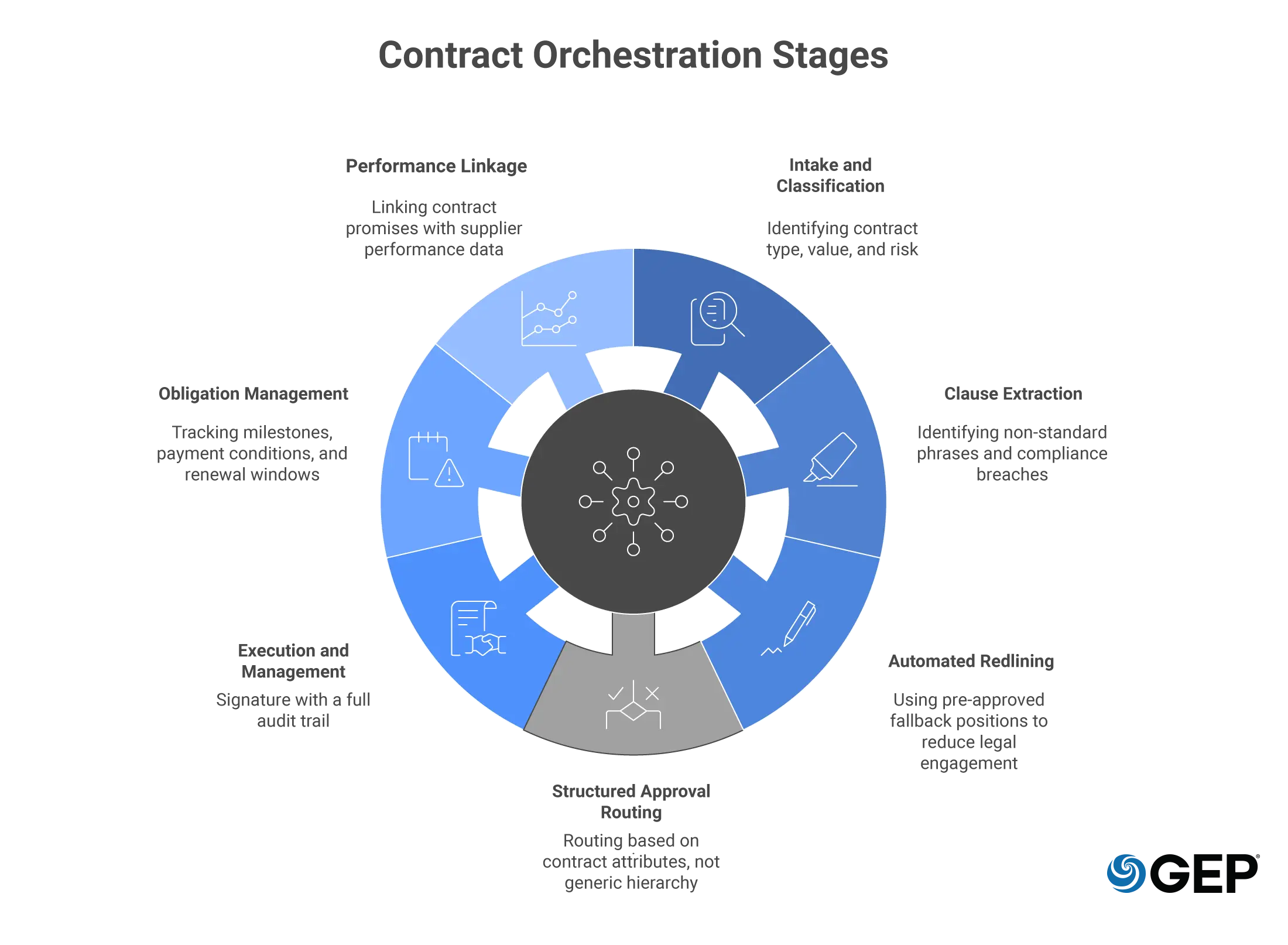
A practical contract orchestration system must deal with seven stages:
- Intake and classification: Identify the contract type, value tier, and risk profile on submission.
- Clause extraction and risk flagging: Identify surface non-standard phrases and compliance breaches before the evaluation begins.
- Automated redlining against playbooks: Use pre-approved fallback positions to reduce legal engagement on standard clauses.
- Structured approval routing: Routing based on contract attributes, not generic hierarchy.
- Execution & Counterparty Management: Signature with full audit trail.
- Obligation management: Track milestones, payment conditions, and renewal windows after signature.
- Performance linkage: Link contract promises with supplier performance data to provide continuous evaluation.
Is Your Contract Process Slowing Down Procurement?
Talk to our experts and find out how AI-native orchestration can transform your contract review and execution workflows.
The Shift From Contract Review to Contract Intelligence
Contracts are where negotiated value is stored or dissolved. Without central oversight and automation of execution, the best negotiated agreements rarely make it through the process unscathed.
AI-native contract orchestration provides procurement teams with the structure to move more quickly without losing control, and the intelligence to approach every agreement as a connected asset rather than a closed document.
The question is not whether to arrange contracts. It’s about how fast your organization can get from reactive review to proactive contract intelligence.
Explore GEP’s AI-Native Contract Management Software




FAQs
Contracts involve several parties, approval layers, compliance requirements, and post-signature duties. Without orchestration, these aspects work in isolation, causing delays, discrepancies, and missed obligations. Orchestration links each stage into a controlled, traceable workflow.
AI-native orchestration is particularly useful for complicated agreements because it performs consistent clause extraction and risk analysis at scale, regardless of the document length or complexity of terms. Approval routing and obligation tracking are set up based on the risk profile of each contract type, so complexity is handled by structured logic, not manual escalation.
Faster cycle times, less legal friction on standard provisions, automatic obligation tracking, lower exception rates post-signature, and direct linking between contract promises and supplier performance data. The cumulative effect is improved value realization from each contract.