AI‑Native Procurement: The Shift Every Forward‑Thinking CPO Needs to Plan For Now
- AI-native procurement platforms embed intelligence into the data model itself, enabling agentic AI to orchestrate every step from sourcing to payment.
- Legacy source-to-pay systems can’t close the negotiation-to-payment cycle autonomously, leaving procurement teams mired in manual work.
- CPOs who redesign processes and data architectures for end-to-end AI orchestration will define their organization’s competitive position for the rest of the decade.
August 26, 2026 | Procurement Software 5 minutes read
CPOs: your procurement technology is probably working exactly as designed. That’s the problem.
The legacy platforms automating purchase orders and routing approvals were built for a different era: linear workflows, stable trade lanes, modest data volumes. They digitized the paper trail. They did not transform the function.
What is transforming is today’s AI-native procurement platform: an architecture where intelligence is not layered on top of workflows but is the foundation they run on.
Understanding the Shift to AI-Native Procurement
Most procurement platforms today are built on workflow logic: define the steps, automate the handoffs, alert a human when something breaks. AI was added later, in a spend analytics module here, or a contract review tool. The underlying architecture remained transactional. Intelligence was bolted on, not baked in.
An AI-native platform inverts this entirely. Legacy systems were built for transactional efficiency, not continuous intelligence. AI-native platforms embed intelligence into the data model itself, enabling AI to inform strategy selection, scenario modeling and supplier recommendations as an integrated experience.
The system doesn’t wait for a human to trigger a query. It continuously synthesizes data across sourcing, contracts and supplier relationships, surfacing insights proactively.
The CPOs embracing this shift are redefining what their teams are responsible for, how they measure value and how procurement contributes to the broader business.
Stop Fighting Silos. Start Operating Intelligently
See how top organizations are scaling agentic AI across the entire procurement lifecycle
Bridging the Gap: How AI-Native Platforms Close the Negotiation-to-Payment Cycle
Every procurement leader knows the frustration of a process that looks clean on paper but dissolves into manual intervention in practice. Contracts sit in redline limbo. POs trigger matching exceptions over a unit-of-measure mismatch. Invoices that should be touchless require human reconciliation over a $12 discrepancy.
These are architectural, not process failures. Traditional source-to-pay systems hand off data between discrete modules without a shared intelligence layer that can reason across all of them simultaneously.
AI-native platforms close this cycle by treating the entire negotiation-to-payment journey as one continuous, intelligent workflow. Agentic AI components can cross-reference contract terms against PO data, identify discrepancies before they become exceptions and resolve routine variances within predefined tolerances without human involvement.
Achieving End-to-End Autonomy with AI-Native Procurement Platforms
End-to-end autonomy does not mean removing humans from procurement. It means changing what humans are responsible for. Routine tasks like supplier onboarding verification, RFQ distribution, PO matching or invoice reconciliation are candidates for full automation. Strategic decisions involving complex negotiations and C-suite trade-offs should stay firmly human.
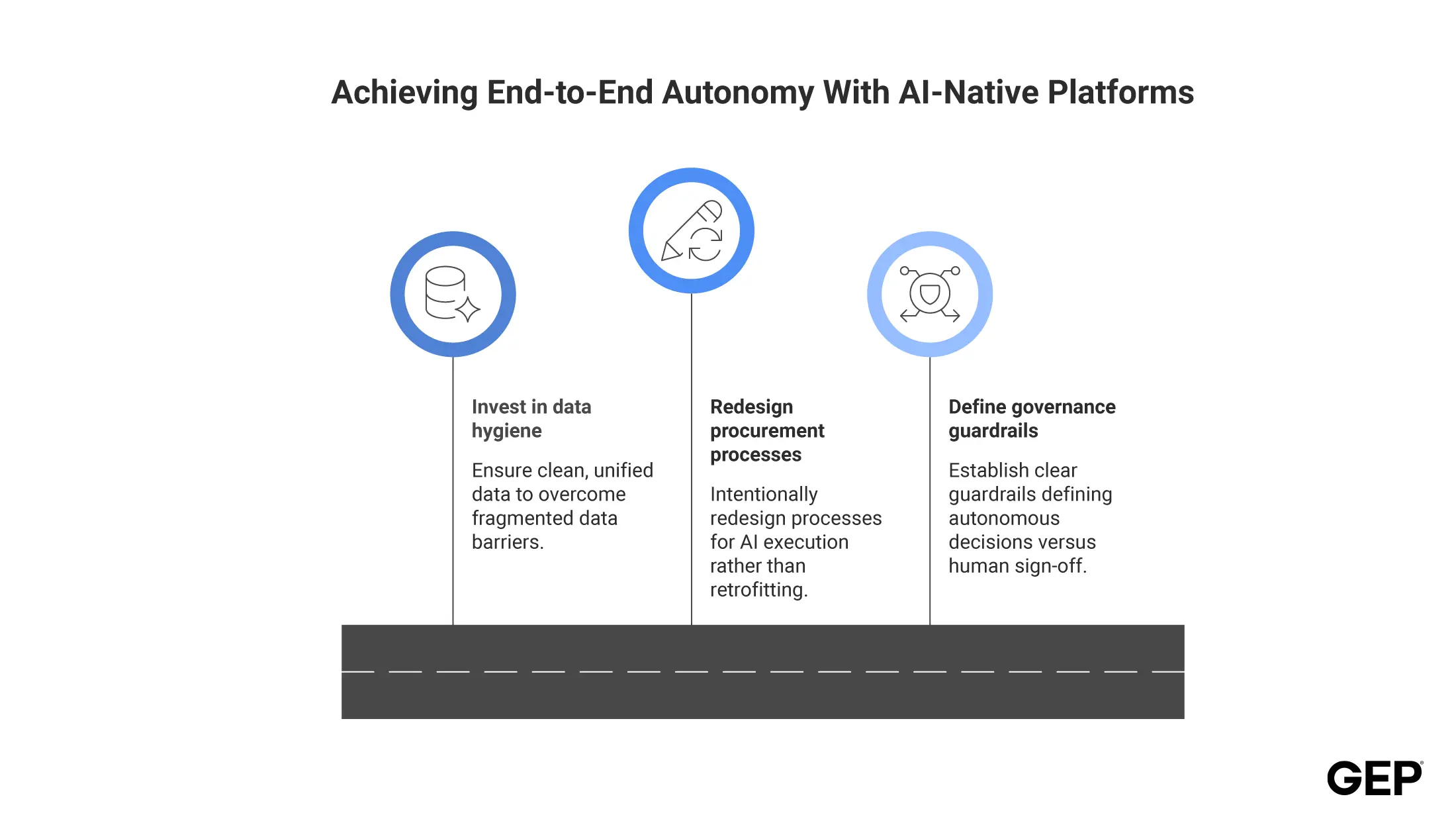
Getting there requires three things: clean, unified data (fragmented data is the primary barrier to scaling AI in procurement); processes intentionally redesigned for AI execution rather than retrofitted; and clear governance guardrails defining what the system decides autonomously versus what requires human sign-off.
Research from GEP and the University of Virginia’s Darden School of Business indicates that less than 1 in 10 organizations have successfully scaled AI in their operations. What distinguishes these organizations is not the technology. It’s their investment in data hygiene and process redesign before expecting the technology to perform.
The Future of Procurement: Orchestration With AI-Native Procurement Platforms
If autonomy describes what AI-native platforms can do, orchestration describes how they do it. Traditional automation is sequential and siloed: each module handles its task and passes a handoff. Orchestration maintains a unified view of objectives across the entire source-to-pay process, with specialized AI agents collaborating in real time: a market intelligence agent informing a negotiation agent, which informs a contract creation agent.
Gartner forecasts that by 2030, 60% of enterprises using supply chain management software will have adopted agentic AI features, up from 5% in 2025. Orchestration-capable platforms are how that adoption translates into strategic value. Delivering innovation requires synthesizing supplier intelligence, risk data and market signals at the same time, which no rule-based system can do.
For CPOs, this makes platform architecture a strategic decision, not a technical one. AI-added features on legacy systems cannot be orchestrated the same way natively intelligent platforms can. The choices being made now will shape organizational capability through the rest of the decade.
The Architecture of the Future Is Being Chosen Right Now
Most organizations using AI in procurement are still using it as a feature — a better report, a smarter chatbot. AI-native procurement is categorically different: intelligence as the operating system, not the interface. When that foundation is in place, procurement moves smarter, adapts to volatility in real time, and generates the continuous, predictive intelligence that turns a cost center into a strategic function.
The CPOs who invest in data unification, process redesign and governance frameworks before they need them will find the transition more manageable. Those who wait will find themselves rebuilding the foundation while the house is on fire. The architecture of procurement’s future is here right now, and the organizations that make that choice deliberately rather than by default, will outpace their competitors.
FAQs
Q. What are the key benefits of AI-native procurement for businesses?
A. The immediate benefits are speed and accuracy: shorter sourcing cycles, faster contract execution, higher touchless transaction rates. The deeper value is continuous predictive intelligence on supplier risk, market pricing and compliance status, which shifts procurement's contribution from cost reduction to risk management and innovation enablement.
Q. Why should CPOs plan for the AI-native procurement shift now?
A. Because the transition is more complex than a technology purchase. It requires data harmonization, process redesign, and change management — work that takes time. Organizations that start now, as a planned transformation, will reach meaningful AI deployment well ahead of those who wait. That lead time translates directly into competitive advantage.
Q. What impact will AI-native procurement have on sustainable sourcing and green procurement?
A. AI-native platforms make ESG data an operational input rather than a compliance exercise. When supplier carbon profiles and sustainability certifications live in the same intelligence layer as cost and risk data, sustainability criteria get applied systematically across every sourcing decision, not just when a regulatory deadline forces it.