


AI-Native Procurement Platforms Change How Teams Work. Bolt-On AI Usually Doesn't
- AI built into workflows reduces manual work and delays.
- Bolt-on AI often struggles with fragmented procurement data.
- Agentic AI can execute tasks instead of only generating answers.
June 23, 2026 | Procurement Software 4 minutes read
Procurement teams are under pressure from every direction. Supplier risks emerge faster than before. Market conditions shift unexpectedly. Internal stakeholders expect quicker responses. At the same time, teams are being asked to do more without adding headcount.
Many software providers now claim to solve these problems with AI. On the surface, the offerings can look similar. Most platforms have a chatbot. Most can summarize information. Most can generate content.
The difference appears when procurement teams try to use AI inside real workflows.
A sourcing manager doesn't need another tool that produces text. They need help identifying suppliers, evaluating bids, monitoring risk, drafting contracts, and moving work forward without jumping between systems.
AI-Native or Bolt-On Procurement Platform?
Find out what separates AI-powered tools from AI-native procurement platforms
Procurement Teams Need More Than AI Assistants
That is where the distinction between AI-native and bolt-on AI becomes important.
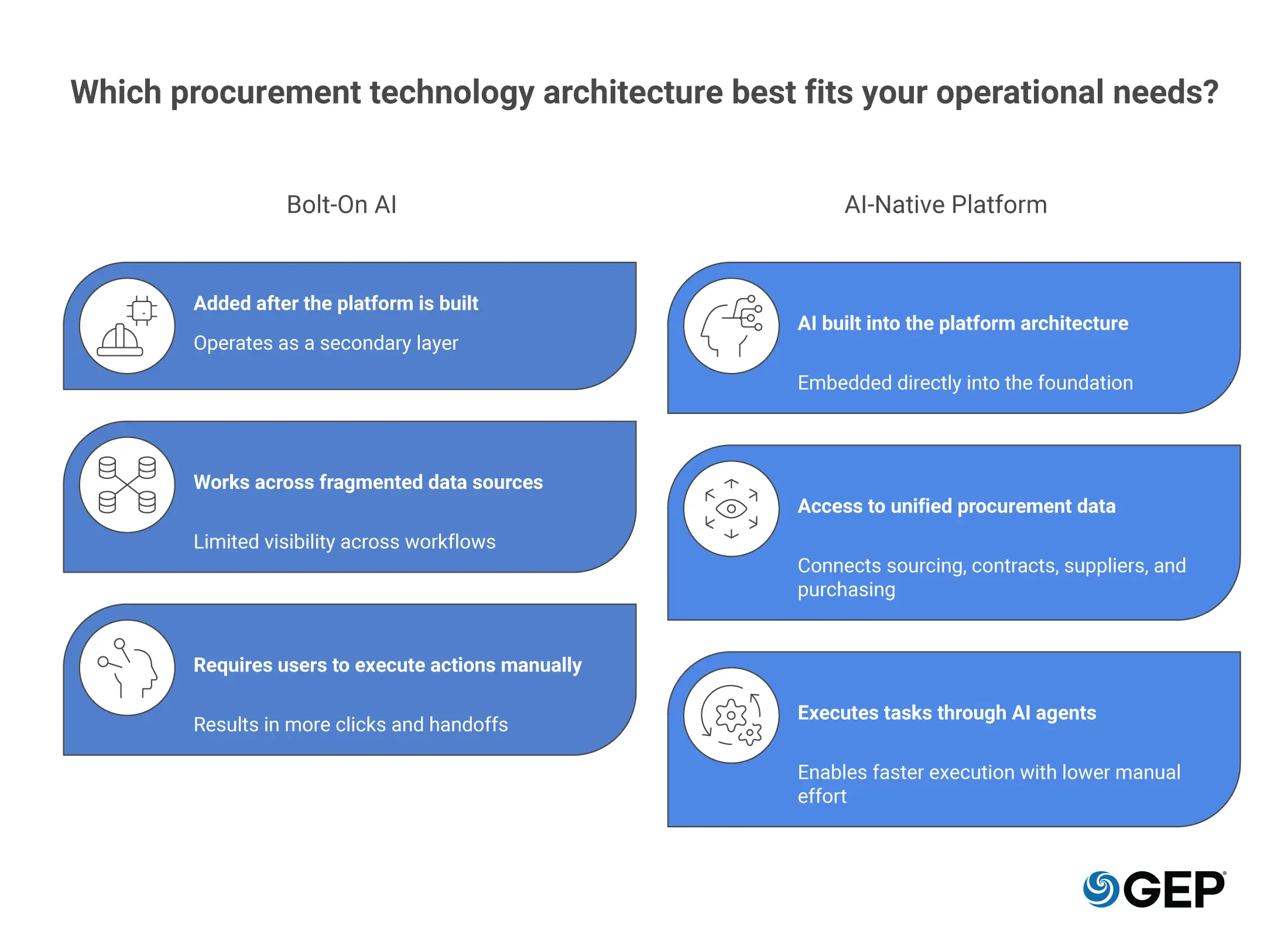
AI-native procurement platforms integrate intelligence right into the foundation of applications. Data structures, workflows, permissions, and automation capabilities are designed with AI in mind from the ground up.
Bolt-on AI takes a different approach. The software already exists. AI capabilities are added later, usually as an extra layer sitting on top of existing processes.
For procurement, this architectural difference carries practical consequences.
Data Fragmentation Limits AI Performance
Data is often the first challenge.
Most procurement organizations operate across multiple systems. Supplier information may reside in one application. Contract data may sit elsewhere. Spend data often comes from several sources.
When AI is added later on, it frequently struggles to access and understand information across the disconnected environments.
The result is familiar. Teams receive summaries and recommendations that sound useful but lack the full context. Information still needs to be manually verified. Confidence in the output starts to erode.
AI-native platforms approach the problem differently. Since procurement data, workflows, and business rules already exist within the same environment, AI has direct access to the information needed to perform work.
Responses become more accurate because the underlying context is available.
That matters during sourcing events, supplier evaluations, contract reviews, and risk assessments.
From Recommendations to Execution
Speed becomes another differentiator. Traditional AI assistants can help users find information. They answer questions and generate content. The user still carries responsibility for executing the next step. Agentic AI changes that model.
Instead of stopping at recommendations, AI agents can perform actions on behalf of procurement teams within predefined guardrails. An agent can identify potential suppliers, gather supporting information, draft communications, launch sourcing events, flag compliance issues, and route approvals.
Work moves forward without constant intervention. Although the distinction may seem subtle, it changes how procurement operates.
Routine work becomes automated. Human attention shifts toward strategic decisions.
Why Visibility Matters Across Procurement Workflows
Many procurement teams struggle with fragmented processes. Intake requests, sourcing activities, contracts, supplier performance, and payments often sit in separate systems.
Information gets lost during handoffs. Stakeholders spend time chasing updates instead of making decisions.
AI-native platforms create a connected operating environment where activities remain linked across the source-to-pay process. When AI agents operate inside that environment, they can understand dependencies and take action based on broader business context.
That capability becomes increasingly important as organizations manage larger supplier networks and more complex compliance requirements.
Faster Responses Reduce Procurement Risk
Bolt-on AI can identify potential concerns if users know where to look. AI-native systems continuously monitor relevant data and proactively alert teams when conditions change. Some can trigger workflows automatically based on predefined policies.
The difference is not simply better reporting. It is faster response.
Organizations facing supplier disruptions rarely struggle because information is unavailable. More often, they struggle because action comes too late.
The gap between awareness and execution remains one of procurement's biggest challenges. AI-native procurement software helps close that gap.
Lead with Agentic AI
Drive smarter procurement & resilient supply chains with enterprise-proven technology
Why Platform Architecture Matters
Industry research increasingly points in this direction. Organizations moving beyond isolated AI experiments are now focused on platforms that combine unified data, embedded intelligence, and workflow automation rather than standalone AI tools.
Procurement leaders want measurable outcomes such as shorter cycle times, better compliance, stronger supplier performance, and faster decision-making.
AI delivers those outcomes only when it can operate inside the processes where work actually happens. That is why platform architecture matters.
Procurement teams should look beyond demonstrations of chat interfaces and content generation. Those capabilities are becoming common across the market.
The more important question is whether AI can understand procurement data, follow procurement rules, and execute procurement work.
If the answer is no, teams may end up with another tool that generates insights but leaves execution unchanged.
Conclusion: Turning Procurement Strategy Into Action
AI agents embedded within procurement software can coordinate sourcing, contracts, supplier management, intake, and purchasing activities as part of a connected workflow. They reduce administrative effort, surface risks earlier, and help teams respond faster when conditions change.
Procurement has never lacked information. Execution has always been the harder problem.
AI-native procurement platforms address that problem by combining data, workflows, and agentic AI in one environment. As adoption accelerates, the organizations that benefit most will be those that move beyond AI as an assistant and begin using AI as an active participant in procurement operations.
That shift will define the next stage of procurement technology.


FAQ's
AI-native platforms embed AI into core workflows and data structures, while bolt-on AI adds capabilities to existing systems, quite often limiting context and execution.
Agentic AI can execute tasks such as supplier evaluation, sourcing event creation, risk monitoring, and approval routing instead of only generating recommendations, thus augmenting procurement operations.
Procurement AI performs best when it has access to unified procurement, supplier, contract, and spend data, enabling highly accurate decisions and faster execution.