
Five Capabilities That Define the AI-Ready Procurement Team
- AI is restructuring procurement at two levels simultaneously: automating how work gets done and transforming the nature of what procurement must evaluate and govern.
- Five capabilities now separate AI-ready procurement teams from those still managing yesterday's operating model.
- CPOs who treat upskilling as a side initiative will find their teams outpaced; those who make it a transformation priority will define what strategic procurement looks like in the years ahead.
August 13, 2026 | Procurement Software 4 minutes read
Most conversations about AI in procurement focus on what AI will do. The more urgent question is what your team needs to do and become.
AI is not arriving as a new software feature to be toggled on. It is restructuring the procurement operating model at two levels at once. It is changing how procurement work gets executed, and it is changing the nature of what procurement must evaluate, negotiate and govern. Suppliers across every category are embedding AI into their products and services, which means procurement professionals are increasingly buying AI-enabled outcomes rather than discrete goods. That shift requires a different kind of expertise than most teams currently possess.
The gap between AI-ready and AI-vulnerable teams is widening quickly. Here is what it takes to land on the right side of it.
Is Your Procurement Team Built for the AI Era?
Explore the five capabilities procurement teams need to compete in an AI-driven market
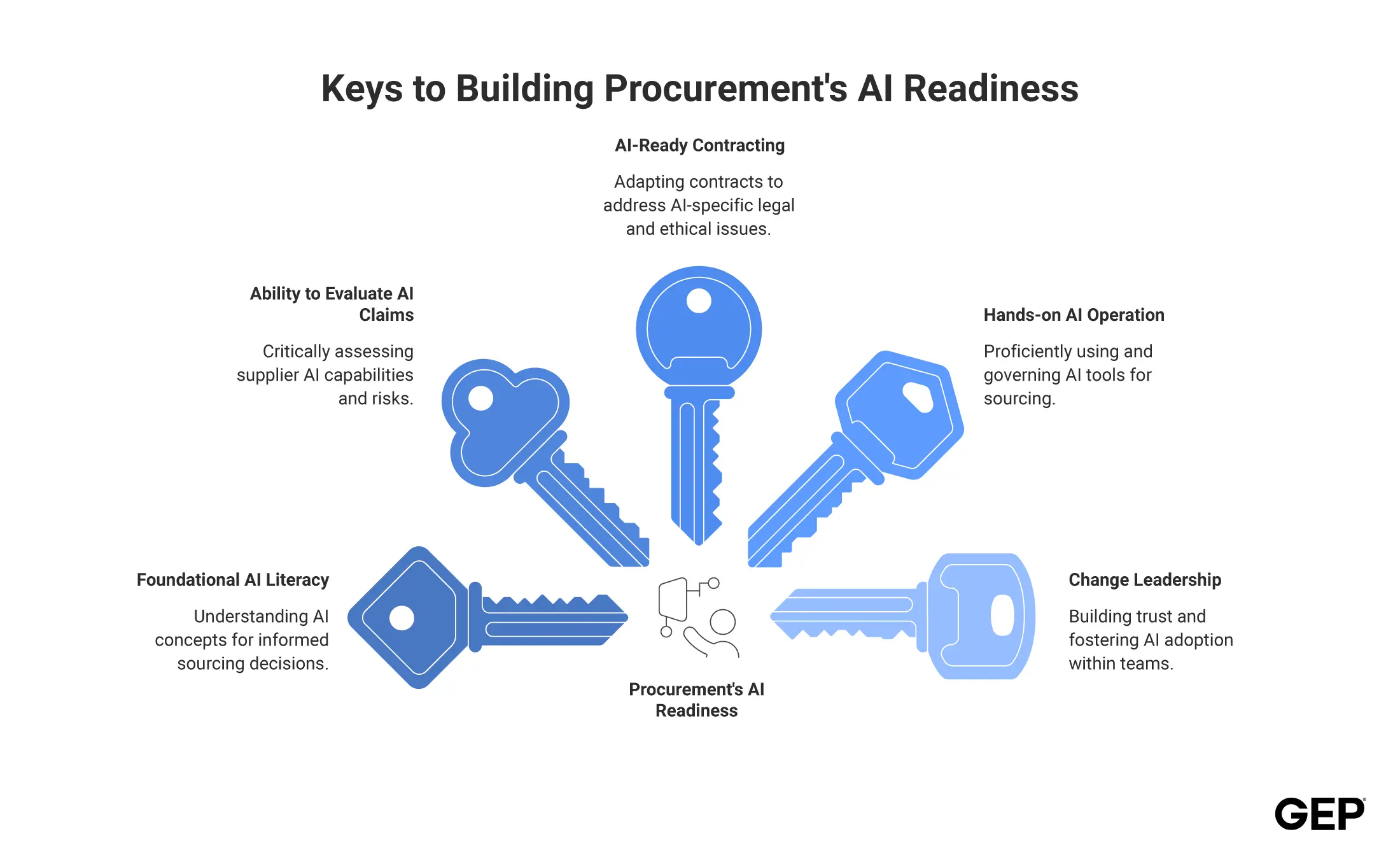
1. Foundational AI literacy
Procurement professionals do not need to become data scientists. But they do need to understand how AI works in practice: where it performs reliably, where it hallucinates, where human judgment remains irreplaceable. Concepts like large language models, probabilistic outputs and training data biases are no longer the province of the IT department. They are baseline knowledge for anyone making sourcing decisions in an AI-driven market.
2. The ability to evaluate supplier AI claims
Vendor AI claims are proliferating faster than the tools to assess them. Procurement teams now need to ask sharper questions: What data was the model trained on? How is customer data protected? Can outputs be audited and explained? How are exceptions handled? These are not IT concerns; they are commercial and risk management concerns that belong squarely in category management. Teams that cannot credibly interrogate these claims will be at a structural disadvantage in every supplier negotiation.
Equally important is understanding how AI reshapes commercial models. Consumption-based pricing, token-driven cost structures and variable usage economics require procurement fluency that most teams have not yet built.
3. AI-ready contracting
Traditional contract structures were not designed for AI-enabled services. Data ownership, intellectual property rights, audit access, model transparency, approved uses of customer data and liability for AI-driven errors are now live contracting issues. Procurement cannot wait for legal to catch up organically. Teams need updated playbooks and template language for AI-enabled categories developed through close collaboration among procurement, legal and information security.
4. Hands-on AI operation and governance
Using AI tools and governing them are not the same skill. Procurement teams need proficiency in effective prompting, agent design, workflow orchestration and output validation. But they also need to test for hallucinations, understand system constraints and maintain accountable human control. In an agentic environment, where AI agents execute significant portions of sourcing events autonomously, the professionals who add the most value will be those who can guide, supervise and continuously improve machine-supported workflows rather than just operate them.
5. Change leadership and trust engineering
This may be the most consequential capability of all. AI adoption stalls not because the technology fails but because teams do not trust outputs they cannot interrogate. Procurement leaders must build trust deliberately through transparent processes, clear escalation paths, honest dialogue about career implications and a culture that encourages experimentation without normalizing recklessness. Trust is not incidental to adoption. It is a capability that must be built and actively sustained.
What CPOs Must Do Now
Training matters but it is not enough. A seminar or a video library will not build an AI-ready procurement function. Three moves separate leaders from laggards.
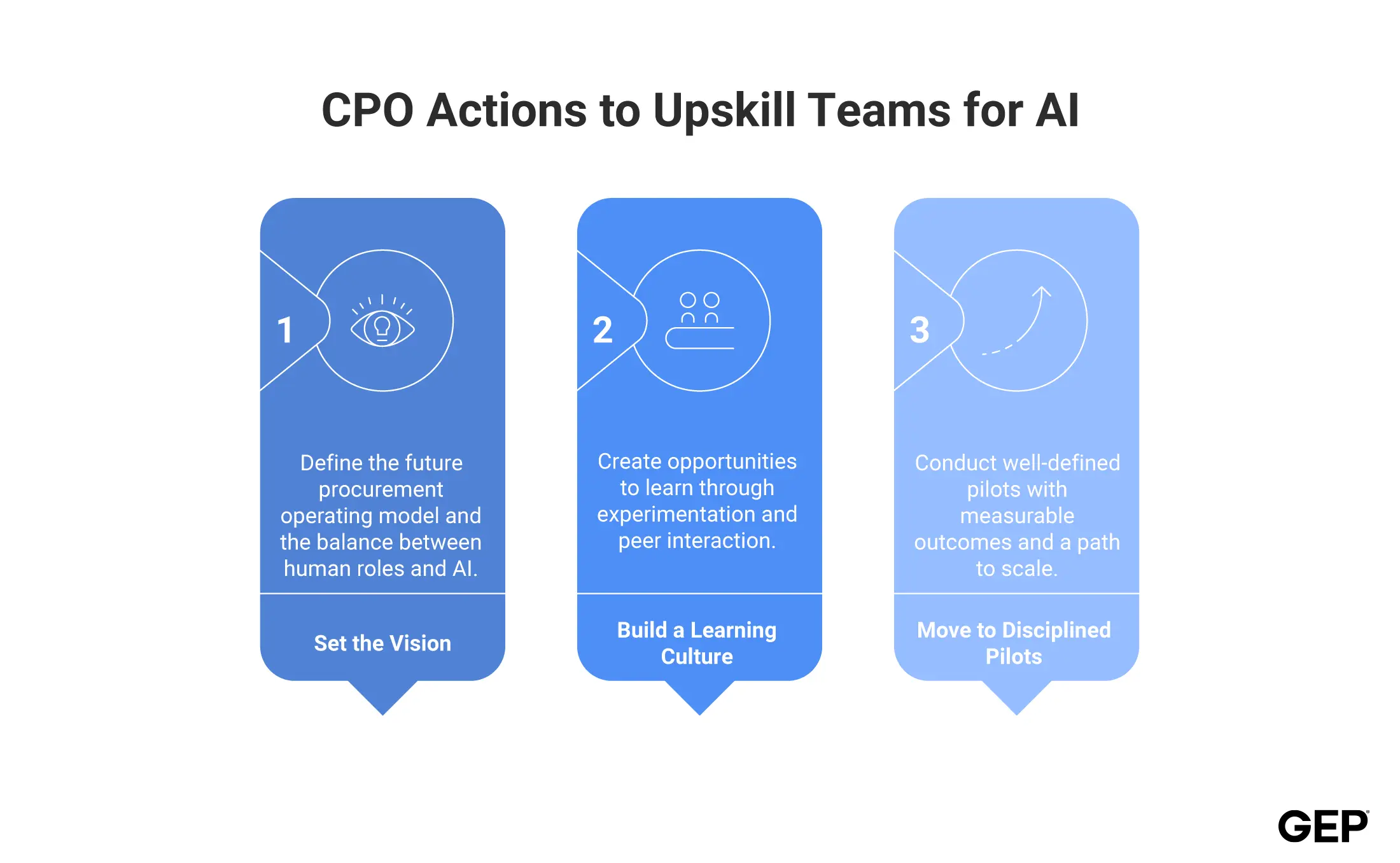
First, set the vision. CPOs must define what the future procurement operating model looks like, including how the balance between human roles and AI-supported workflows will evolve. Without that clarity, upskilling efforts lack direction and organizational buy-in.
Second, build a learning-while-doing culture. Real capability is built through use, not observation. Teams need access to tools, sandboxes and peer-learning forums where experimentation happens under controlled conditions. The goal is structured practice, not passive instruction.
Third, move from experimentation to disciplined pilots. The next phase requires well-defined objectives, clearly mapped responsibilities, measurable outcomes and a credible path to scale. Senior leadership increasingly expects a business case. Procurement must develop the discipline to test rigorously, learn fast and scale what works.
The Bigger Picture: Re-Architecting Procurement Around Value
AI will reduce transactional work and compress some lower-level roles. But the larger story is not displacement; it is re-architecture. As routine tasks migrate to intelligent automation, procurement's contribution shifts toward stakeholder influence, supply-market innovation, resiliency design and enterprise value creation. That is a more strategic mandate than the function has traditionally held.
The transition will not be immediate or frictionless. Tools are still maturing, adoption curves are steep and large-scale change takes time. But organizations that start building AI capability now will be far better positioned to capture the upside when the technology matures. The window for proactive investment is open, but it will not stay open indefinitely.
The question was never whether AI would change procurement. It already has. Will procurement leaders treat upskilling as a side initiative or as the core transformation agenda that determines how strategic, influential and valuable the function becomes in the years ahead?
For a deeper look at how AI is reshaping procurement talent and operating models, read the full bulletin: The AI-Ready Procurement Team: Upskilling for the Next Era of Value Creation.