


How to Manage AI Tokens in Procurement: A Framework for the Agentic Era
- Agentic AI's non-linear consumption is exposing procurement budgets to unpredictable swings that traditional software licensing was never built to handle.
- Copilots and autonomous agents burn tokens at wildly different rates, and treating them the same in a budget model guarantees a shortfall.
- Winning organizations are building FinOps discipline and consumption-based contract guardrails before scaling agentic deployments, not after the invoice arrives.
August 26, 2026 | Procurement Software 5 minutes read
Procurement teams spent the last two years mastering software licensing: per-seat pricing, tiered subscriptions, predictable renewals. Then agentic AI arrived, and the rules changed overnight.
AI tokens are quietly becoming one of the most volatile line items in the enterprise budget. Unlike a software seat, a token doesn't come with a fixed monthly cost. It scales with usage, and usage under agentic AI can multiply without warning, leaving procurement to negotiate and defend a spend category it doesn't yet fully understand.
What Are AI Tokens in Procurement?
A token is the basic unit an AI model reads and writes. Roughly speaking, one token equals about four characters of text, so a paragraph of instructions to an AI system can run several hundred tokens before the system even starts working.
In procurement, tokens power everything from a copilot that drafts a supplier email to an autonomous agent that runs a full three-way match across an ERP system. Every prompt, every retrieved document and every step an agent takes to reason through a task consumes tokens, and every token has a price that varies enormously depending on which model is doing the work.
Still Running Procurement on Predefined Rules?
See how agentic AI moves procurement from rigid automation to adaptive orchestration
Why Addressing the Growing AI Token Consumption Issue Is Important
The scale of this shift is hard to overstate. Gartner forecasts AI agent software spending will reach $206.5 billion in 2026, up from $86.4 billion in 2025, and climbing to $376.3 billion in 2027.
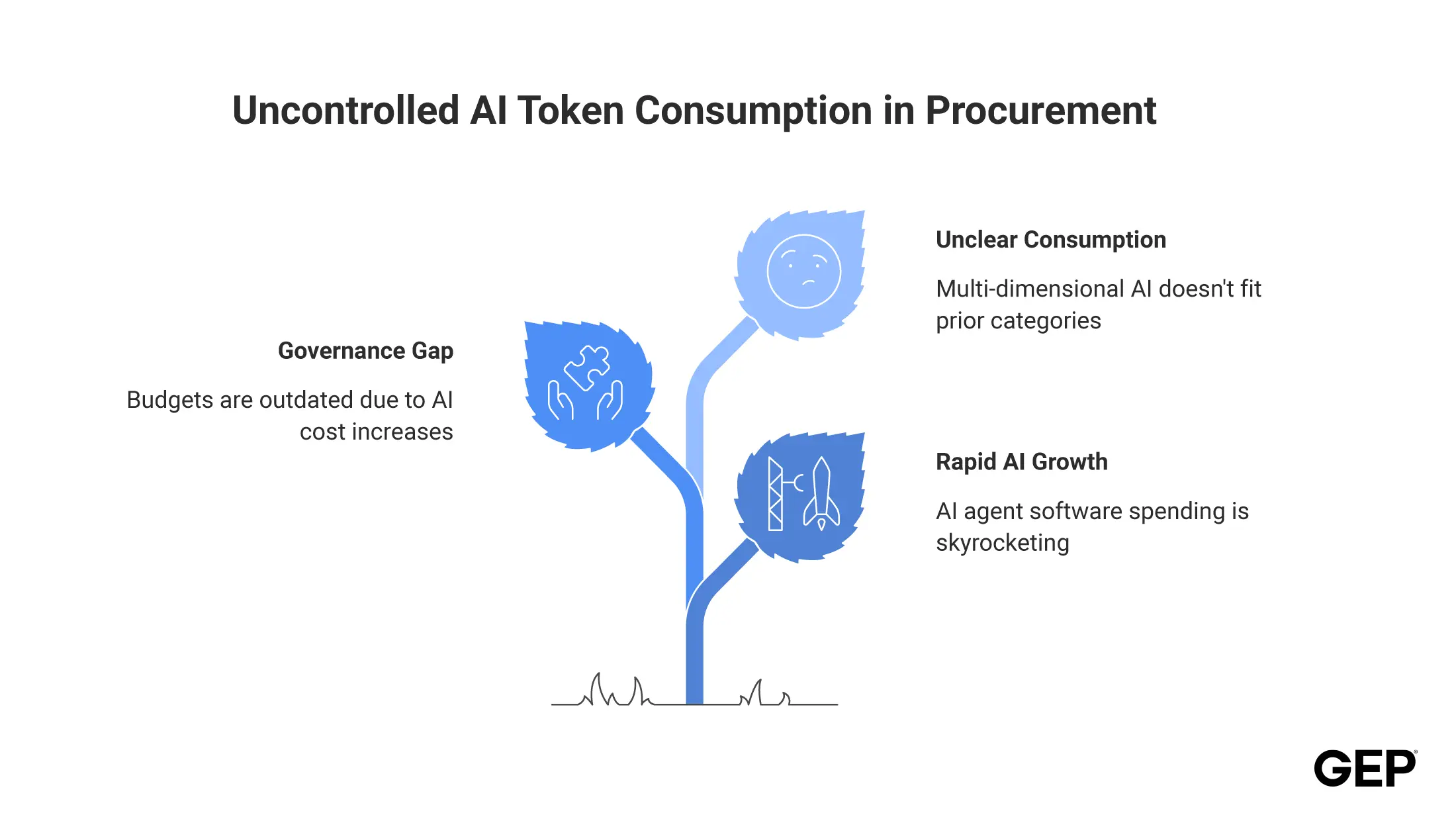
For procurement, this growth curve creates a governance gap. Budgets built on last year's assumptions about AI cost will be wrong by the time this year's invoices arrive. Multi-dimensional intelligence, systems that plan, reason and act across multiple steps, consumes tokens in ways that don't map cleanly to any prior software category. Ignoring the issue doesn't make it smaller. It just moves the reckoning from the negotiating table to the finance team's inbox.Also Read: Turning Data Into Actionable Intelligence With AI-Driven Spend Analytics
Why Traditional Software SaaS Licensing Fails With Token Economics
Traditional SaaS licensing was built around a simple assumption: cost scales with headcount. Add a user, add a seat fee. That model made forecasting easy and made vendor negotiations predictable.
Token-based pricing breaks that assumption. Two employees on the same seat license can generate wildly different bills depending on how they use the tool. One might ask a copilot a few questions a day. Another might kick off an autonomous agent that loops through dozens of reasoning steps to complete a single task.
Gartner puts a number on how disruptive this shift is. The firm estimates up to $234 billion of enterprise application software spending is at risk from what it calls agentic arbitrage by 2030, roughly 20% of enterprise SaaS spend. Agentic AI isn't just changing how software gets used. It's changing how software gets priced, and procurement teams still negotiating seat-based contracts are negotiating against a model that's already becoming outdated.
Token Dynamics of Copilots vs. Autonomous Agents
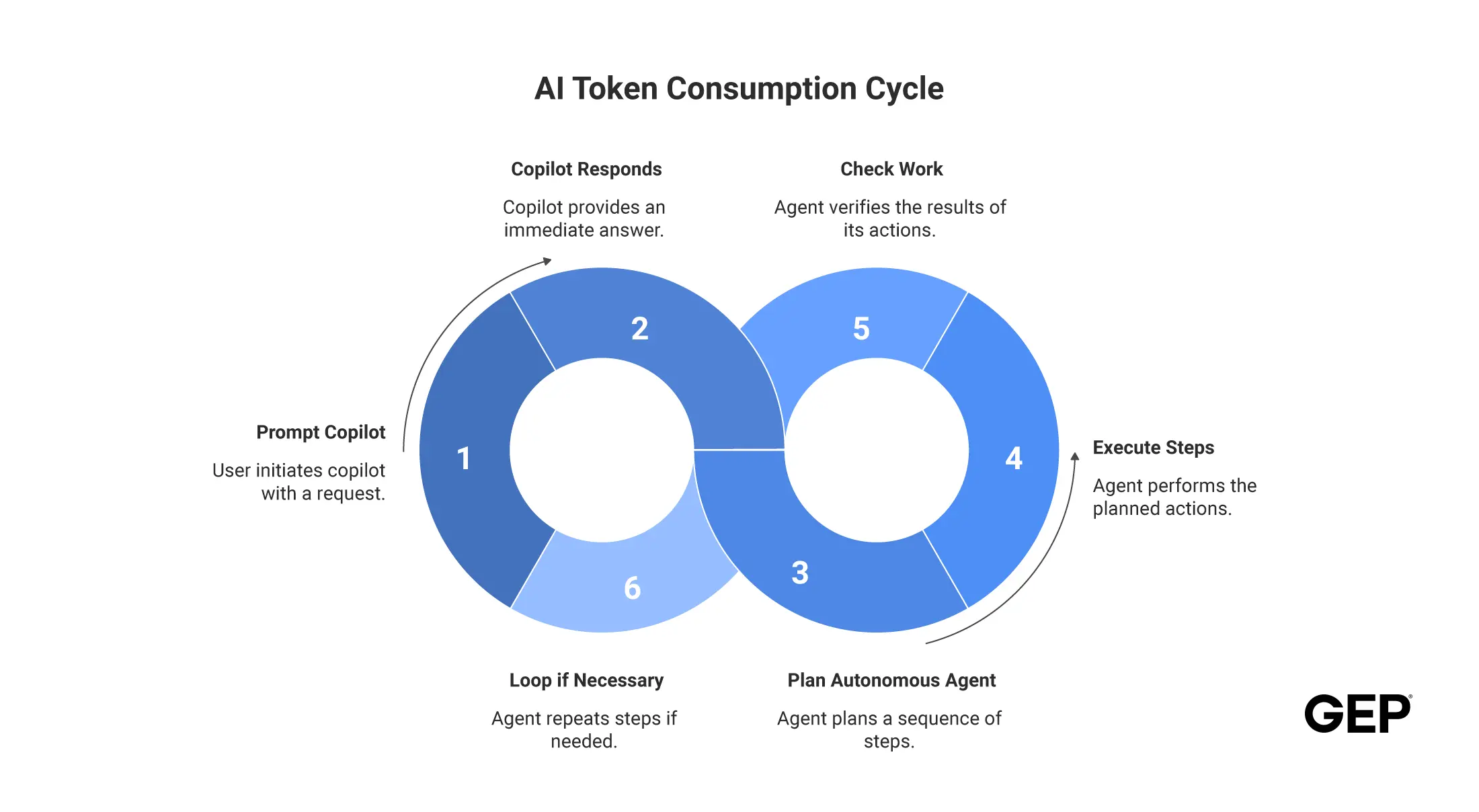
Not all AI consumption is created equal, and the gap between a copilot and an autonomous agent is where most budget surprises start. A copilot responds when prompted. An autonomous agent plans a sequence of steps, executes them, checks its own work and often loops back to try again, and that looping can drive consumption higher by an order of magnitude for a single completed task.
Uber's experience with AI coding tools is a useful, if painful, illustration. The company burned through its entire 2026 AI budget in four months after rolling out an AI coding assistant across its engineering organization. Monthly per-engineer costs ranged from $500 to $2,000 as adoption jumped from 32% to 84% of engineers in a matter of weeks. Procurement teams evaluating AI-powered platforms should ask vendors directly how pricing behaves as usage shifts from copilot prompts to autonomous, end-to-end execution.
Ready to Get Ahead of Your AI Spend?
See how leading procurement teams are building visibility and control into agentic AI deployments.
Establishing a FinOps Framework for Total Token Visibility
The organizations avoiding budget surprises treat AI spend with the same discipline finance teams apply to cloud computing: real-time visibility into consumption, not a monthly invoice that arrives after the fact.
A working FinOps framework starts with metering. Procurement and finance need to see which teams, workflows and models are driving consumption, broken down at a level granular enough to act on. From there, model routing becomes a lever. Not every task needs a frontier model. Classification, extraction and routine document processing can often run on lower-cost models without sacrificing accuracy, while complex reasoning tasks justify the premium.
Guardrails for Negotiating Consumption-Based AI Vendor Contracts
Once visibility exists, procurement's job shifts to building contracts that protect the business from runaway consumption. Spending caps and usage alerts should be non-negotiable contract terms, not optional dashboard features. Vendors should be required to expose token-level usage data, not just a total bill, so procurement can audit where consumption is actually happening.
Procurement should also negotiate the right to adjust model tiers mid-contract as workloads evolve. Locking into a single model tier for the life of a contract locks in today's cost structure for tomorrow's usage patterns. The goal isn't to slow AI adoption. It's to make sure the organization scales AI spend on purpose rather than by accident.Explore GEP’s – AI Native Procurement Software
Conclusion
AI tokens are not a footnote in the procurement budget anymore. They are one of the fastest growing, least predictable cost categories most organizations have ever managed, and the tools built for seat-based software licensing were never designed to handle them.
The organizations getting ahead of this are building FinOps visibility, negotiating consumption-based guardrails and treating token economics as a core procurement competency rather than an IT afterthought. The rest will keep discovering their AI budget the way Uber did, after it's already gone.




Frequently Asked Questions
Start with visibility. Meter consumption by team, workflow and model before trying to cut costs. Once procurement can see where tokens are actually being spent, routing routine tasks to lower-cost models and reserving frontier models for complex reasoning typically delivers the biggest savings without hurting output quality.
Treat agentic deployments differently from copilots at the contracting stage. Autonomous agents loop through multiple steps to complete a task, which multiplies token consumption compared to a single prompt and response. Negotiate spending caps, usage alerts and the ability to adjust model tiers before scaling an agentic deployment, not after it's already in production.
Cutting AI usage across the board usually cuts value along with cost. The better approach is matching model capability to task complexity, so routine work runs on efficient models while complex, high-value tasks retain access to premium reasoning. Paired with real-time spend visibility, this lets organizations control cost without slowing adoption where it delivers the most return.