


How Autonomous Invoice Exchange Transforms Finance Operations
- Autonomous invoice sending and receiving remove the manual handoffs that slow payment cycles and inflate processing costs.
- AI-native validation at the point of entry reduces invoice exceptions before they reach approval queues.
- Real-time invoice tracking gives finance and procurement leaders the visibility needed to make faster, more precise working capital decisions.
July 16, 2026 | supplier sentiment analysis 8 minutes read
In most of the finance teams, there is a shared inbox no one wants to own. It collects supplier invoices in every format imaginable: PDFs, scanned images, the occasional spreadsheet, and occasionally a plain-text email with line items pasted in. A team member opens each one, reads it, and enters the data into the ERP. Volumes spike, and the queue backs up. A field goes missing, or a PO number doesn't match, and the invoice stalls in the queue.
This is not a niche problem. It is a daily operational reality for a significant share of global enterprises, including ones that consider themselves digitally mature.
The gap between receiving an invoice electronically and processing it autonomously is wider than most finance leaders acknowledge. Closing that gap is what autonomous invoice sending and receiving is designed to do.
How Automated Invoice Sending Reduces Delays and Improves Payment Cycles
The efficiency gap in invoice processing is rarely a people problem. It is an architecture problem.
When invoices arrive as PDFs or scanned images, a system cannot read them without human translation. Someone interprets the document, extracts the values, and enters them into an ERP. That step alone introduces transcription errors, delays, and a processing cost that scales directly with volume. Add supplier diversity, multi-currency transactions, cross-border regulatory requirements, and complexity compounds quickly.
Automated invoice exchange removes that translation layer. Suppliers transmit invoices in structured, machine-readable formats. The buyer's system receives data, not a document. Validation runs immediately. Matching happens at entry. The invoice either clears or routes to the right person with a specific reason attached.
For organizations processing thousands of invoices monthly, the efficiency impact is significant. Processing time per invoice drops. Exception rates fall. Accounts payable teams spend less time on transaction handling and more time on supplier relationships, dispute resolution, and process improvement.
Beyond the PDF: Redefining True E-Invoicing Efficiency
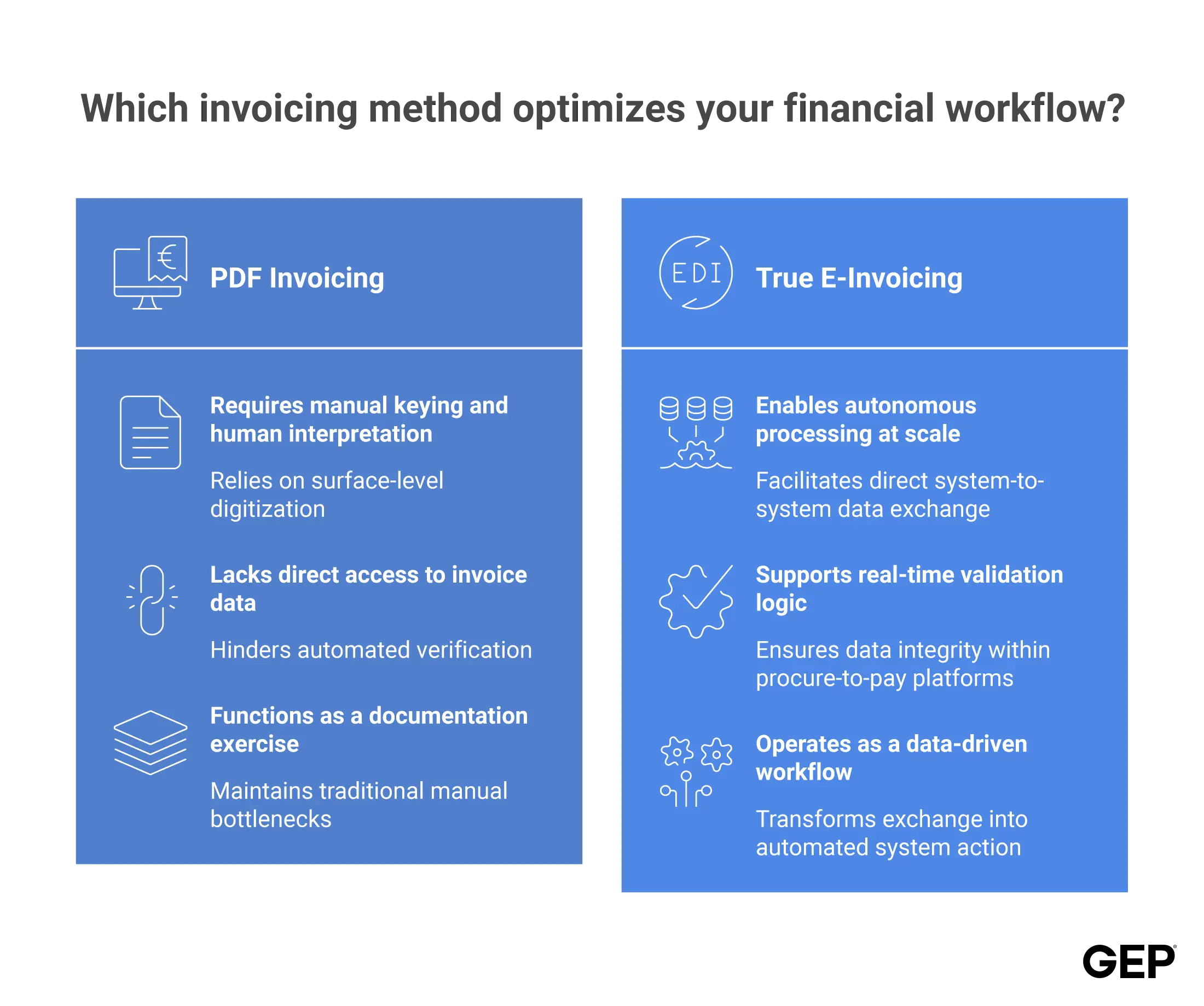
Receiving a PDF by email is not e-invoicing. It is an email with an attachment.
True e-invoicing is structured data transmission: invoice information exchanged in a format that a system can parse, validate, and act on without human interpretation. The distinction matters because many organizations believe they have modernized their invoicing process when they have only digitized its surface.
A PDF still requires keying. A scanned image still requires interpretation. Neither gives the receiving system direct access to invoice data. Neither enables real-time validation. Neither supports autonomous processing at scale.
The shift to e-invoicing requires suppliers to transmit in standardized electronic formats, often through a connected network or portal, and buyers to have validation logic embedded in their procure-to-pay platform. When both sides of that exchange are structured, the invoice process stops being a documentation exercise and starts functioning as a data-driven workflow.
The Shift Toward Automated Invoice Exchange in Modern Finance Operations
Multiple pressures confront finance operations. Regulatory environments in several major markets now mandate structured electronic invoicing for tax compliance. Supplier bases are growing more complex. CFOs are asking for tighter working capital management with less headcount growth.
Automated invoice exchange sits at the intersection of all three. It supports compliance by generating structured, auditable transaction records. It accommodates supplier complexity by standardizing the format at the point of transmission rather than the point of receipt. It gives finance leadership the real-time data infrastructure that working capital decisions require.
The shift is also supplier-side. Suppliers connected to an automated network submit invoices that meet the buyer's format and validation requirements by default. There is no reformatting, no duplicate entry into a buyer portal, and no ambiguity about whether the invoice has been received. Both sides of the transaction gain clarity.
Is Your AP Automation Strategy Missing a Critical Piece?
Learn the three essentials that determine whether AP automation delivers real value or just adds complexity
How Automated Invoice Sending Reduces Delays and Improves Payment Cycles
Delays in invoice processing almost always trace back to the same sequence: late matching, missing information, and approval routing that was never designed for the volume it now handles.
Automated invoice mailing addresses each of those. When a supplier submits a structured invoice, required fields are validated before the invoice enters the buyer's system. A missing PO reference, a quantity outside tolerance, or a price that does not align with the contract is flagged at entry. The invoice does not proceed until the issue is resolved. That single change moves exception handling from the back of the process to the front.
Approval routing becomes rule-based. Invoices above a threshold go to one approver. Invoices associated with a specific cost center are routed to a different approver. Compliant invoices below a threshold clear automatically. The queue that once required daily human management runs on logic instead.
Payment cycles are shortened, consequently. When invoices are validated in hours rather than days, the time between receipt and payment authorization compresses. For suppliers, that predictability changes how they manage their own cash flow. For buyers, it creates the conditions for early payment programs and dynamic discounting that would be operationally unworkable under manual processing.
Enhancing Invoice Receiving Accuracy Through Intelligent Data Capture and Validation
Accuracy in invoice receiving is not just about catching errors. It is about catching them at the right moment.
In manual processing environments, a three-way match between a purchase order, a goods receipt, and a supplier invoice often happens after the invoice has already moved through approval. Errors surface late. Reversing them takes longer than catching them at entry would have.
AI-native validation changes that sequence. When an invoice arrives in a structured format, the system checks it immediately against the relevant purchase order, goods receipt record, and contract terms. Before any approval step begins, the system identifies quantity variances, price discrepancies, and duplicate invoice references. Clean invoices are clear. Invoices with issues are routed to the appropriate person, with the specific discrepancy documented.
The practical outcome is fewer exceptions reaching the accounts payable team, and the exceptions that do arrive come with context. A reviewer does not need to reconstruct what went wrong. The system has already identified it.
Real-Time Invoice Tracking and Workflow Automation for End-to-End Visibility
One shift that organizations underestimate until they experience it is the impact of real-time invoice status visibility on operational decision-making.
In a manual environment, finance teams know what has been paid. They have limited visibility into the invoices that are staged, in approval, or disputed. Working capital decisions rely on reports generated the previous day or the previous week.
With automated invoice workflows, every invoice has a live status. Finance can see exactly which invoices have cleared validation, which are in approval, which are flagged for resolution, and which are queued for payment in the current cycle. Procurement can confirm a supplier's invoice is progressing. Suppliers can check a portal for payment status rather than emailing a contact who may or may not respond promptly.
That shared, real-time view is also what makes dynamic discounting operationally viable. When a finance team knows precisely which invoices are approved and payable, it can offer early payment selectively, on terms that reflect the specific invoice and the supplier relationship. The return on that cash deployment would not be accessible without the visibility that automated processing provides.
The Strategic CFO Dividend: Quantifying the Financial Return
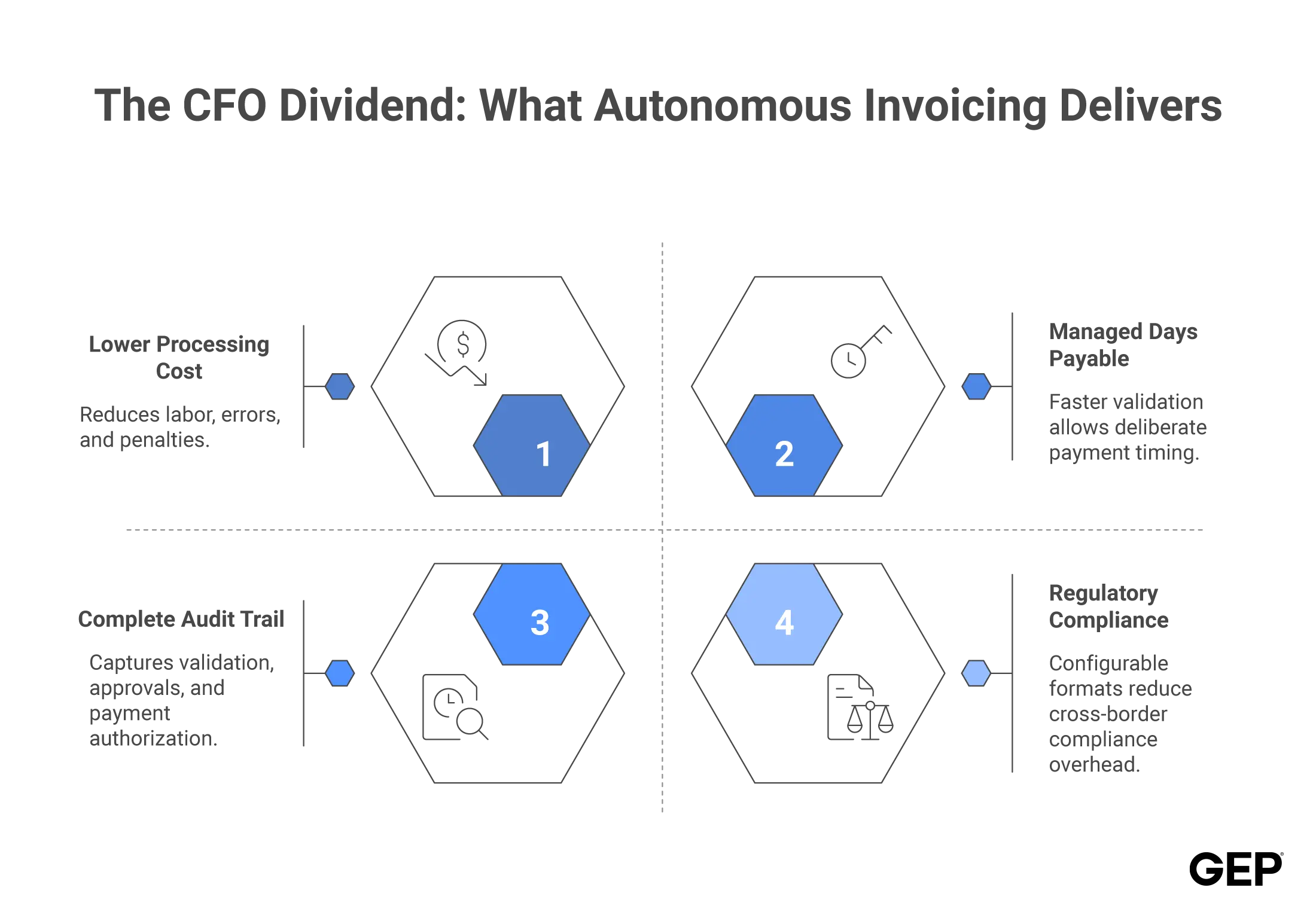
The financial case for autonomous invoicing holds across most enterprise contexts, though the magnitude varies by starting baseline.
Processing cost per invoice falls when manual handling is removed from compliant transactions. The reduction depends on current labor intensity, exception rates, and the share of invoices arriving in non-standard formats. For most enterprises, the savings show up in three places: fewer staff hours on transaction handling, lower error correction costs, and reduced late payment penalties.
Days payable outstanding shifts from a byproduct of processing speed to a managed variable. When invoices are validated and approved in hours rather than days, payment timing becomes a deliberate choice rather than whatever the processing queue allows.
Audit exposure reduces as a byproduct. Autonomous processing generates a complete, time-stamped record of every invoice's path through the system: validation results, approval steps, exception notes, and payment authorization. That record exists in the system of records without manual documentation.
For finance leaders managing operations across multiple jurisdictions, structured e-invoicing also supports regulatory compliance in markets where electronic invoicing mandates apply. Format requirements can be configured by supplier country or transaction type, reducing the compliance overhead that cross-border procurement creates.
Ready to Automate Your Invoice Process?
Talk to a GEP expert and find out where automation will have the fastest impact on your payment cycles
What Finance and Procurement Leaders Should Do Next
The starting point is a breakdown analysis, not a technology selection.
Where do invoices stall in your current process? Do invoices stall at entry due to inconsistent supplier formats? Is the matching process stalled due to incomplete purchase order data? In the approval routing process, issues arise because thresholds and rules were never clearly defined. In payment execution, are treasury and accounts payable working with different data?
Each failure point has a specific fix. Those fixes compound when addressed together, but implementing automation without first mapping where the process breaks tends to produce a faster version of the same broken workflow.
Autonomous invoice sending and receiving, implemented with the right foundation, changes the relationship between finance operations and supplier performance. Payment becomes predictable. Cash position becomes transparent. The accounts payable team focuses on decisions, not transactions.
Explore GEP’s AI E-Invoicing Software




BLOG CATEGORIES
FAQs
What technologies enable automated invoicing?
Structured data exchange formats, AI-native validation engines, and workflow automation platforms work in combination. The transmission layer typically involves a supplier portal or connected invoice network. Validation logic sits within the procure-to-pay platform and runs checks against purchase order, contract, and goods receipt data at the point of entry before any approval step begins.
Does automated invoicing help meet compliance requirements?
In several ways. Structured invoicing creates a complete audit trail, capturing approval history and validation outcomes in the system of record. Configurable format rules meet jurisdiction-specific requirements in markets where electronic invoicing mandates apply. Duplicate payment controls and authorization logic are embedded in the workflow rather than dependent on individual human checks.
How does automated invoice sending and receiving reduce errors?
Errors are caught before they travel downstream. Validation runs the moment a structured invoice arrives, checking every field against purchase order terms, agreed pricing, and goods receipt quantities. A mismatch triggers an exception with the specific discrepancy already documented. A clean invoice clears automatically. The key difference from manual processing is timing: problems surface at entry, not midway through an approval chain.