



Building Your First Procurement AI Agent: A Blueprint for Beginners
- A procurement AI agent is defined by autonomy, not conversation. It perceives, reasons and acts inside a workflow instead of waiting for a prompt.
- Intake triage is the ideal first pilot because it is high volume, low risk and has a clear, measurable outcome.
- The Model Context Protocol gives beginners a standardized way to connect an agent to real procurement tools without custom code for every system.
August 26, 2026 | Procurement Software 5 minutes read
Most procurement teams already have a chatbot. Far fewer have an agent. The difference matters; it is the difference between a tool that answers questions and a system that actually gets work done.
A procurement AI agent does not wait for you to ask it something. It reasons through the steps needed to complete it, takes action inside your systems and learns from the outcome. That’s a fundamentally different capability than a chat window bolted onto a knowledge base, and it’s why so many procurement leaders are now asking “how do we actually build one?”
This blueprint walks through that first build, from defining what an agent is, to scoping a pilot, to the protocol that connects your agent to real tools, to the guardrails that keep a beginner project safe in production.
From Chatbots to Agents: Defining the Autonomous Procurement Loop
A chatbot is reactive. You type a question, it retrieves an answer, the interaction ends. Nothing changes in your systems and nothing happens without your next prompt.
An agent runs a loop. It perceives new information, such as an incoming request or a change in a data field. It reasons about what that information means against your policies and history. It acts by calling a tool, updating a record or drafting a document. Then it learns from the result and folds that learning into the next cycle.
Get the Playbook for Agentic AI
Move From Automation to Orchestration With This Essential Guide
Scoping Your Pilot: Why Intake Triage is the Ideal First Project
The biggest mistake beginners make is scoping too ambitiously. A first agent should not attempt to run full source-to-pay orchestration. It should solve one narrow, well-defined problem exceptionally well.
Intake triage is a great candidate for that problem. An intake triage agent needs to read each incoming request, classify it by category and urgency, check it against existing contracts or preferred suppliers and route it to the correct owner. The task is bounded, the volume is high enough to prove value quickly and the risk of a wrong call is low: a misrouted request gets caught and reassigned, not a disaster. That combination makes it the ideal training ground for your first build.
Using the Model Context Protocol (MCP) for Tool Access
An agent is only as useful as what it can touch, and this is where the Model Context Protocol, or MCP, matters for beginners specifically. MCP is an open standard for connecting AI agents to external tools and data sources without writing a custom integration for every single system.
Instead of building a bespoke connector between your agent and each application, you connect to an MCP server for that resource, and any MCP-compliant agent can use it. What started as a developer convenience has moved into standard production infrastructure, now supported across major AI platforms rather than tied to a single vendor.
Thus, a procurement team building its first agent is not stuck choosing one AI provider and rebuilding integrations if they switch later. The team can connect the intake system, supplier database and contract repository once, through MCP, and the agent gains tool access without a custom engineering project behind every connection.
Also Read: How MCP and Agentic AI Transform Procurement Efficiency
Step-by-Step Blueprint: Assembling and Prompting Your Agent
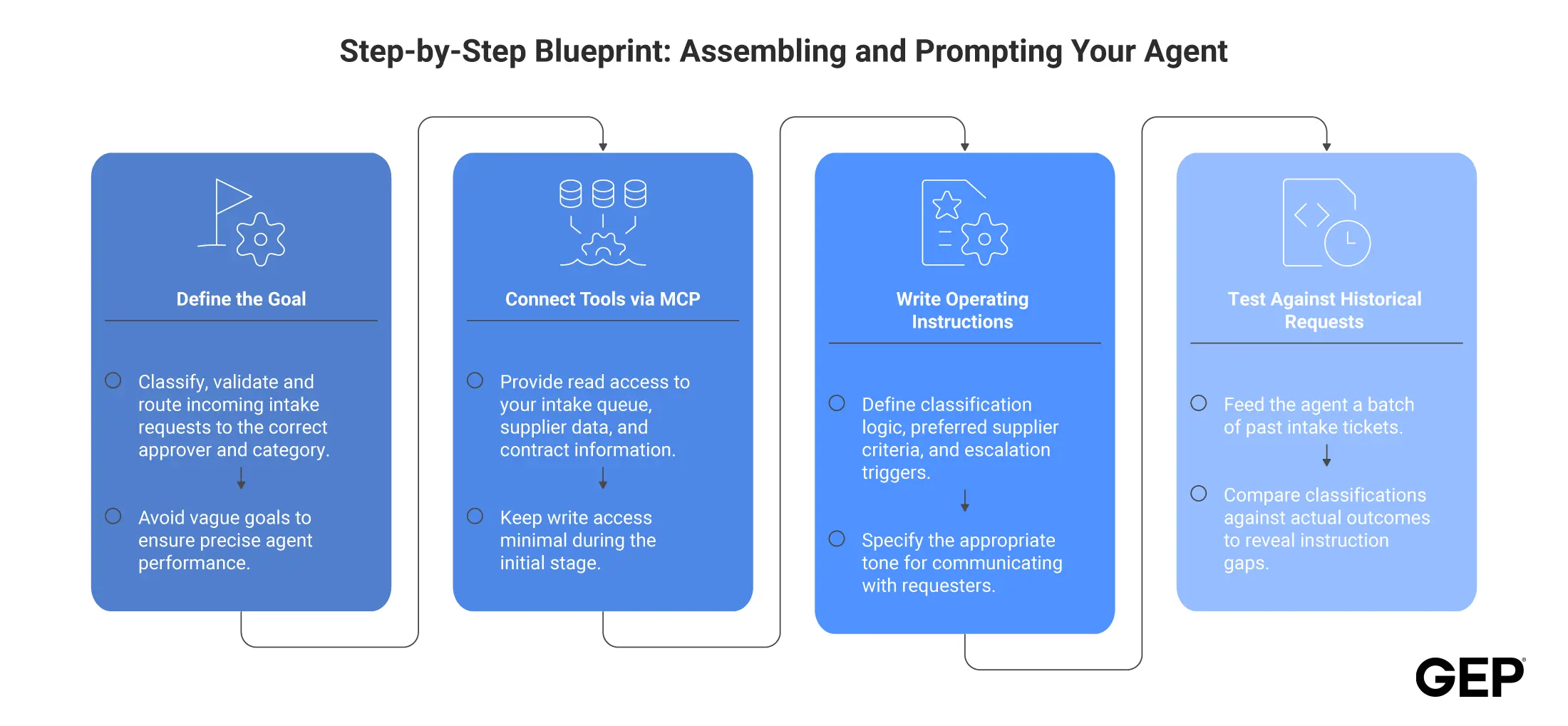
Start by defining the goal in plain language: classify, validate and route incoming intake requests to the correct approver and category. Vague goals produce vague agents.
Next, connect your tools through MCP, giving the agent read access to your intake queue, your supplier and contract data and your routing or ticketing system. Keep write access minimal at this stage.
Then write the agent's operating instructions. This is not a single clever prompt. It is a policy document: how to classify requests, what counts as a preferred supplier, when a request needs escalation and what tone to use when communicating with requesters.
Finally, test against historical requests before it touches a live queue. Feed the agent a batch of past intake tickets and compare its classifications against what actually happened. This reveals gaps in its instructions long before they become real routing errors.
Setting Up Human-in-the-Loop Guardrails
Autonomy without oversight is how pilots fail. Gartner recently found that applying identical governance to every AI agent, regardless of what it is actually allowed to do, is itself a common cause of enterprise agent failure. The firm predicts that by 2027, 40 percent of enterprises will demote or decommission autonomous agents because governance gaps only became visible after something already went wrong in production.
Gartner's recommendation is proportional governance based on autonomy level. A beginner intake agent should sit at a low tier: it can read data and recommend a routing decision, but a human needs to approve before anything is finalized. As confidence builds and the agent's track record proves out, you can extend its authority in stages, rather than granting full autonomy on day one.
Practically, this means defining up front which actions the agent can take unsupervised, such as classifying and drafting a routing recommendation, and which always require sign-off, such as approving spend above a threshold or overriding a preferred supplier list.
Log every decision the agent makes so you can audit its reasoning later. This is not bureaucracy; it’s what turns a promising pilot into a system your organization actually trusts.
Scaling Your Agent From Prototype to Production
The teams that succeed with agentic AI are not the ones who move fastest. They are the ones who scope narrowly, connect tools through open standards like MCP and build human oversight into the design from the first line of instructions rather than bolting it on after a mistake.
A procurement AI agent is not a distant capability reserved for teams with data science budgets. It is a scoped, well-governed pilot that most procurement teams can build this quarter, provided they start narrow and build trust before building autonomy.




Frequently Asked Questions
No. Modern agent-building platforms and standards like MCP are designed to minimize custom coding, letting procurement professionals define policies, connect existing tools and set instructions in plain language rather than writing integration code from scratch.
Ground the agent's reasoning in your live systems rather than static training data, connect it to current contract and supplier records through MCP, and require it to cite the source record behind any recommendation so humans can verify it before approval.
Through standardized connections such as MCP, which let an agent read and act on ERP, contract and supplier data through a common protocol instead of a custom integration built for every individual system.
Track classification or routing accuracy against historical outcomes, cycle time reduction on the target task, the volume of decisions that required human override, and whether audit logs show consistent, policy-aligned reasoning over time.