No More Handoff Failures: How End-to-End Process Orchestration Connects the Full Procurement Lifecycle
- Procurement doesn't lose value inside individual steps. It loses value in the gaps between them, where hand-offs fail, context disappears and fragmentation compounds across the lifecycle.
- The second dimension of Total Agentic Orchestration connects every process from requisition to payment into one intelligent engine, closing the gaps that point solutions have never been able to fix.
- When Dimension 1 and Dimension 2 work together, every request captured at intake flows seamlessly into execution, governed, intelligent and gap-free.
May 28, 2026 | Procurement Software 4 minutes read
Procurement teams don’t lose value where they think they do. The sourcing event runs well. The contract gets signed. The invoice eventually gets paid. Each step, in isolation, looks fine. The value disappears in between, in the moment a sourcing outcome gets manually re-entered into a contract system, in the week a new supplier sits in an onboarding queue, in the AP exception that requires three human hand-offs before it gets resolved.
These are failures of connection. The second dimension of Total Agentic Orchestration closes these gaps, connecting every process from requisition to payment into a system that runs as one continuous, intelligent whole.
The Fragmentation Problem That Investment Alone Can’t Fix
Most large enterprises have the tools: sourcing platforms, contract management systems, supplier portals, AP automation. The problem is that these were built to do specific jobs, not to work together.
The result is a procurement function that runs on hand-offs rather than flows. Data has to be re-keyed between systems, context is dropped at every boundary, risk information gets siloed from the category strategy it should inform.
Procurement leaders feel this acutely. The Hackett Group’s 2026 Procurement Executive Insight Report, developed in partnership with GEP, identified complex, fragmented processes and systems as one of procurement’s primary internal concerns, with leaders noting that today’s processes are manual and slow.
It’s why 78% of procurement leaders in the same study view orchestration as highly or extensively important to their overall strategy. The market has reached a consensus: fragmentation is the core problem. Orchestration is the answer.
What the Second Dimension Actually Does
End-to-end process orchestration is the complete S2P engine: sourcing, contracting, category management, supplier management, risk management and procure-to-pay — running as a connected intelligent system rather than a series of sequential steps managed by humans.
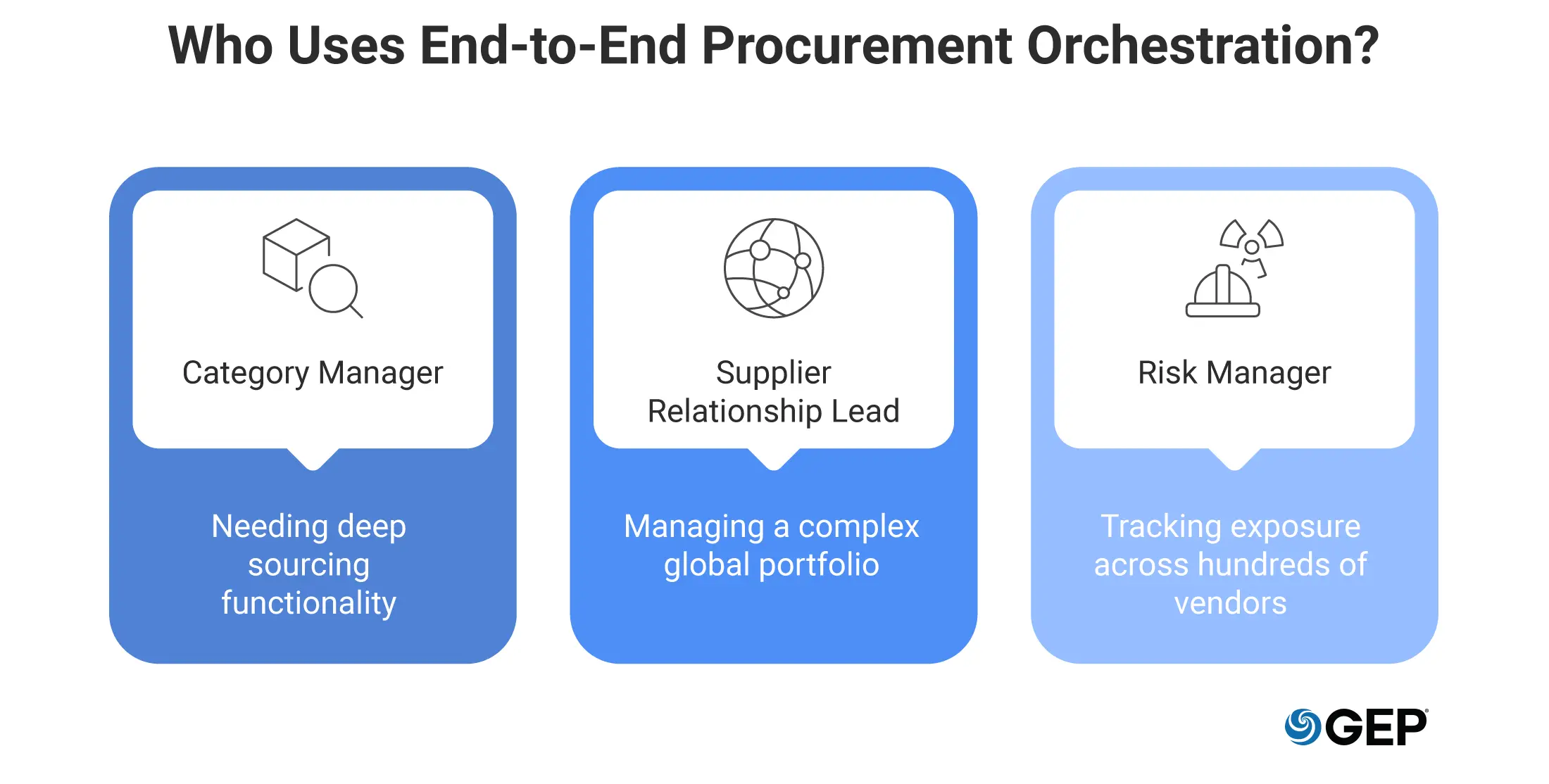
Where Dimension 1 creates an intelligent front door for every employee, Dimension 2 is built for the strategic power user: the category manager who needs deep sourcing functionality, the supplier relationship lead managing a complex global portfolio, the risk manager tracking exposure across hundreds of vendors. These users need an engine powerful enough to handle the full complexity of enterprise procurement and intelligent enough to reduce the manual burden of running it.
Where Dimension 1 Ends and Dimension 2 Begins
The relationship between the two dimensions is structural. Dimension 1 generates the clean, structured, compliant data that Dimension 2 depends on to function. Without that foundation, the process layer works from incomplete inputs. Without the process layer, the intake experience is a well-organized queue that leads nowhere.
When both operate together, the hand-off is invisible. A request enters through a conversational intake experience, gets classified and routed automatically, and arrives at the process layer already carrying what it needs to execute: spend category, supplier parameters, risk flags, budget context and applicable policy. No re-entry or lost context. No delay.
The Hand-Off Failures That Orchestration Eliminates
The value of orchestration is clearest when you trace a single process across its lifecycle. In a fragmented environment, a sourcing event closes and someone manually transfers awarded terms into a contract template, then emails IT, AP and compliance separately to trigger parallel workstreams that each wait on the previous. An AP exception arrives with no context about the supplier, the PO or the contract terms it should match against.
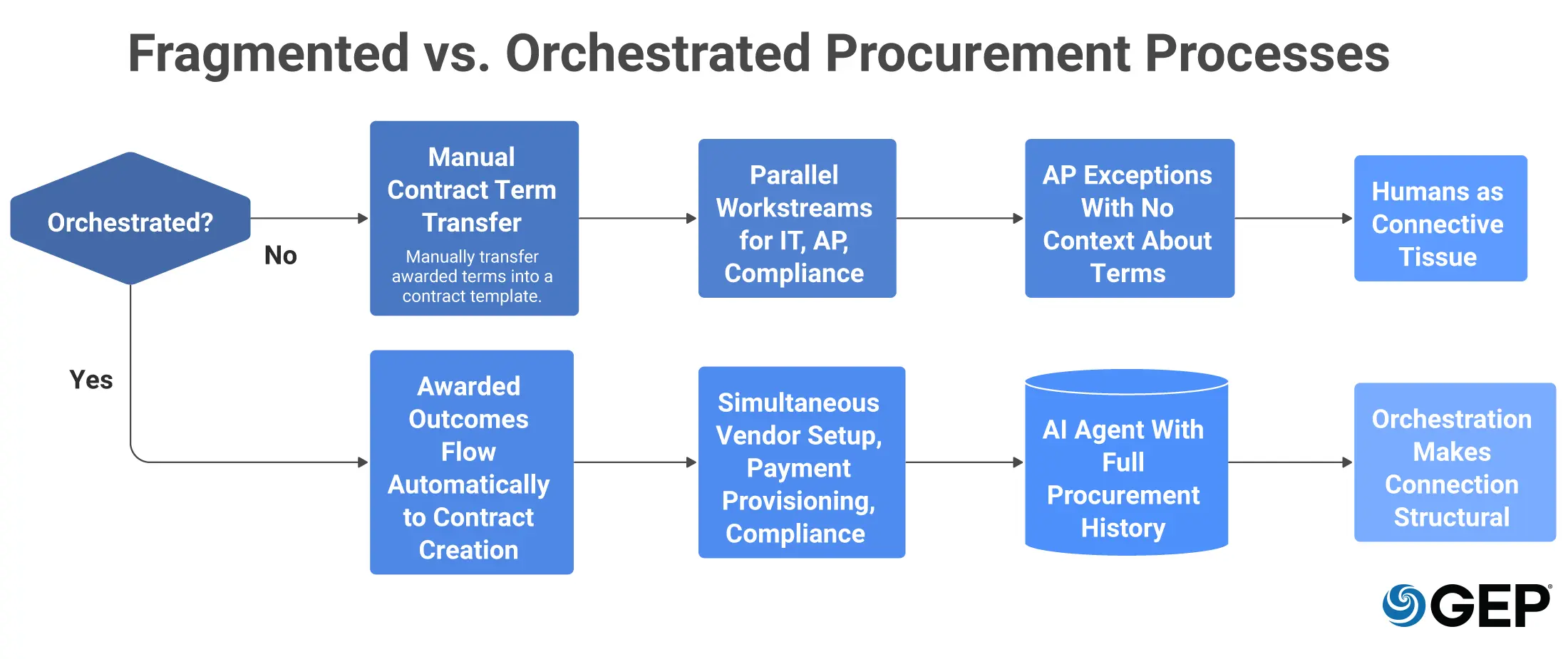
In an orchestrated environment, awarded outcomes flow directly into contract creation. Contract execution triggers vendor setup, payment provisioning and compliance checks simultaneously. The AI agent handling the AP exception has the full procurement history assembled.
Fragmentation forces humans to act as connective tissue. Orchestration makes the connection structural.
From Task Automation to Decision Automation
Legacy S2P automates tasks: generate the PO, route the approval, send the payment. Agentic process orchestration automates decisions. It reasons through context, weighs it against business rules and acts.
According to the Hackett Group, 89% of procurement organizations expect process efficiency and autonomy to be the primary benefit of agentic AI, and zero organizations report no plans for adoption at all.
Yet agentic AI maturity remains highest in structured transactional processes. Sourcing, contracting and supplier management are still largely immature. This is precisely where end-to-end process orchestration creates its most urgent value: providing the connected data fabric and structured workflows that let AI agents move from transactional execution into genuine decision automation. Category managers shift to strategy. Risk managers focus on frameworks rather than data gathering. Procurement stops managing processes and starts orchestrating outcomes.
Start on the Path to Autonomous Procurement
Move Beyond Task Automation to True Agentic Orchestration
Orchestration Beyond Procurement’s Own Walls
The Hackett Group report reveals the true scope of the second dimension: 89% of procurement organizations share their orchestration strategy with Finance, 67% with Legal and contracts and half with IT. End-to-end process orchestration was never just a procurement initiative. When workflows run continuously from sourcing through contracting to payment, every function that depends on procurement’s outputs becomes a stakeholder in how well it works — making Dimension 2 a source of reliable, governed, real-time workflow intelligence across the enterprise.
But the most consequential risks enterprises face don’t stop at procurement’s boundary. Supplier networks, multi-tier dependencies and supply chain ecosystem dynamics require a different order of orchestration entirely. That’s the territory of the third dimension of Total Agentic Orchestration, where the reach of an intelligent procurement function extends across the entire enterprise value chain.