France’s E-invoicing Mandate: The Next (Mega) Step in Digital Transformation
- France is making electronic invoicing mandatory for all B2B transactions starting September 2026 for large companies and September 2027 for smaller businesses.
- The mandate aims to create a more efficient, data-driven tax environment that benefits both authorities and businesses.
- To prepare, businesses will need to update outdated systems, get suppliers and customers ready for digital invoices and manage compliance across multiple countries.
March 12, 2026 | e-Invoicing 4 minutes read
Ready or not, France’s ambitious new e-invoicing mandate will rewire how business gets done.
France is moving ahead with one of the world’s most ambitious e-invoicing and e-reporting initiatives. The reform is designed to modernize tax compliance, reduce VAT fraud, and simplify reporting processes by making electronic invoicing mandatory for domestic B2B transactions.
This new model will require businesses to rethink processes throughout their supplier and customer base as well as internally. Read on to learn how you can prepare for the impact.
A Phased Rollout Starting in September 2026
Here’s what the confirmed implementation timeline looks like:
- From 1 September 2026 – All companies must be able to receive electronic invoices. Large and medium-sized enterprises will also be required to issue e-invoices and submit e-reporting data.
- From 1 September 2027 – Small and micro-enterprises will follow, making e-invoicing mandatory for all VAT-registered businesses in France.
This phased approach balances regulatory control and business readiness, giving organizations time to test integrations and adapt their systems before full enforcement. But only if they move early and don’t leave the change to the last minute.
What the Mandate Covers
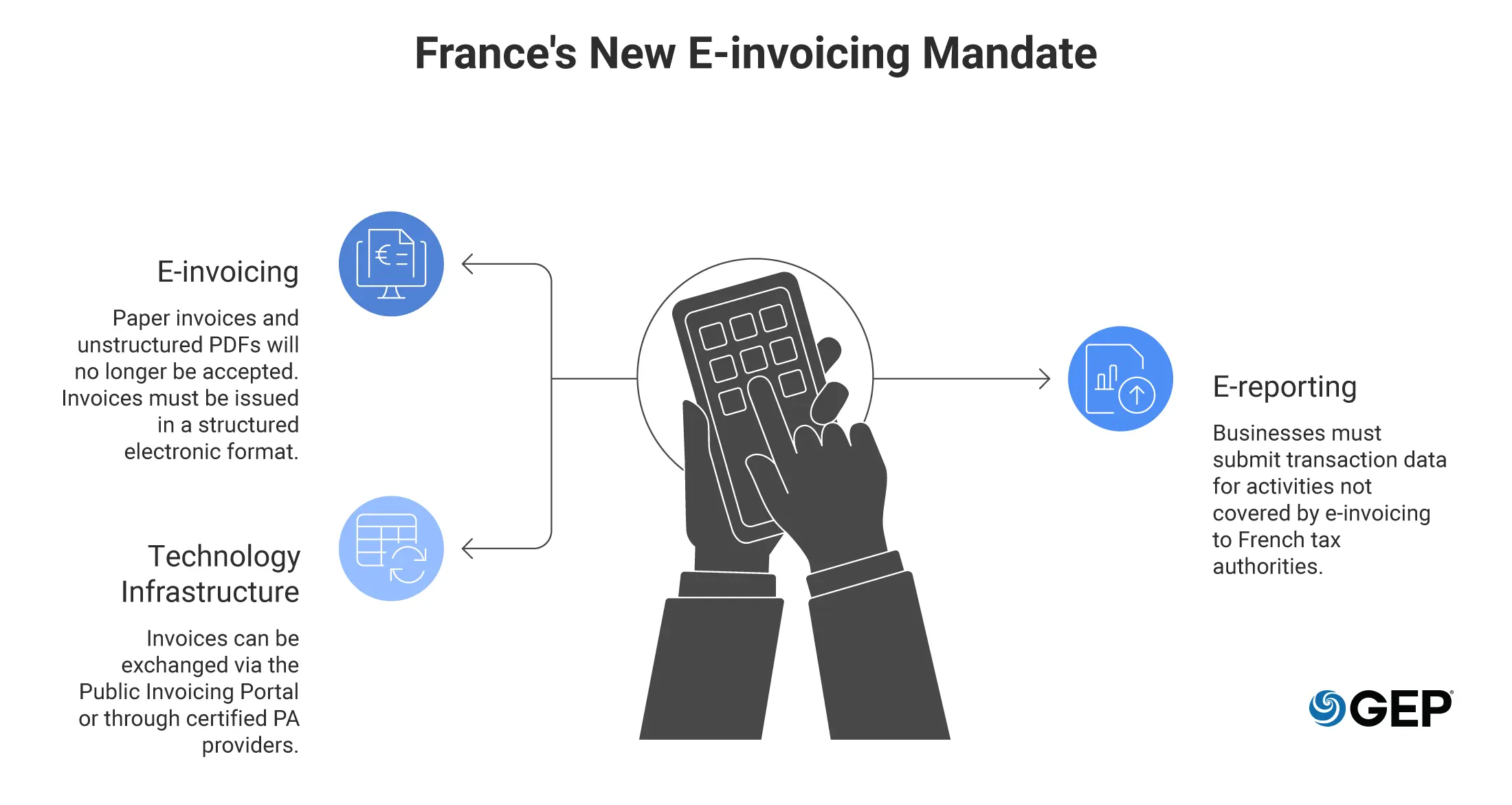
France’s model brings together two core obligations: e-invoicing for domestic B2B transactions and an e-reporting requirement.
- E-invoicing – Paper invoices and unstructured/image PDFs will no longer be accepted. Invoices must be issued in a structured electronic format such as UBL 2.1, UN/CEFACT CII or Factur-X (a hybrid PDF/XML format).
- E-reporting – Businesses must submit transaction data for activities not covered by e-invoicing, such as cross-border trade and B2C sales, as well as payment status information, to the French tax authorities.
- Technology infrastructure – The system follows a “Y-model” architecture. Invoices can be exchanged either via the Public Invoicing Portal (PPF) or through certified PA (Plateforme Agréée) providers, which connect directly to the PPF.
Together, these mechanisms aim to give the tax administration near real-time visibility into transactions, while improving invoice accuracy and reducing administrative workload for businesses in the longer term.
Who Is in Scope
The mandate applies to any business operating in France that is subject to French VAT, regardless of size or sector. It also covers foreign companies with a permanent presence in France that issue B2B invoices for domestic transactions.
While B2C invoices are not subject to mandatory e-invoicing, they remain within the scope of e-reporting. Suppliers issuing B2G invoices have already been using the Chorus Pro platform since 2020, and this existing infrastructure forms the foundation for the wider rollout.
Why France Is Taking This Approach
France’s reform aligns with a broader European shift toward Continuous Transaction Controls (CTC), where tax authorities gain real-time (or near real-time) access to transaction data. The key objectives include:
- Strengthening VAT collection and reducing fraud through faster access to data
- Simplifying VAT reporting and return processes
- Supporting digital transformation across finance and procurement functions
- Improving payment traceability and overall compliance transparency
With this mandate, France aims to create a more efficient, data-driven tax environment that benefits both authorities and businesses.
Key Challenges and Considerations
However, to achieve compliance, organizations will need to address several practical challenges:
- Technical readiness – Many legacy ERP systems aren’t designed to handle the required XML formats or data mappings. Businesses will need to ensure proper integration with the Public Invoicing Portal (PPF) or a certified PA.
- Data quality – Gaps or inconsistencies in VAT data can quickly lead to rejected invoices and delays in processing.
- Operational impact – Finance teams will have to adjust approval flows, reconciliation activities and archiving methods to work effectively with structured invoice data.
- Multi-country coordination – For multinational organizations, aligning invoicing standards across different countries is critical to avoid fragmented processes and systems.
- Supplier and customer readiness – A smooth rollout depends on suppliers and customers being just as ready to send and receive compliant e-invoices.
How to Prepare
Businesses should start preparing immediately, taking the following topics into consideration:
- Choose a compliance partner (PA) or ensure a direct connection to the Public Invoicing Portal (PPF)
- Review existing systems to confirm that ERP and AP/AR solutions can issue and receive structured electronic invoices
- Identify mandatory data fields and update invoice templates to meet legal and technical requirements
- Prepare for e-reporting by identifying the right data sources and defining clear submission processes
- Establish governance to track compliance, manage changes and stay up to date with regulatory developments
Starting early allows organizations to test solutions, build confidence and close system gaps well ahead of the deadlines.
The Broader Opportunity
The new e-invoicing mandate also presents a wider opportunity for digital transformation. Automating invoice exchange and processing will reduce manual effort, streamline processes and improve transparency across the supply chain.
As the implementation date approaches, companies that treat e-invoicing as a strategic initiative (rather than just a tax requirement) will be best positioned to capture long-term efficiency gains and valuable business insights.
How GEP Can Help
GEP helps enterprises prepare to France’s e-invoicing and e-reporting mandate. From platform integration and data readiness to end-to-end compliance management, GEP provides the technology and expertise needed for a smooth transition to France’s new digital invoicing framework. GEP is accredited and listed as PA (Plateforme Agréée) as OpusCapita.
GEP delivers solutions for sending and receiving electronic invoices globally, not limited to the French mandate. Get up to speed on e-invoicing requirements worldwide using the E-Invoice Compliance Navigator, and explore current mandates in Belgium, Poland and Germany.
Book a meeting with our experts now to learn more.