


Fixing Lean Procurement: The CPO’s Roadmap to a 90-Day Foresight Window
- Over 80% of supply chain leaders faced supplier disruptions in 2025.
- Lean procurement without predictive intelligence is bound to fail.
- Risk foresight requires total visibility weeks before disruption hits.
October 12, 2026 | Procurement Strategy 6 minutes read
For a decade, the procurement playbook rewarded leanness. That meant lower inventory, faster cycle times, and razor-thin margins. It worked until a tier-2 supplier went dark or a port backed up for weeks. That’s when the lean procurement model, which lacked an early warning system, turned from a competitive edge into a liability overnight.
The numbers make the case louder than any consultant could. Over 80% of supply chain and procurement leaders reported a supplier disruption in 2025. 62% call current risk levels high or very high, and 68% expect conditions to worsen. Tariff-driven cost spikes rank as a top risk for 92% of leaders, while 75% brace for slower demand.
Efficiency without predictive intelligence isn't efficiency at all. It's fragility in a good suit. You don't get ahead of this by hoarding more stock but by building supply chain resilience using information.
Why Lean Procurement Fails Without Intelligence
Lean procurement is an organization’s process to streamline purchasing and inventory management to maximize efficiency. But how do you justify the failures it comes with?
Quarterly audits are rearview mirrors. They tell you what already happened, but never what's about to happen next. By the time a report lands on your desk, the disruption it describes is usually already reshaping your production schedule.
Take a CPO running a textbook lean strategy with no predictive monitoring layered on top. Now, if a tier-2 supplier in Southeast Asia takes a hit due to floods, the CPO has no early warning signal and no alternate supplier vetted in advance. Production halts for three weeks, and the final bill touches over $40 million in lost revenue.
The loss isn't subtle. By the time a supplier calls to report a failure, your leverage to pivot is already gone. That’s when predictive intelligence comes into play.
Smart Buffering: Replacing Inventory Buffers with Information Velocity
An AI-native control tower shifts procurement from static reporting to real-time orchestration.
Instead of waiting for a report to flag a problem, the system monitors workflows closely and consistently to tell you what's changing in real-time, so you can act on it immediately. This is the core of AI supply chain risk management: using information velocity to do the job inventory used to do alone.
You can track shadow risk indicators, which are signals that lie outside the traditional supplier scorecard but move well before an official failure does. Payment delays and deteriorating financial health inform you if a supplier is under strain, long before they say so out loud. Port congestion and other logistics choke points highlight exactly where physical chokepoints are forming. ESG or labor violations, paired with adverse local news, often surface risk that never shows up in a financial statement at all.
This is what makes smart buffering possible. Rather than holding blanket safety stock across every component, you reallocate buffers dynamically based on predicted volatility. Stable components stay lean, while volatile ones get covered in advance. Organizations using this approach have cut excess inventory by 15% to 30% while raising service levels by 8% to 15% at the same time.
If a lithium battery shortage hits your consumer electronics supply base, you can avoid spending millions of dollars on expedited freight costs by dynamically reallocating safety stock based on predicted volatility, instead of guesswork. A manufacturer that took this approach saved $14 million during this kind of shortage.
Can Procurement See Risk Before It Hits?
Learn how predictive intelligence helps CPOs act before supplier risk becomes a business threat.
Operationalizing the 90-Day Foresight Window
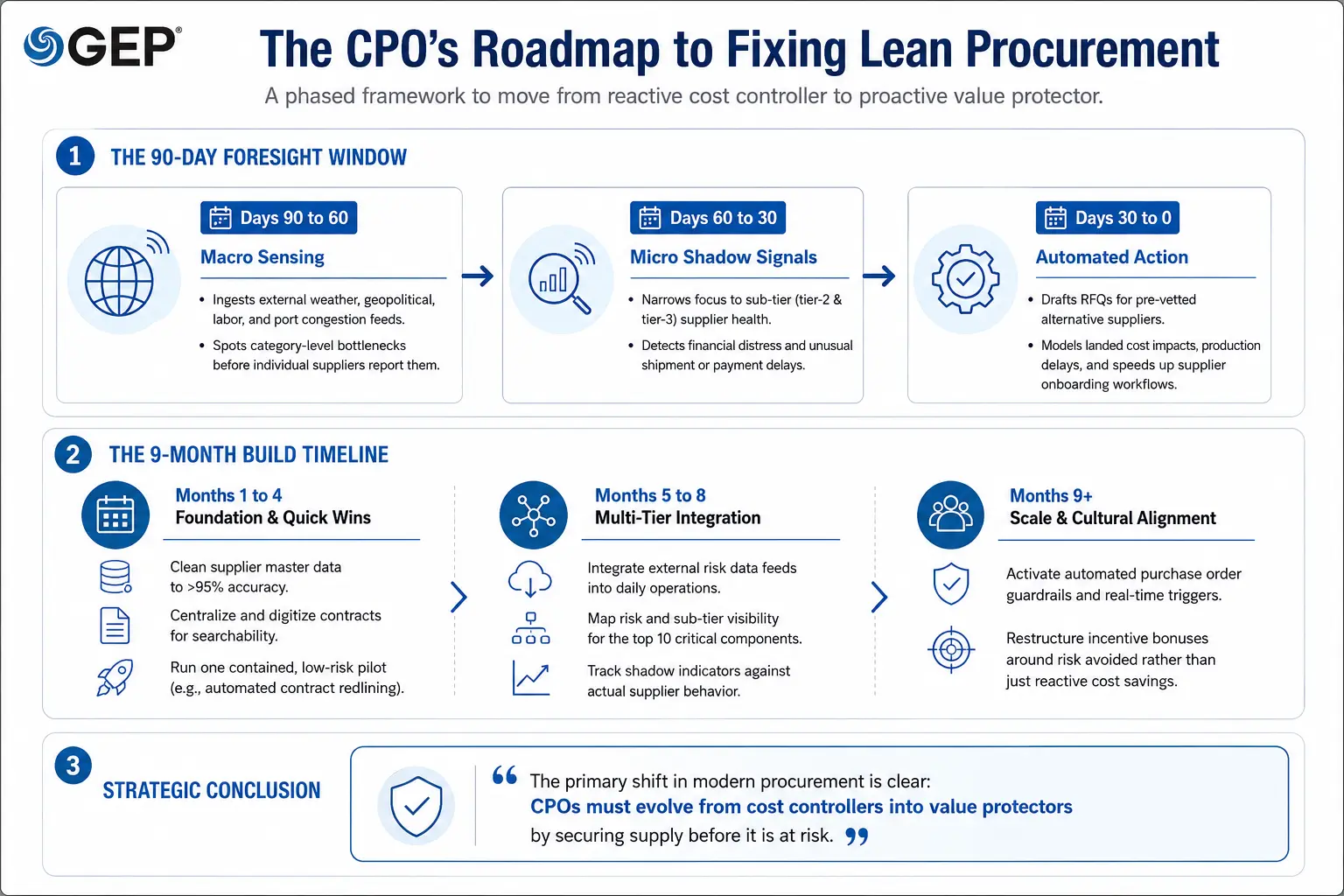
An AI risk engine doesn't treat the next 90 days as one undifferentiated stretch of uncertainty. It breaks the window into three 30-day horizons, each doing a different job for you.
From day 90 to day 60, the focus is macro sensing. The system ingests external feeds on weather, labor disputes, geopolitical developments, and port congestion, looking for category-level bottlenecks before any single supplier has said a word about them.
From day 60 to day 30, your attention narrows to micro shadow signals. This is where the system tracks financial distress and unusual shipment or payment delays across your tier-2 and tier-3 base, the layers of the supply chain most CPOs can't see with the naked eye.
From day 30 to day 0, the system moves from watching to acting on your behalf. It drafts RFQs for pre-vetted alternative sources, calculates the landed cost impact of switching, models what the delay would do to your production schedule, and triggers supplier collaboration workflows to speed up onboarding, all before your line ever feels the disruption.
When day zero arrives, you're ready to execute a plan that's already been brewing behind the scenes for the past two months.
Related Read: Agentic AI for Lean Procurement Teams
What This Looks Like in Practice
Run mature predictive procurement analytics, and you start catching sub-tier risk with real lead time, not just better dashboards.
In pharmaceutical supply chains, this kind of monitoring has flagged at-risk active ingredient suppliers an average of 45 days before a shortage becomes visible through traditional channels. That's a 45-day head start to activate contingency suppliers and adjust safety stock for the components that matter most, instead of managing a shortage after the fact.
The same pattern holds outside pharma.
In one electronics supply chain, an AI risk engine caught abnormal shipment delays and deteriorating payment patterns at a tier-2 supplier, escalating it to high risk six weeks before the company's insolvency became public. Procurement had already pre-vetted a secondary source and modeled the cost of shifting production, so a potential multi-million dollar disruption never became one. That's the real payoff of a 90-day window: it turns crisis response into a scheduled decision.
The CPO’s Roadmap to Build Real Predictive Intelligence
Foresight must be built in phases, typically over about nine months.
In months 1 to 4, the work is foundational. You get supplier master data to better than 95% accuracy and centralize contracts so they're searchable. With that, you run one contained, low-risk initiative, something like automated contract redlining, to prove the model before scaling it.
In months 5 to 8, you integrate external data feeds and build real tier-2 visibility. You map risk for your ten most critical components and track the shadow indicators covered earlier against actual supplier behavior.
From month 9 onward, the shift is cultural and technical. You activate automated purchase order guardrails and real-time triggers, and just as important, you restructure incentive bonuses around risk avoided rather than reactive cost savings. That last change is what makes the system stick, because a control tower nobody's compensated for using tends to get ignored.
Predict Disruptions Before They Happen
Learn how AI-native predictive intelligence protects lean procurement
Move from Cost Control to Value Protection
Your job as CPO is shifting. Cutting costs still matters, but you'll pull ahead over the next few years by protecting value before it's at risk, not just recovering it after the fact. That's the real shift in CPO strategy this decade: from cost controller to value protector.
To know more about building your own 90-day foresight window, read GEP’s latest whitepaper, "The Future-Ready CPO: Using AI to Move from Cost Control to Value Protection."



Frequently Asked Questions
An AI-driven model breaks the lean-versus-resilient trade-off by replacing bloated safety stock with high-velocity information. Instead of holding inventory across the board, you use predictive analytics to monitor real-time component volatility and sub-tier risk, then keep targeted buffers only where the risk is actually forming. This kind of smart buffering can cut excess inventory by 15% to 30% while still raising service levels.
Shadow risk indicators are non-traditional signals that flag trouble long before a supplier admits there's a problem: payment delays, deteriorating financial health, labor and ESG red flags, adverse local news, and port congestion. Traditional quarterly audits only tell you what already happened, but monitoring these signals continuously lets you catch supplier distress as it's forming. That gives you visibility into tier-2 and tier-3 supplier problems 30 to 60 days before a supplier reports a failure or insolvency.
The biggest obstacle is dirty master data, and fixing it takes a phased rollout spread across roughly nine months. In the first four months, you clean supplier master data to better than 95% accuracy while running one contained, low-risk initiative to prove the model works. Over the next four months, you integrate external data feeds and build multi-tier visibility into your top critical components. From month nine onward, you activate automated purchase order guardrails and real-time risk workflows across the organization.