


How Predictive Procurement Turns Approvals into Smarter Spend Decisions
- Organizations relying on manual approval workflows are leaving measurable spend value on the table, cycle after cycle.
- Predictive procurement enables decision-making from reactive sign-offs to intelligence-led actions, lowering risk and enhancing outcomes at scale.
- AI-native platforms are now the baseline expectation for procurement teams that want to move from spend visibility to spend control.
July 13, 2026 | Spend Management 5 minutes read
Procurement leaders are under pressure from every direction. Budgets are tighter, supplier markets are volatile, and internal stakeholders expect faster answers with fewer escalations. Yet in most organizations, the approval process still looks the same as it did a decade ago: a request comes in, moves through a queue, someone signs off, and the cycle repeats.
The problem is not the process itself. It is what the process cannot see. Manual approvals treat every transaction as a discrete event, disconnected from spend patterns, supplier performance data, and category benchmarks. That blindness is expensive.
This blog breaks down how predictive procurement changes the decision-making logic within your organization and what leaders need to put in place to move from approval management to spend governance smarter.
Are Your Approvals Missing Spend Insight?
Learn how intelligence-led workflows improve every purchase decision
The Problem: Manual Approvals and Missed Spend Opportunities
Most procurement approval workflows are designed for control, not intelligence. A request passes a threshold, triggers an approval rule, and waits. What the workflow cannot do is ask whether the purchase is well-timed, whether a better supplier exists, or whether a consolidated order would unlock a contracted discount.
The result is a pattern procurement leaders know well: compliance on paper, but leakage in practice. Maverick spend persists because approved channels feel slower. Category savings targets get missed because individual transactions are never evaluated in aggregate.
The assumption has been that more approvals mean better control. The reality is that approvals without intelligence are just delays.
How Predictive Procurement Converts Approvals into Smarter Decisions
Predictive procurement replaces static approval logic with a continuous decision layer. Instead of asking "has this been approved?", the system asks, "Is this the right decision, given what we know?"
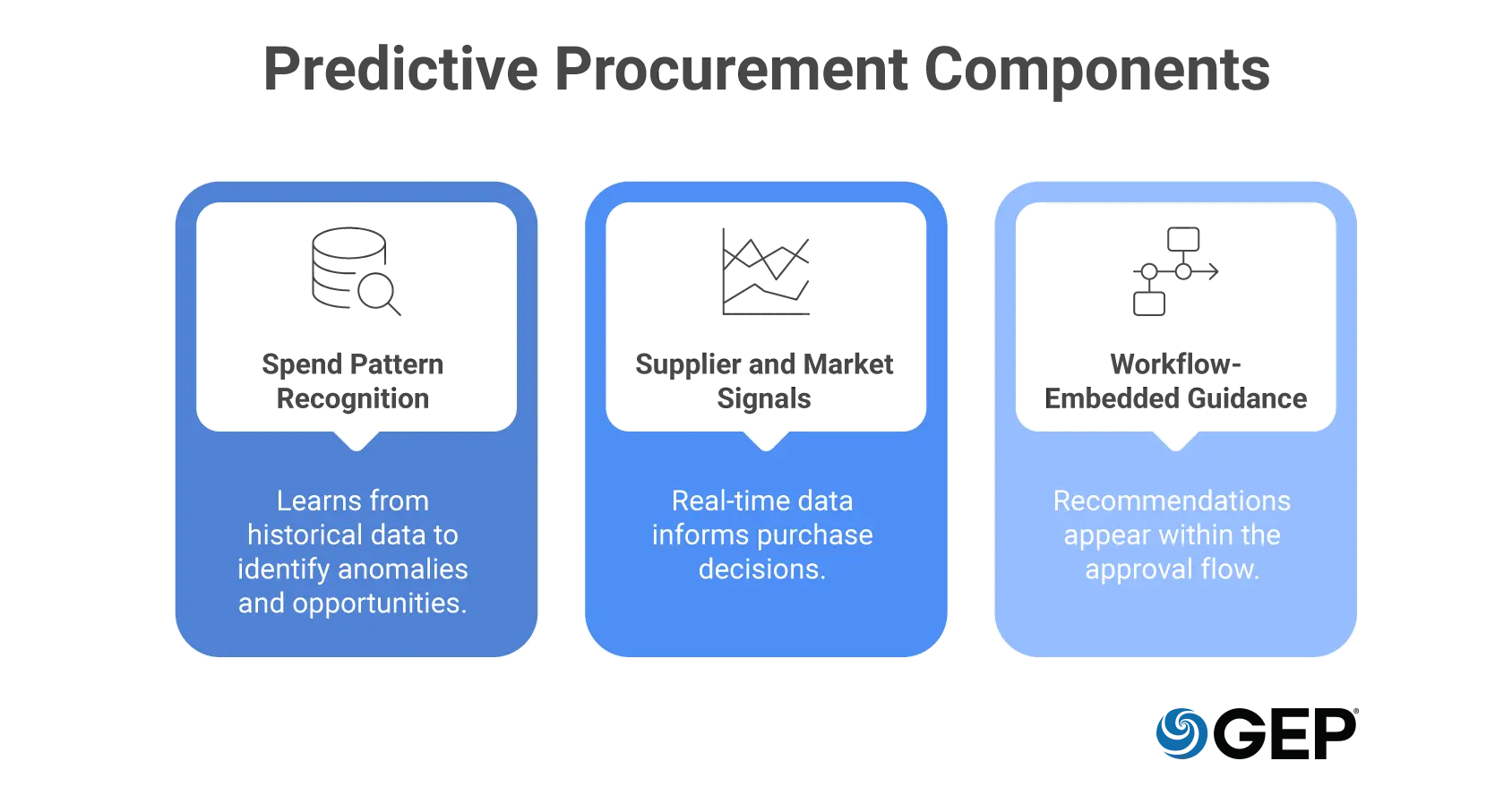
That shift depends on three things working together:
Spend pattern recognition:
The system learns from historical transaction data to flag anomalies, surface consolidation opportunities, and identify purchases that fall outside category norms.
Supplier and market signals:
Real-time supplier performance data and market benchmarks inform whether a purchase should proceed, be renegotiated, or redirected to an alternative source.
Workflow-embedded guidance:
Recommendations surface inside the approval flow itself, so the person making the decision has the right context at the right moment, without switching tools.
Predictive procurement does not eliminate human judgement. It makes human judgement better by reducing the information gap that causes poor decisions.
AI-Native Procurement Platforms: The New Standard for Smarter Spend
The question is no longer whether AI belongs in procurement. It is whether your organization has the workflow foundations to make it work at scale.
AI-native procurement platforms are built with intelligence embedded at every workflow stage, not added as a reporting module. For spend decisions specifically, this means approval queues that prioritize by risk rather than time received, automatic matching of purchase requests against contracted suppliers and pricing, and predictive flagging of spend trending outside budget tolerance before the period closes.
The organizations moving fastest are not those with the largest technology budgets. They are those that have standardized their intake-to-pay data and built AI-native workflows on top of clean, connected foundations. Without that data layer, AI surfaces the fragmentation rather than solving it.
The gap between organizations that have made this move and those still running manual approval logic is widening. The window to close it is narrowing.
Overcoming the Key Barrier to Scaling AI in Procurement
The most common reason predictive procurement stalls at the pilot stage is fragmented data. AI models require consistent, structured input. When procurement data sits across disconnected ERP systems, spreadsheets, and supplier portals, the signal quality degrades and so do the recommendations.
The fix is not a full system overhaul. It is a deliberate sequencing: consolidate spend data first, establish a unified supplier master, then layer intelligence on top. Organizations that try to implement predictive capabilities before data foundations are stable typically find that their AI recommendations surface the fragmentation rather than solving it.
How AI Is Reshaping Supplier Evaluation and Spend Decisions
Supplier selection has traditionally been labor-intensive: RFIs, scorecards, committee reviews. That model works for strategic sourcing events. It does not scale to the volume of transactional decisions procurement teams handle every quarter.
AI-native platforms change the evaluation model for transactional spend by running continuous supplier scoring in the background. Delivery reliability, pricing consistency, quality metrics, and compliance signals are updated in real time and surfaced at the point of decision. A buyer approving a purchase order can see, without leaving the workflow, whether that supplier is performing within acceptable parameters or whether an alternative would reduce risk.
This is not about removing supplier relationships from the equation. It is about giving relationship owners better data to act on.
Turn Approval Workflows into Spend Control
Embed data into decisions at the moment they matter
Ready to Shift to Predictive Procurement?
The shift from manual approvals to predictive procurement is an operating model change, not a technology project. Organizations seeing the clearest returns are those that have treated spend intelligence as a workflow design challenge, not a reporting upgrade.
Predictive procurement delivers value at the decision point, not after the fact. It makes approvals faster and more defensible, surfaces savings opportunities that manual processes miss, and builds the audit trail that modern compliance environments demand.
If you want to explore how to operationalize this at scale across your organization, talk to us.




FAQs
How does predictive procurement improve decision-making in procurement processes?
Predictive procurement embeds intelligence directly into approval workflows. Rather than evaluating a transaction in isolation, the system draws on spend history, supplier performance data, and category benchmarks to surface context at the point of decision. Approvals become informed by pattern recognition and risk signals, not just policy thresholds.
What impact does predictive procurement have on supplier relationship management?
Continuous scoring across delivery, quality, and compliance metrics gives relationship managers a factual basis for performance discussions and a clearer view of which suppliers warrant deeper strategic investment.
How can predictive procurement help organizations forecast future spending trends?
By analyzing historical transaction data alongside supplier pricing signals and demand patterns, predictive procurement platforms can model likely spend trajectories by category, business unit, or supplier, giving procurement and finance teams earlier sight of budget risk and consolidation opportunities.
How does predictive procurement support cost reduction and budget optimization?
The primary mechanism is opportunity identification at scale. Predictive systems flag consolidation opportunities across similar purchase requests, surface off-contract spend before it compounds, and recommend better-priced alternatives within approved supplier panels.