


Your Audit Trail Is Clean. You're Still Overpaying.
- A clean audit trail proves your processes work. It says nothing about whether you're capturing the value your contracts promised.
- The commercial detail that drives real savings, including rebate thresholds, index-adjusted pricing and markup caps, lives in unstructured contract language that no procure-to-pay system reads or enforces.
- Closing this gap requires linking every contract clause to every transaction at the line level, something only possible now that AI can read contracts at scale.
September 11, 2026 | Procurement Software 6 minutes read
Every invoice approved. Every purchase order matched. Every payment logged in the ERP on time and to policy. If you ran a compliance audit today, your procurement organization would pass with flying colors.
And you'd still be overpaying.
Not because anyone made an error or circumvented a rule, but because the compliance framework most organizations rely on was never designed to catch the value that's leaking. It catches process failures but misses commercial ones. The rebate threshold that was crossed without anyone noticing. The invoiced price that drifted above the contracted rate. These don’t show up as audit findings because none of them violate a workflow; they violate a contract clause.
Is Your Compliance Strategy Protecting Value or Just Checking Boxes?
Learn how forward-thinking CPOs are using AI to close the gap between cost control and continuous value protection.
What "Compliant" Actually Means Today
Most procurement compliance frameworks are built around process governance. Did the requisition follow the approval chain? Was a three-way match completed at the document level? Is the audit trail intact? These controls protect against fraud and policy violations and keep organizations on the right side of regulatory scrutiny.
But they answer a narrow question: did we follow the rules? They don't answer the more expensive one: did we get what we paid for?
The commercial terms that drive real value live inside unstructured contract documents. Examples include tiered rebates, volume-based discounts, CPI- or COLA-adjusted pricing formulas, third-party markup caps or early-payment discount windows. Procure-to-pay systems store these contracts as PDF attachments; they don't read them. They can't cross-reference a rebate threshold against cumulative spend across multiple buying entities or verify that an index-adjusted price was calculated correctly on a given invoice line.
So the terms that were hardest to negotiate are the easiest to lose. A supplier contract might include a 5% rebate once cumulative purchasing crosses $2 million. Across thousands of transactions and several business units, nobody tracks when the threshold is hit. The supplier doesn't volunteer it. The rebate goes unclaimed. Meanwhile, the audit trail is spotless.
The Anatomy of Commercial Leakage
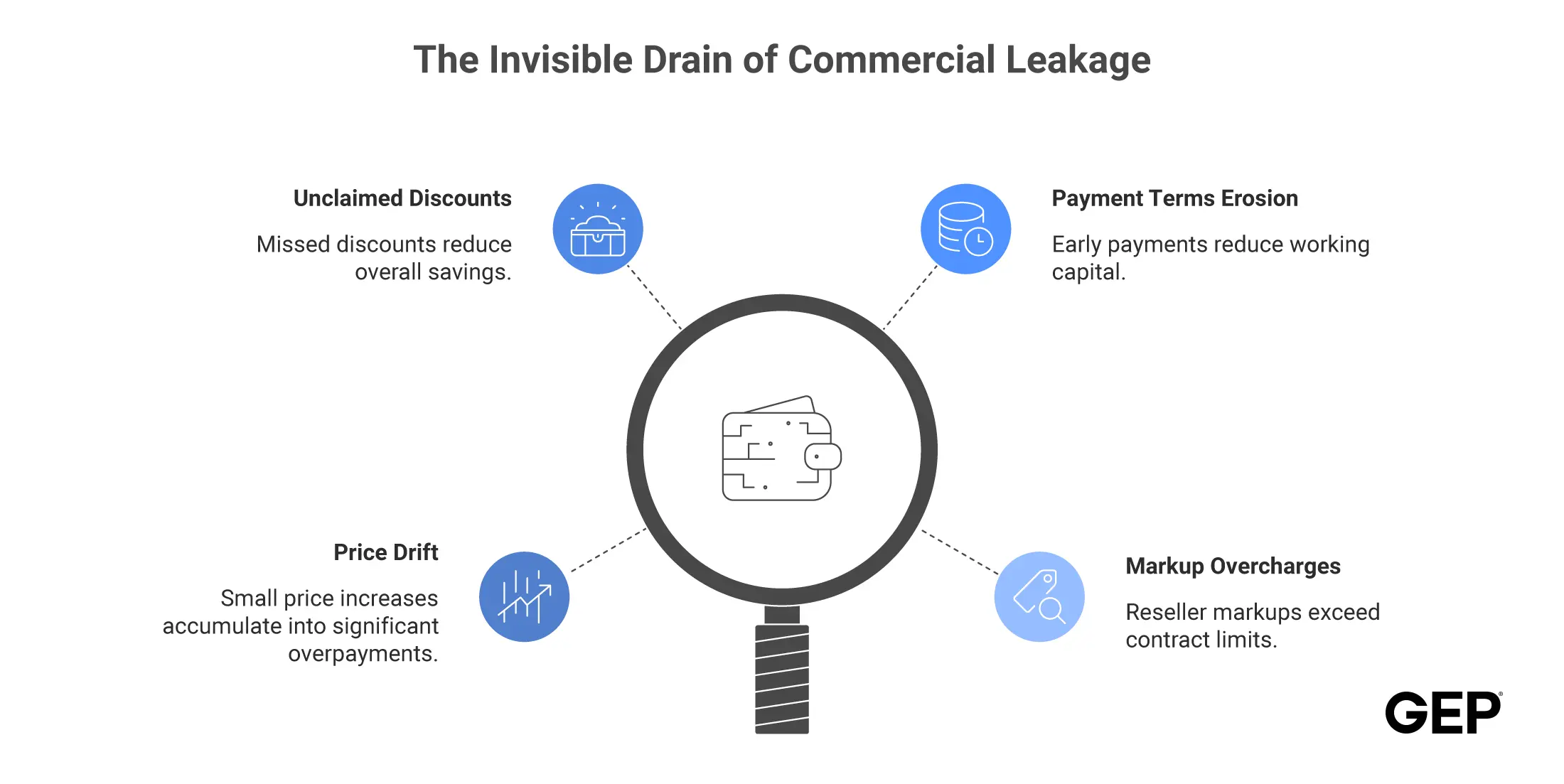
Commercial leakage isn't one type of failure. It's a family of failures that share a single trait: they're invisible to process-oriented compliance systems.
Price drift
Invoiced unit prices quietly creep above the contracted rate, or pricing tied to an index or currency conversion is applied incorrectly. Each deviation is small on a per-line basis. Across thousands of transactions, the compound effect is enormous.
Unclaimed discounts and rebates
Early-payment discounts go uncaptured even when accounts payable pays within the qualifying window. Rebate thresholds are crossed without being triggered. The value was negotiated and available, it just wasn't collected.
Payment terms erosion
A contract specifies Net 90. Accounts payable pays in 45 days. The ERP supplier master may not even reflect the contracted terms, so the deviation is never flagged. The money isn't lost to a vendor overcharge; it's lost to surrendered working capital on every affected invoice.
Markup overcharges
When purchases route through authorized resellers or distributors, the contract caps the markup at a defined percentage. Validating the actual markup on every transaction across every reseller requires joining contract data to invoice data at the line level, something standard procure-to-pay checks cannot do.
Why This Gap Has Persisted
The issue is an information architecture problem: the commercial terms live in contracts, while the transactional data lives in ERPs and P2P platforms, and nothing connects the two at the line level.
Manual audits can bridge this gap, but they are huge efforts done only in retrospect and usually only by sampling. A year-end audit might review a fraction of contracts and find recoverable dollars after the money is already gone. It's expensive, slow and inherently incomplete.
The result is that the gap between what contracts promise and what operations actually deliver has been tolerated as a cost of doing business. Until recently, there was no practical alternative.
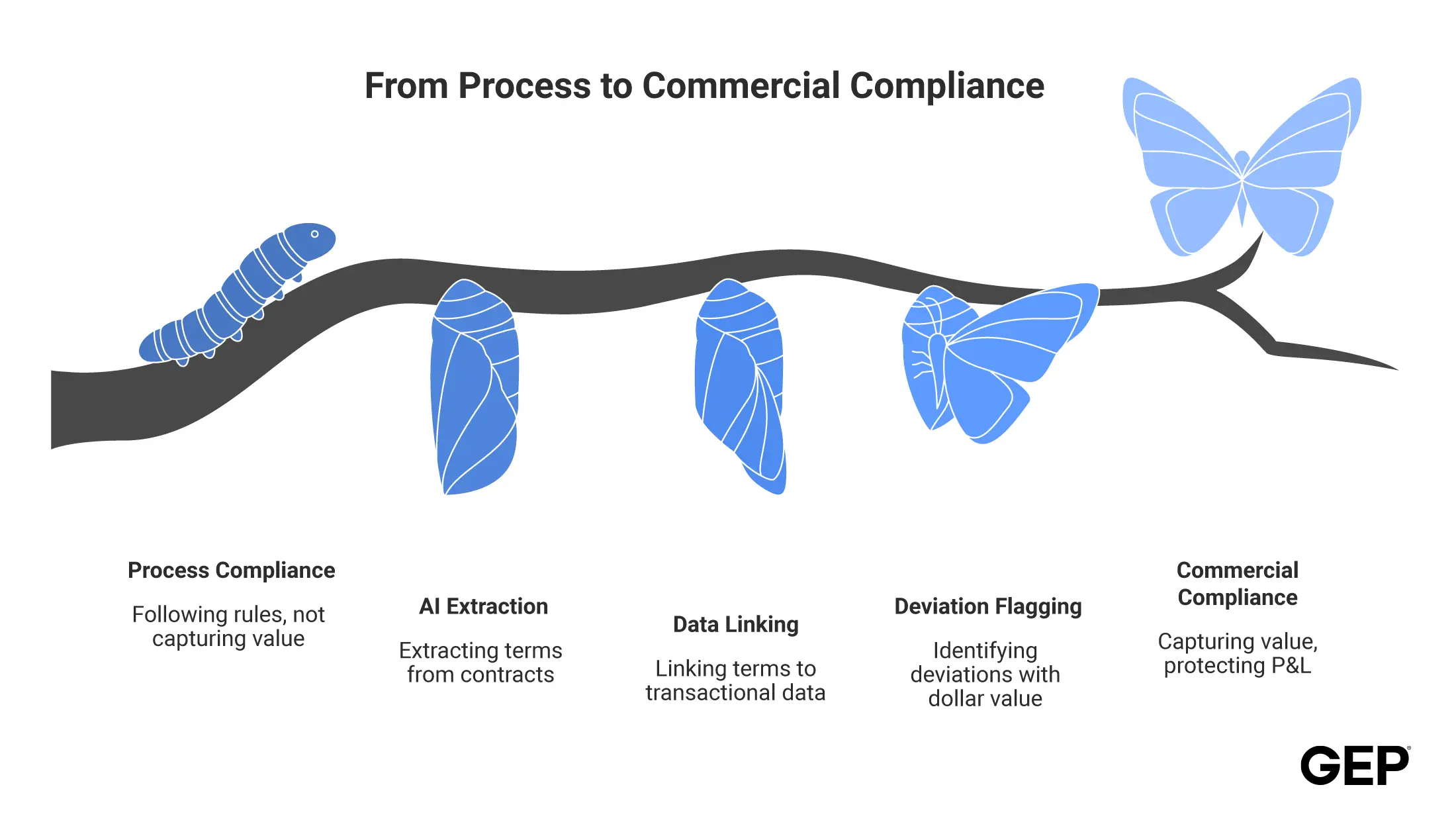
From Process Compliance to Commercial Compliance
Agentic AI changes this equation. AI agents can extract commercial terms from thousands of contracts, link those terms to live transactional data at the line level and flag every deviation with a dollar value and confidence score attached.
Think it won’t save you anything? Google’s invoice-validation agent will save the company an estimated $200 million a year by identifying overpayments.
This is the shift from process compliance to commercial compliance. Process compliance asks: did we follow the rules? Commercial compliance asks: did we capture the value? The first protects governance. The second protects the P&L.
But reading a contract is the easy part. Knowing what a rebate clause, a markup cap or a continuous-improvement commitment means in procurement context requires decades of domain expertise built into the system itself. And enforcing those terms requires orchestration across whatever procurement and finance systems an enterprise already runs, connecting contracts to purchase orders to invoices at the line level regardless of where each document lives.
The practical result is a system that not only flags problems after payment but intercepts leakage before the invoice is paid, turning compliance from a retrospective exercise into a continuous safeguard.
Also Read: Contract Lifecycle Management Guide
What This Means for the CPO's Agenda
For CPOs under pressure to demonstrate value beyond savings, commercial compliance is a compelling lever. It doesn't require renegotiating contracts or restructuring supplier relationships. The value was already negotiated. It just wasn't captured.
The CFO conversation shifts as well. Instead of framing compliance as "audit readiness," procurement can present a value realization strategy with a clear cost-to-coverage ratio. Commercial leakage is a P&L line item hiding in plain sight. Recovering it isn't a speculative technology bet. It's found money, and a credible recovery program funds itself from what it finds.
Perhaps more importantly, recovery is only the starting point. The real transformation happens when organizations move from periodic audits to continuous monitoring, catching deviations as they occur rather than discovering them months or years later. That's the difference between recovering past losses and preventing future ones.
The Columns You Haven't Filled In
A clean audit trail is a necessary condition for good procurement but not a sufficient one. The organizations that will lead the next era of procurement are both process compliant and commercial compliant. They know what their contracts promise as well as what their operations deliver, and they’re using AI-native procurement tools to close that gap in real time.




FAQs
Commercial leakage is the gap between the value negotiated into supplier contracts and the value realized through transactions. It occurs when commercial terms like rebates, discounts, price adjustments and markup caps are not enforced at the transaction level. Commercial leakage doesn't trigger audit findings because it doesn't violate a workflow.
Process compliance ensures that procurement activities follow approved workflows, policies and approval chains. Commercial compliance ensures that the financial terms in contracts are reflected in what gets ordered, invoiced and paid. An organization can be fully process-compliant while still losing significant value through uncollected rebates, price drift and payment terms erosion.
Yes. Advances in agentic AI now make it possible to extract commercial terms from unstructured contracts, link them to live transactional data and flag deviations continuously. This shifts compliance from a retrospective sampling exercise to an ongoing mechanism that can intercept leakage before payment is made, rather than recovering it after the fact.