



Spend Data Cleansing and Classification: The Taxonomy Work That Makes Analytics Trustworthy
- If your spend data isn't mapped to a consistent category structure, even the most advanced platforms will give you misleading answers.
- Cleaning and classifying spend data is a continuous process, not a project with a finish line.
- AI-native tools and strong data governance turn taxonomy maintenance from a manual grind into something that scales and actually improves over time.
September 15, 2026 | Spend Management 5 minutes read
Most procurement leaders have been in this room before: the dashboard says one thing, the category manager says another, and the CFO's spreadsheet contradicts both. The numbers don't agree because the data underneath them was never properly organized.
Spend data classification taxonomy is the work that sits underneath every trustworthy analytics output. You're taking raw transaction data, cleaning it up and mapping it to a consistent set of categories. Do that well, and procurement teams get real visibility — the kind that holds up when you're negotiating with suppliers or presenting savings numbers to finance.
What Is Spend Classification, and Why Does It Need a Taxonomy?
Spend classification is the act of assigning every procurement transaction to a defined category. A taxonomy is the hierarchical structure those categories live in, typically organized from broad groups (like "IT Services") down to specific commodities (like "Cloud Infrastructure Hosting").
Without a taxonomy, classification is ad hoc. One analyst files a software license under "IT." Another puts it in "Professional Services." Someone else never classifies it at all. The result is a spend cube that no one trusts and no one uses. A well-designed spend taxonomy creates a shared language across the organization so that when procurement says "we spent $4 million on logistics," finance and operations are looking at the same definition.CTA Heading: Turn Spend Data Into Actionable Intelligence
Why Is Spend Data Cleansing Important for Trustworthy Analytics?
Raw spend data is messy by nature. Supplier names arrive in dozens of variations. Invoice descriptions are inconsistent. Fields are missing or duplicated. Analytics platforms can only work with what they're given, and when the input is unreliable, the output is too.
Cleansing means standardizing supplier names, removing duplicates, correcting errors and filling gaps before classification even begins. Teams are often tempted to skip straight to categorization, but that just guarantees the taxonomy inherits the mess. Without clean inputs, no amount of categorization rigor will save the output.
The Cost of Dirty Spend Data: Where Bad Analytics Comes From
The consequences of poor data quality compound quickly. Duplicate supplier records inflate the apparent size of the supply base, masking consolidation opportunities. Misclassified transactions hide savings in the wrong categories. Incomplete data creates blind spots in tail spend that grow larger with every reporting cycle.
But the deeper cost is credibility. When a CPO presents spend numbers that don't match what business units see in their own systems, the analytics function loses its standing. And once that trust is gone, rebuilding it takes far longer than getting the taxonomy right from the start.
How to Cleanse and Classify Spend Data: A Step-by-Step Framework
The sequence is straightforward. Start by extracting spend data from every source system: ERPs, accounts payable platforms, procurement tools and corporate cards. From there, normalize supplier names by mapping variations to a single parent record. Enrich the data by filling in missing fields (e.g., commodity codes, business units and contract references) using internal and external data sources.
Classify each transaction against the chosen taxonomy, assigning it to the appropriate level of the hierarchy. Finally, validate the output against known baselines and flag exceptions for human review. This framework is not a one-time exercise. Each step should feed into a repeatable process that runs on a defined cadence.
Also Read: Spend Data Management for Procurement Success
Choosing a Classification Taxonomy (UNSPSC, Custom, or Hybrid)
The most widely adopted standard is UNSPSC (United Nations Standard Products and Services Code), which provides a universal four-level hierarchy. The main advantage is comparability: if you're on UNSPSC, you can benchmark against peers and plug into external data sources without translation.
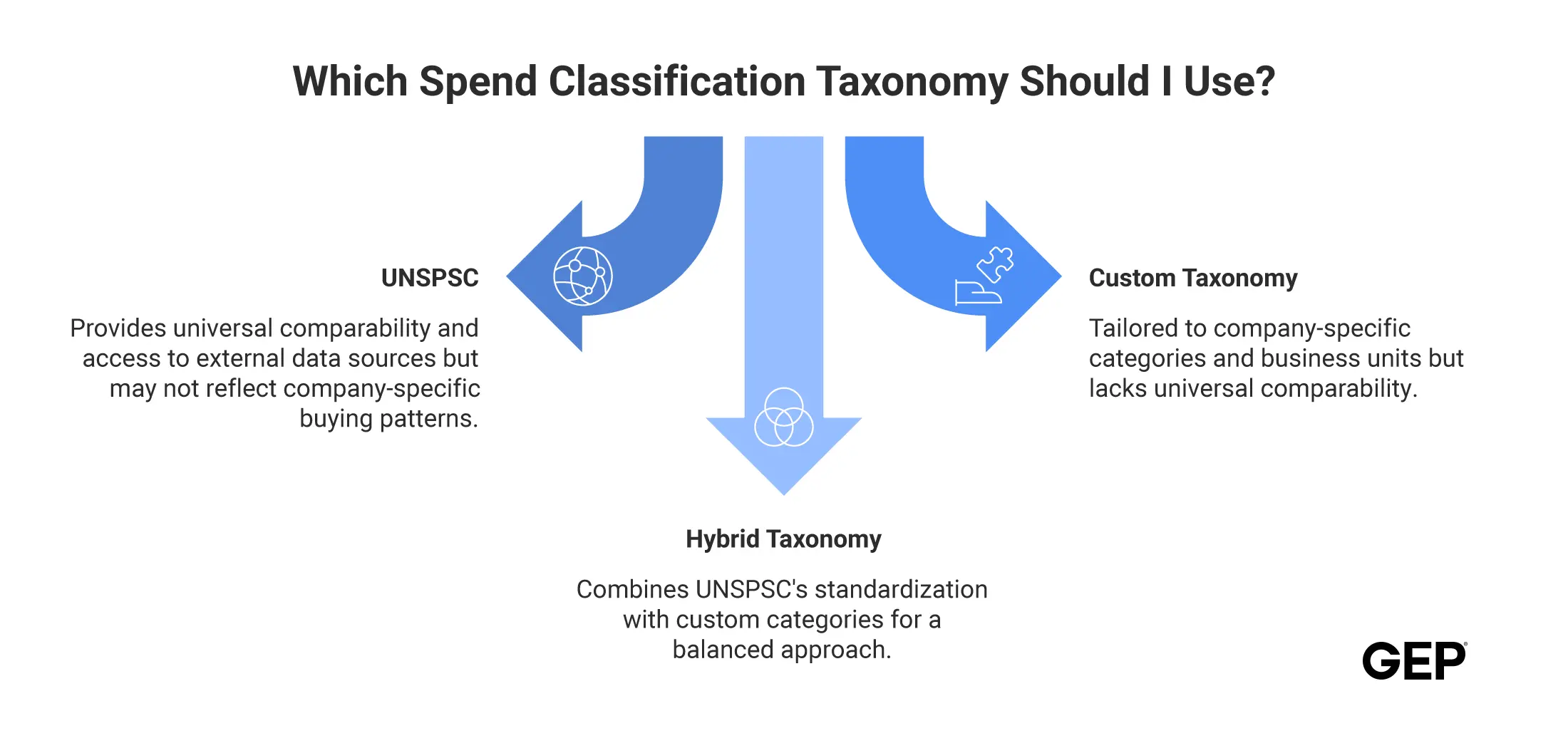
However, UNSPSC doesn't always reflect how a specific company buys. A manufacturer's direct materials taxonomy will look very different from a financial services firm's IT-heavy spend profile. That's where custom or hybrid taxonomies come in, blending UNSPSC's standardization with company-specific categories that map to internal business units and sourcing strategies. The right choice depends on the complexity of the spend and the maturity of the analytics program.
Automating Data Cleansing and Classification with AI-Native Tools
Manual classification doesn't scale. As transaction volumes grow, the gap between what teams can process and what needs processing widens. According to a 2025 ProcureCon survey of 100 CPOs, 38% of procurement leaders identified enhancing data analytics and spend visibility tools as their top technology initiative for the next 12 months. The urgency is real.
AI-native spend management platforms address this by using machine learning to automate the cleansing and classification process. These tools learn from historical patterns and human corrections, getting sharper with every cycle. They handle supplier name mapping, category assignment and exception flagging faster and more consistently than any manual team could.
Common Pitfalls in Spend Data Projects (and How to Avoid Them)
The biggest trap is treating taxonomy work as a one-time cleanup instead of a standing capability. Organizations invest heavily in an initial classification project, declare victory and then watch data quality erode within months as new suppliers and transactions flow in without governance.
Other pitfalls include building a taxonomy that is too granular too early (complexity without corresponding analytical value), ignoring indirect and tail spend categories (which often hold the largest untapped savings) and failing to align the taxonomy with the questions the business actually needs to answer. The taxonomy should serve the analytics, not the other way around.
Governance: Keeping Classified Spend Data Clean Over Time
Governance is the difference between a spend classification program that sticks and one that quietly fades after the initial push. Governance means assigning clear ownership for taxonomy maintenance, setting rules for how new categories and suppliers are added and establishing regular review cycles to catch drift and reclassify where needed.
Strong governance also includes data lineage: the ability to trace any classified transaction back to its source record. This transparency builds confidence across stakeholders and ensures that when the numbers are challenged, they can be defended with a clear audit trail.
Trustworthy Analytics Starts with the Taxonomy Work
Procurement's ability to drive strategic value depends on the quality of its data. No analytics platform, however advanced, can overcome a broken taxonomy or dirty underlying records. The organizations that invest in rigorous cleansing and classification, back it with automation and sustain it with governance, are the ones whose insights actually hold up when it's time to make a decision.




FAQs
Cleansing is about fixing the data itself: removing duplicates, standardizing supplier names and correcting errors. Classification is about organizing that clean data into a taxonomy so it can be analyzed by category. Cleansing comes first; classification builds on top of it. Both are essential for trustworthy spend analytics.
At minimum, quarterly. Organizations with high transaction volumes or rapidly changing supplier bases should run cleansing cycles monthly. The key is establishing a repeatable process rather than treating it as an annual project. AI-native tools make continuous classification practical by processing new transactions as they arrive.
Machine learning can automate the vast majority of classification work, but full autonomy without human oversight is not realistic today. AI excels at handling high-volume, pattern-based categorization and improves with every correction. However, edge cases, new suppliers and ambiguous transactions still benefit from human review. The goal is supervised automation, not replacement.