Procurement That Works for Everyone: The Case for Agentic Orchestration
- The case for agentic orchestration starts with people: employees who need procurement to be simple, professionals who need it to be powerful and executives who need it to be intelligent.
- Agentic AI reasons and executes autonomously across systems, turning fragmented processes into one connected journey from the first request to the last supply chain decision.
- Most organizations are still applying AI at the task level. The enterprises pulling ahead are orchestrating outcomes across all three dimensions of procurement.
July 02, 2026 | Procurement Software 4 minutes read
Ask a procurement leader why their organization is exploring agentic AI and you will usually get a technology answer. But the reason agentic orchestration is gaining traction in boardrooms is simpler and more human than that.
Employees find procurement hard to access. Procurement professionals spend more time coordinating than deciding. CPOs are often the last to know about the supply chain signal that should have changed a sourcing strategy weeks ago.
Total agentic orchestration addresses all three as a single connected journey. What makes it agentic rather than automated is that these systems reason, decide and execute autonomously, understanding goals rather than following rules.
For the Employee: Procurement That Meets You Where You Are
For most employees, procurement is something that happens to them rather than something that works for them. They need a contractor, a software license or a piece of equipment. They are pointed to a portal they have never used, asked to categorize a request they cannot classify and told to wait for an approval that takes days. Many find a workaround and that spend leaves the process before procurement ever sees it.
Agentic orchestration changes this at the point of entry. An employee opens Microsoft Teams or Slack and describes what they need in plain language. The Intake Management Agentic agent reads the request, classifies it, applies the right policy and routes it automatically. Compliance is not a checklist they fill out, it’s built into the moment they ask.
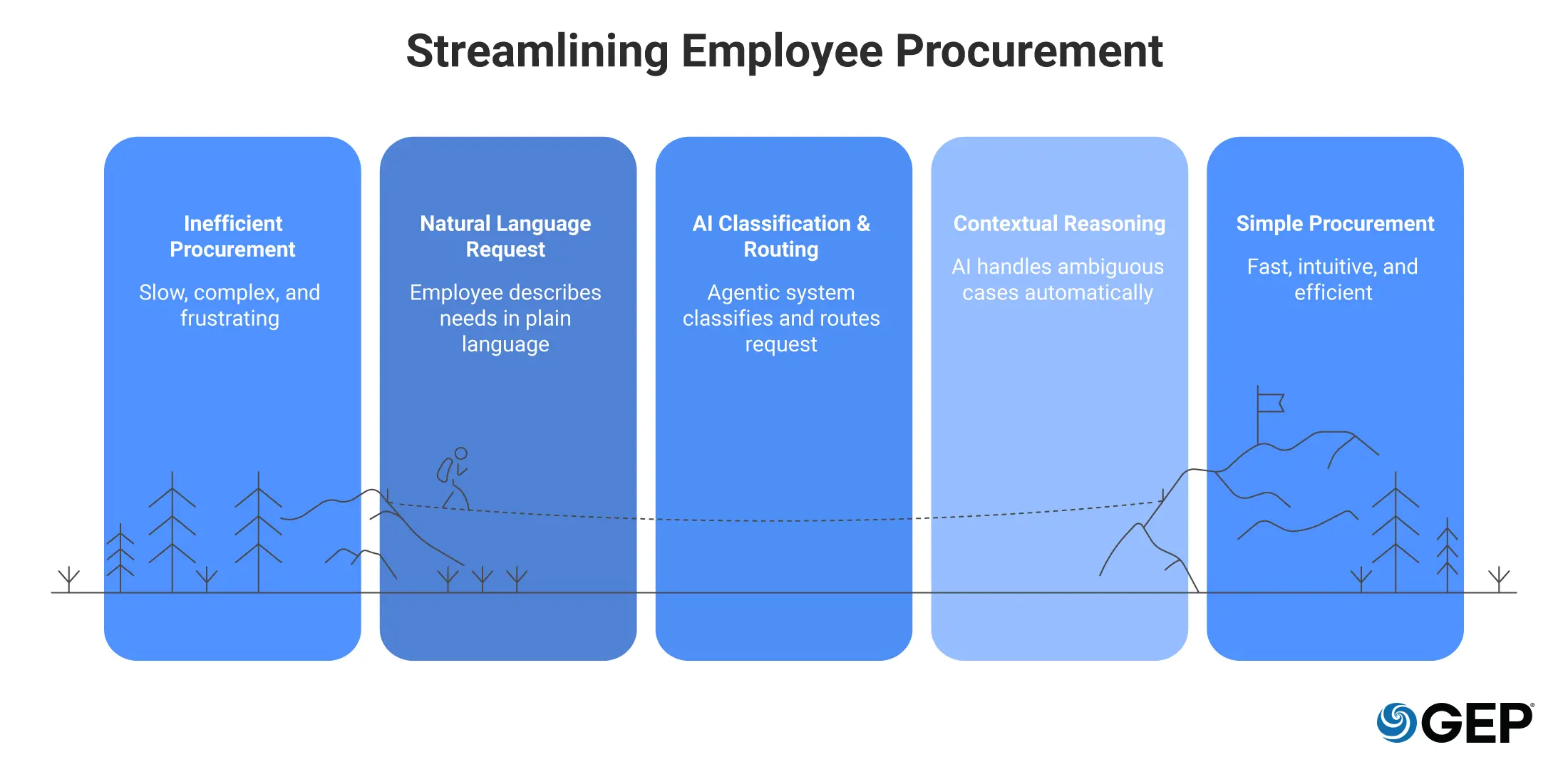
A form routes the request based on how it was configured. An agentic system reasons about the request in context, handling the ambiguous cases that a form would send to a human queue. For the employee the experience feels simple. Behind it, the AI is doing work that once required a procurement professional to intervene.
For the Procurement Professional: From Task Manager to Outcome Deliverer
For procurement professionals, the job can still feel like coordination. Building sourcing events, reviewing third-party contracts and triaging invoice exceptions are time-consuming by default. Most of that time is coordination, not judgment.
Agentic orchestration changes the operating model. A sourcing manager types a prompt and the Strategic RFP Creator agent builds the full event, drawing on category intelligence, historical data and policy. When bids come in the Award Optimization Agent runs scenario analysis and surfaces the optimal award strategy. The sourcing manager makes the strategic call. The agents handle the execution.
In contracts the Contract Authoring and Orchestration Agent drafts a new agreement in minutes. When third-party paper arrives the AI Redlining and Review Agent reads it against the internal playbook and flags deviations by risk level. The procurement power user handles the strategy, the AI handles the execution.
This sets procurement pros free to focus on the supplier relationships, category strategies and cross-functional work that create genuine value. The function does not just run faster: it becomes capable of work it never had time for before.
For the CPO: Intelligence That Connects to Decisions
The experience gap at the executive level is different. CPOs typically have data. What they often lack is the analytics on that data to make the best decision in the right time. A commodity price movement, a supplier health indicator and a contract expiry exist in separate systems and arrive at different times. By the time they are synthesized, the window for action has often closed.
Agentic orchestration connects signals to action in real time. The Market Intel Agent delivers commodity pricing, supplier risk indicators and tariff scenarios as they shift, in the flow of work rather than a weekly report. The Category Action Center surfaces these as prescriptive recommendations: a contract expiring with a financially stressed supplier, a market index movement affecting an open sourcing event, a category strategy that needs revisiting. The CPO does not have to go looking for insights, because they’re already there with a recommended action.
This is the dimension where the gap between where most enterprises are and where they need to be is greatest. A May 2026 Gartner survey of 140 senior supply chain leaders found that only 17% are pursuing transformational redesign of their workflows using AI. The remaining 83% are applying it incrementally. Incremental AI improves tasks, but it doesn’t orchestrate better outcomes.
See What Orchestration Looks Like in Practice
Eliminate the Gaps That Are Holding Procurement Back
One Answer to the Question
Why agentic? Because every person in this picture is experiencing the same underlying problem. The systems meant to help them are not connected, not intelligent and not fast enough.
Total agentic orchestration addresses that at every level, with AI that reasons and executes across systems rather than routing tasks between them. Simpler for the employee, more powerful for the professional and more intelligent for the executive. It all starts with the user.