
Beyond the Four Walls: How Total Agentic Orchestration Extends Procurement Across the Entire Value Chain
- The biggest risks to enterprise performance in 2026 don’t originate inside procurement. They originate in supplier networks, supply chain ecosystems and geopolitical dynamics.
- The third dimension of Total Agentic Orchestration extends orchestration from source-to-pay across the entire value chain, connecting suppliers, partners, operations and finance into a single intelligent system.
- This is the dimension that separates a truly autonomous enterprise from one that has simply automated its internal processes. And it’s territory that most platforms have never attempted.
May 28, 2026 | Procurement Software 4 minutes read
The first two dimensions of Total Agentic Orchestration do something genuinely powerful. They create a seamless, intelligent procurement function, where every request enters through a governed front door and flows through a connected source-to-pay engine without friction or failure. For most organizations, reaching that state would be a significant leap forward.
But it would still leave the most consequential risks unaddressed. The risks that define enterprise performance in 2026 — geopolitical instability, commodity volatility, supplier financial stress, multi-tier dependencies — don’t live inside procurement’s four walls. They live in the ecosystem beyond them. And they cannot be managed by a system that stops at the source-to-pay boundary.
The third dimension of Total Agentic Orchestration is built for exactly this territory.
Where Most Platforms Stop
Every enterprise procurement platform, however sophisticated, has an implicit boundary: the edge of the organization. It manages what procurement buys, how it buys it and who it buys it from. What it cannot do — what most platforms were never designed to do — is orchestrate the flow of information, risk signals and decisions across the supplier network that makes those purchases possible.
The consequence is a visibility gap that procurement leaders know well but struggle to close. According to a Gartner survey, only 19% of organizations fully integrate scenario planning into their supply chain strategies. And the Hackett Group’s 2026 Procurement Executive Insight Report found that only 43% of purchasing categories have proactive risk monitoring in place. The majority of supply exposure is managed reactively — addressed when something goes wrong rather than anticipated before it does.
In a stable world, that gap is manageable. In a world defined by trade wars, commodity cycles, logistics disruptions and geopolitical instability, it is not. Supply chain disruptions in 2024 led companies to incur financial losses averaging around 8% of their annual revenues. That is not a cost that better internal processes can absorb. It requires a fundamentally different architecture.
What the Third Dimension Does
The third dimension extends orchestration beyond source-to-pay to the entire value chain. It connects procurement’s internal intelligence — the supplier data, category strategies, contract terms and risk assessments built across Dimensions 1 and 2 — to the external ecosystem of suppliers, sub-tier partners, logistics providers and market signals that determine whether that intelligence is sufficient.
Multi-tier supply chain visibility gives organizations sight beyond their direct suppliers, illuminating the sub-tier dependencies where the most serious hidden risks tend to accumulate.
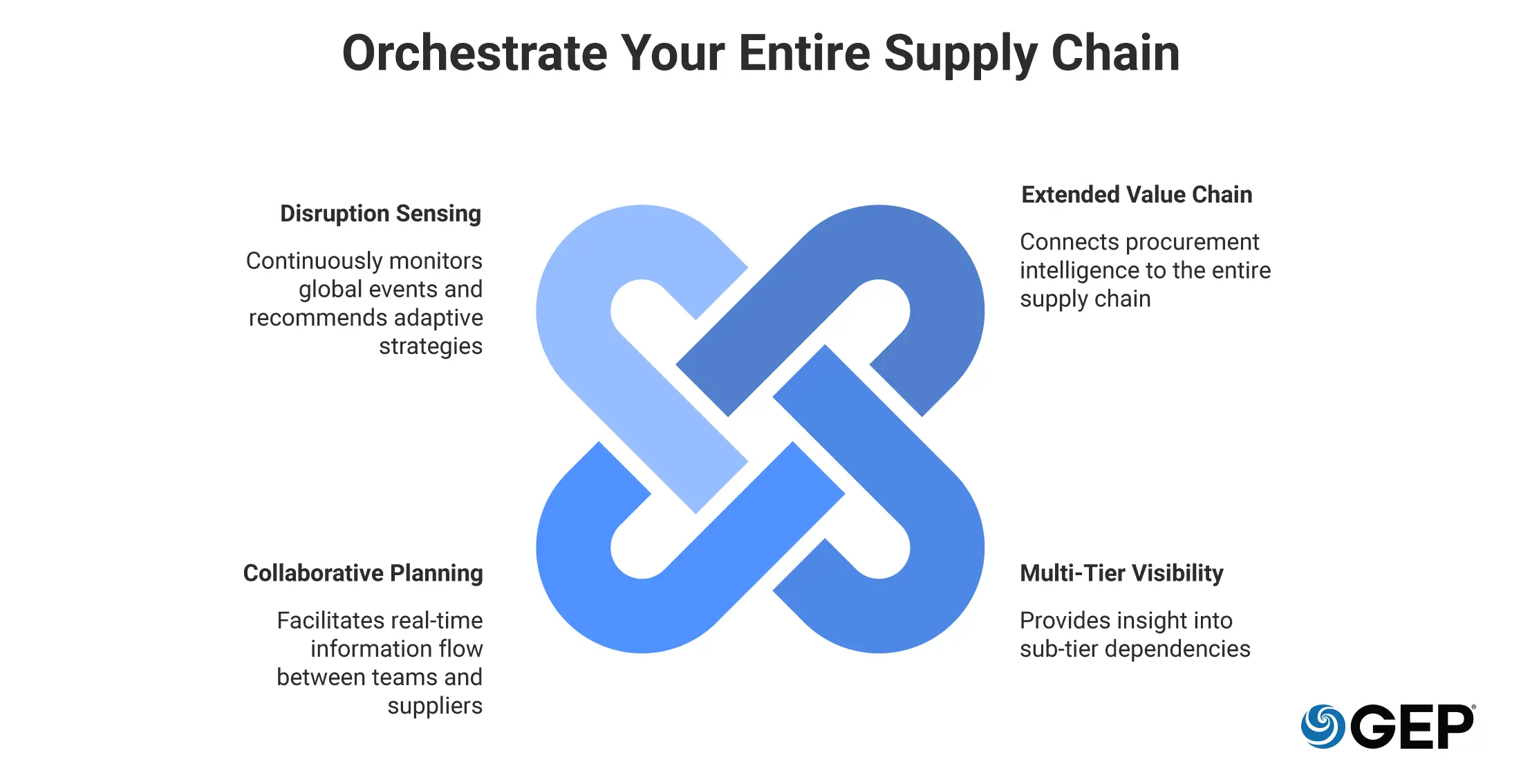
Collaborative demand and supply planning brings internal teams and external suppliers into the same information flow, replacing sequential batch-based forecasting with real-time shared intelligence. And AI-powered disruption sensing continuously monitors global events, models scenarios and surfaces adaptive strategies before disruptions reach the point of crisis.
This is what orchestration looks like when it operates at ecosystem scale: not a dashboard that reports on what has happened, but an intelligent system that senses what is emerging and recommends how to respond.
The Internal Dimension of Ecosystem Orchestration
Ecosystem orchestration is not only outward-facing. It also breaks down the walls between procurement and the internal functions whose decisions shape supply chain performance: finance, operations, planning and commercial leadership.
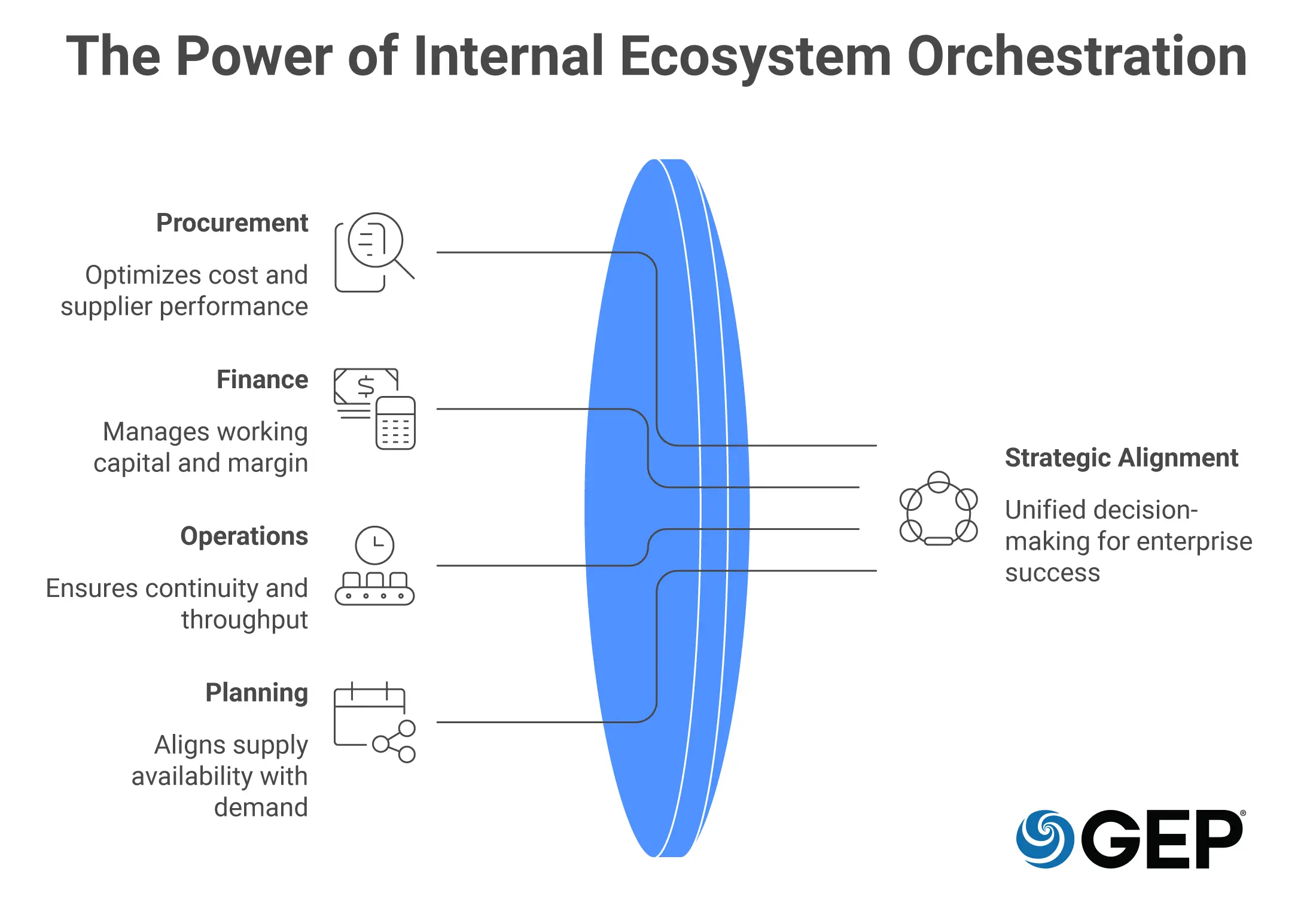
In most enterprises, these functions operate with different data, different planning cycles and different definitions of success. Procurement optimizes for cost and supplier performance. Operations optimizes for continuity and throughput. Finance optimizes for working capital and margin.
When these objectives are pursued independently, they create their own fragmentation: procurement decisions that create operational risk, financial constraints that undermine sourcing strategy, planning assumptions that bear no relationship to actual supply availability.
The third dimension resolves this by extending the connected data and decision fabric that runs through Dimensions 1 and 2 across the full enterprise. When procurement, finance, operations and supply chain planning share a unified view of supplier health, demand signals and risk exposure, strategic alignment stops being an aspiration and becomes an operational reality.
Start on the Path to Autonomous Procurement
Move Beyond Task Automation to True Agentic Orchestration
The Competitive Frontier
The first dimension of Total Agentic Orchestration solved a problem most organizations recognized: intake chaos and poor user adoption. The second solved a problem most organizations felt: fragmentation across the source-to-pay lifecycle. The third addresses something more fundamental: the gap between what procurement can see and what it actually needs to see to protect enterprise value in a volatile world.
Most platforms have mastered the first dimension to some degree. Many are working toward the second. The third remains largely uncharted territory. Not because the need isn’t clear, but because it requires a depth of supply chain domain expertise, a supplier network and an agentic AI architecture that very few organizations have built.
The enterprises that close this gap will not just have better procurement; they will have a genuinely autonomous supply chain that can sense, decide and adapt faster than the disruptions it faces.