More Agents, Same Chaos: Why Procurement Scale Requires Orchestration
- Agentic AI raises expectations for procurement speed and autonomy. But agents operating without orchestration reproduce fragmentation at higher volume rather than eliminating it.
- Scaling procurement is not a task problem. It is a coordination problem. Agents handle tasks. Orchestration handles the connections between them.
- What makes agent output usable at enterprise scale is a unified data fabric, embedded domain intelligence and end-to-end process control working as one.
August 03, 2026 | Procurement Software 5 minutes read
Every procurement leader has heard the pitch by now. Deploy AI agents across your source-to-pay process, automate the repetitive work and watch the function transform. The logic is appealing. The math, on the surface, seems to work.
But the math only holds if the agents have somewhere coherent to operate. In most enterprise procurement environments, they do not. Systems are fragmented. Data lives in silos. Policies are applied inconsistently. Supplier context sits in one platform, contract terms in another and spend history somewhere else entirely.
In that environment, adding more agents does not solve the scale problem. It makes the coordination problem faster and more visible. The missing layer is not AI capability. It is orchestration.
What AI Agents Can and Cannot Do
AI agents are genuinely capable. They can read and classify documents, draft RFx packages, route requests, flag risk signals and generate supplier summaries at a speed no human team can match. For well-defined tasks with clear inputs and outputs, they deliver real value quickly.
The limitation is not intelligence. It is scope. A single agent operates within the boundaries of what it can see and what it has been told to do. It does not know what happened upstream in a different system. It does not know what policy applies to the downstream consequence of its action. It does not know when to stop, escalate or defer to a human.
The central risk with agentic AI in procurement is confidence without context. An agent can produce an output that looks correct but is built on incomplete information, because the data it needed existed somewhere it could not reach. At small scale, that is manageable. At enterprise scale, it compounds into a different class of problem.
Workflow Orchestration Is Not the Same as Procurement Intelligence
Learn what separates platforms that move work faster from platforms that drive better outcomes
Procurement Is a Coordination Problem, Not a Task Problem
The reason automation has not solved procurement at scale is not that the tools lack capability. It is that the underlying problem is architectural.
Procurement decisions are not isolated events. A sourcing request connects to a category strategy, which connects to a preferred supplier list, which connects to a risk profile, a contract and a set of performance obligations. Every node in that chain depends on context from the others.
An agent that optimizes one node without visibility into the rest does not scale procurement. It creates faster activity at that node while leaving the coordination gap intact. Cycle times on individual tasks improve. End-to-end process time stays flat or gets worse, because the bottleneck has moved rather than been removed.
This is the structural problem that AI agents alone cannot fix. Orchestration is what addresses it.
Explore GEP’s - AI-Native Procurement Software
What Orchestration Actually Provides
Orchestration is not a layer on top of agents. It is the environment that makes agents coherent. In practical terms, it provides three things agents cannot supply on their own.
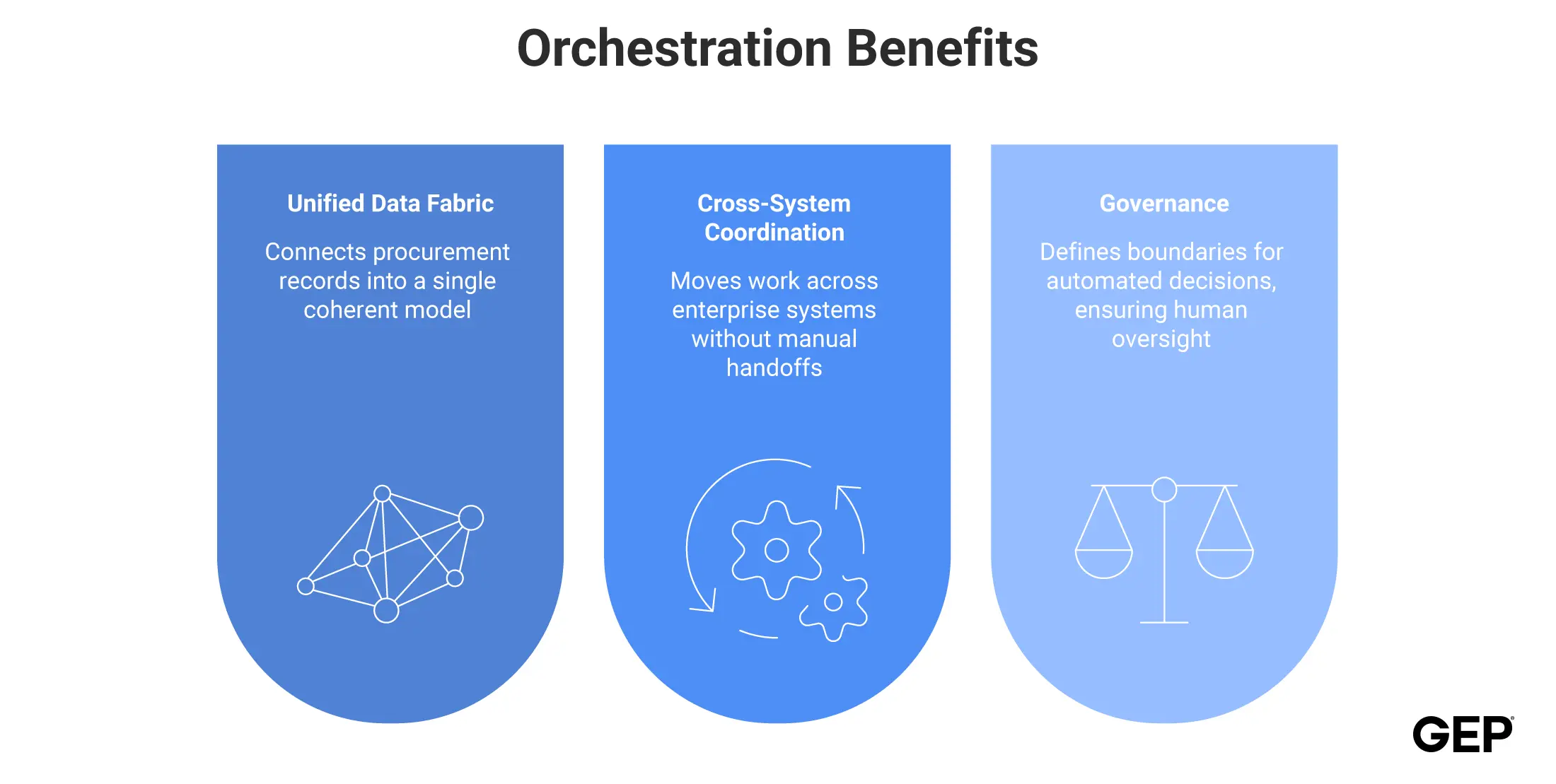
A unified data and decision fabric
Procurement intelligence is relational. The value of knowing a contract exists is inseparable from knowing which supplier it covers, which categories it governs and what the exposure is if it lapses. Orchestration connects those records into a single coherent model that agents can reason across rather than each operating on an isolated slice of data.
Cross-system process coordination
Enterprise procurement spans ERP, sourcing platforms, contract lifecycle management, supplier management and AP systems. Orchestration moves work across those systems without manual handoffs, maintaining context at each step so nothing is lost between tools.
Governance
Not every procurement decision should be automated. Some require human judgment, legal review or a compliance audit trail. Orchestration defines those boundaries: what agents execute autonomously, what they surface for human decision and what they escalate immediately. Without that layer, agents act with confidence in situations that call for caution.
What Orchestrated Agentic AI Actually Delivers
When agents operate within a properly orchestrated environment, the picture changes substantially.
A sourcing request enters through a single intelligent front door. The orchestration layer classifies it, checks existing contracts and preferred suppliers, applies the right policy and routes it to the correct downstream process automatically. If a preferred supplier already covers the need, the agent surfaces that before a new sourcing event is triggered.
Contract renewals do not wait for someone to notice an expiry date. The system monitors obligations continuously, alerts owners with enough lead time to negotiate and triggers the renewal workflow without a human having to remember it exists.
Supplier onboarding does not stall at the handoff between procurement and risk. The orchestration layer coordinates compliance screening, financial assessment and documentation collection in parallel, reducing a process that might take weeks to one that takes days.
In each case, the agent is doing the execution. The orchestration layer is what makes that execution coherent, compliant and connected to the broader enterprise context. Procurement stops processing requests reactively and becomes what it is capable of being: a function that anticipates demand, manages risk proactively and drives value across the supply chain.
The Right Frame for Agentic Investment
The question procurement leaders should be asking is not how many agents to deploy. It is what orchestration architecture those agents will operate within.
An agent without orchestration is a capable tool with no organizational context. It can complete a task but cannot participate in a process. It can produce an output but cannot ensure that output connects correctly to what comes before and after it.
Orchestration is what gives agentic capability somewhere coherent to go. It is also what determines whether AI investment compounds in value over time or accumulates as another layer of complexity to manage.
The enterprises that will get the most from agentic AI in procurement are not the ones that deploy the most agents. They are the ones that build the orchestration architecture first.