



Rewriting the CPO Agenda: From Savings Targets to Strategic Value Creation
- Procurement leaders anchoring their mandate to cost savings alone are losing influence at the enterprise level, where strategic value, resilience, and supplier innovation now set the pace.
- AI-native tools and integrated operating models give CPOs the intelligence and workflow capacity to shift procurement from a back-office cost center into a front-line value driver.
- CPOs who redefine success metrics, from savings rates to total value delivered, are better positioned to attract strategic suppliers, shape enterprise outcomes, and lead through volatility.
July 14, 2026 | Procurement Strategy 8 minutes read
Chief Procurement Officers are walking into a different conversation with leadership. Tariff volatility, supply disruptions, regulatory complexity, and ESG accountability have changed what enterprises expect from procurement, and a savings number no longer captures any of it. Boards want to know what procurement contributes to growth, resilience, and competitive positioning.
Meanwhile, many procurement organizations are still judged almost entirely on what they reduce. That gap between what procurement can deliver and what the enterprise is asking for is the core tension driving the mandate shift happening right now.
This blog explores why that shift is accelerating, what strategic value creation genuinely looks like within a procurement function, and what CPOs need to do to lead it.
Build a Procurement Operating Model That Delivers Enterprise Impact
GEP works with CPOs at leading enterprises to design procurement models built for strategic value.
The Death of the Savings-Only Mandate
Here is the honest reality: cost savings still matter. Nobody is arguing otherwise. But when savings become the only thing procurement is measured on, the function quietly boxes itself out of the conversations that shape the business.
A procurement team operating as a cost center gets called in at contract renewal time. It gets looped in when a supplier fails. It does not get a seat at the table when the business is deciding which markets to enter, which product lines to accelerate, or how to structure the supply base for the next five years. That exclusion is not accidental, as it reflects exactly how leadership perceives the function's scope.
Organizations that have broken out of this model have done something deliberate: they have repositioned procurement as the part of the business with the clearest visibility into supplier ecosystems, commodity risk, and operational exposure. That visibility, when used well, is genuinely hard to replicate elsewhere in the enterprise.
Defining Strategic Value in the Modern Procurement Ecosystem
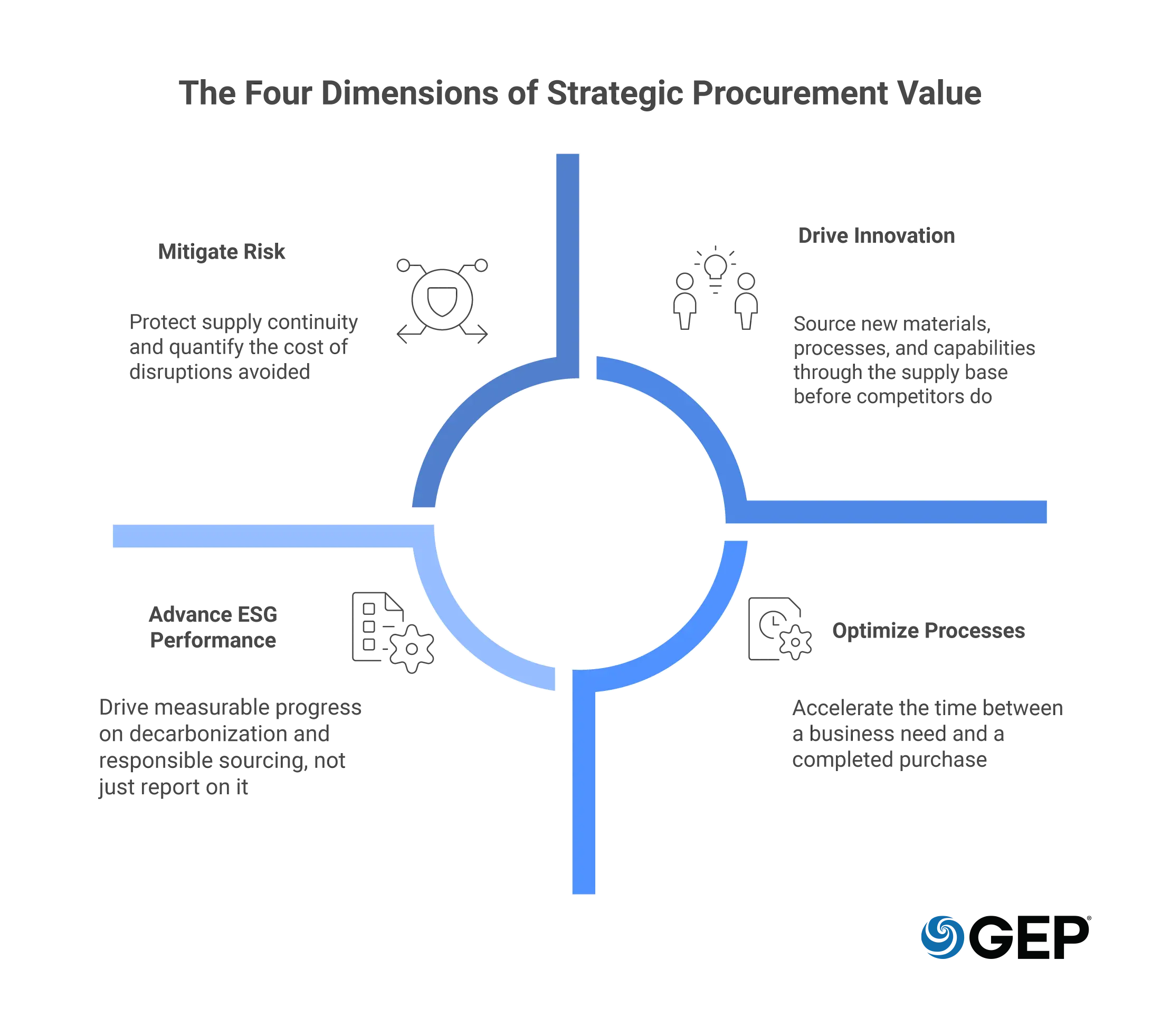
Strategic value is not a soft concept. It shows up in numbers, just different numbers than the ones most CPOs are currently reporting.
Think about what procurement uniquely touches: every significant supplier relationship, every major spend category, and the contracts that govern how the business operates under stress. When those levers are managed strategically, the outcomes include supply continuity during disruptions, faster product launches through supplier collaboration, cleaner ESG data for regulatory reporting, and working capital improvement through smarter payment terms.
CPOs who are already in this space tend to think about value across four areas:
- Risk-adjusted savings: not just price reduction, but the cost of disruptions avoided and the supply continuity that was quietly protected.
- Supplier-driven innovation: new materials, processes, or capabilities sourced through the supplier base often before competitors have access to them.
- ESG performance: using contracts and supplier monitoring to make measurable progress on decarbonization and responsible sourcing, not just to report on it.
- Operational speed: cutting the time between a business need and a completed purchase, so teams stop working around procurement and start working through it.
None of that fits a savings-only scorecard. That is exactly the problem CPOs need to solve with their CFOs and CEOs before anything else changes.
Catalysts Driving the New CPO Priority Shift
A few things have converged to make this the right moment for the shift, not just strategically, but practically.
Regulatory pressure is one. Frameworks like the EU's Corporate Sustainability Reporting Directive (CSRD) now require enterprises to account for supply chain emissions, supplier labor practices, and ESG risk in granular, auditable ways. Procurement owns the supplier relationships where that data lives. That makes the function structurally central to compliance, not peripheral.
Geopolitical disruption is another. The past few years have been unambiguous about what happens to organizations that optimized purely for cost without building sourcing flexibility. The ones that came through better had already invested in resilient supplier networks, dual sourcing, and visibility into their supply base beyond tier one. That kind of resilience is a procurement outcome; it just never showed up in a savings report, which is part of why it was underfunded for so long.
Technology has also made the shift genuinely feasible. AI-native platforms can now aggregate spend data across categories, monitor supplier risk signals in real time, and automate routine approvals without adding headcount. That frees procurement teams to focus on work that requires real judgment: category strategy, supplier development, and commercial negotiation on complex deals.
How Successful CPOs Are Redefining Procurement Success Metrics
The metric conversation is where most of this either lands or falls apart. CPOs who have successfully repositioned their function have almost always started here by getting explicit alignment with the CFO and CEO on what "value" means before trying to change anything else.
What that looks like in practice: the old scorecard tracked savings achieved, PO cycle time, and contract compliance. The new one keeps those, but adds supplier-led cost avoidance events, ESG data coverage across the supply base, the share of strategic spend under active category management, and procurement input into new product introduction timelines.
The reason this matters is straightforward. Metrics drive behavior. If the only number the team is held against is savings, that is where attention goes, even when the business would benefit more from procurement time spent elsewhere. Changing the scorecard is not just a reporting decision; it is a signal about what kind of function procurement is expected to be.
Redefine What Procurement Delivers
See how leading CPOs are shifting from savings mandates to strategic value creation.
Role of Technology in Enabling Strategic Value Creation
The operating model shift requires data that most procurement teams do not currently have clean, reliable access to: supplier performance history, real-time spend visibility, contract compliance signals, and ESG metrics from across the supply base. Without that foundation, strategic procurement remains more of an aspiration than an operating reality.
AI-native platforms close that gap by pulling data together across source-to-pay workflows and surfacing intelligence at the point where decisions are made, not in a weekly report that is already three days old by the time anyone reads it.
Three capabilities matter most in this context:
Predictive risk signals: let procurement teams get ahead of supplier problems, financial stress, geopolitical exposure, and capacity constraints before those problems affect operations. The difference between early warning and after-the-fact response is often the difference between a managed risk and a business disruption.
Automated compliance workflows: take routine tasks off the plate entirely. PO approvals, contract renewal alerts, policy exception routing, when these run on their own, procurement professionals can spend their time on things that need them.
Structured ESG data collection: makes it possible to gather and validate supplier sustainability data at scale. Without this, ESG commitments made at the board level tend to stall at the supplier engagement stage, where the data is sparse and inconsistent.
What ties this together: technology does not make a strategic case for procurement. But it gives CPOs the data and the operational capacity to make that case themselves credibly, in real time, in front of the people who need to hear it.
How CPOs Can Successfully Transition to a Value Creation Model
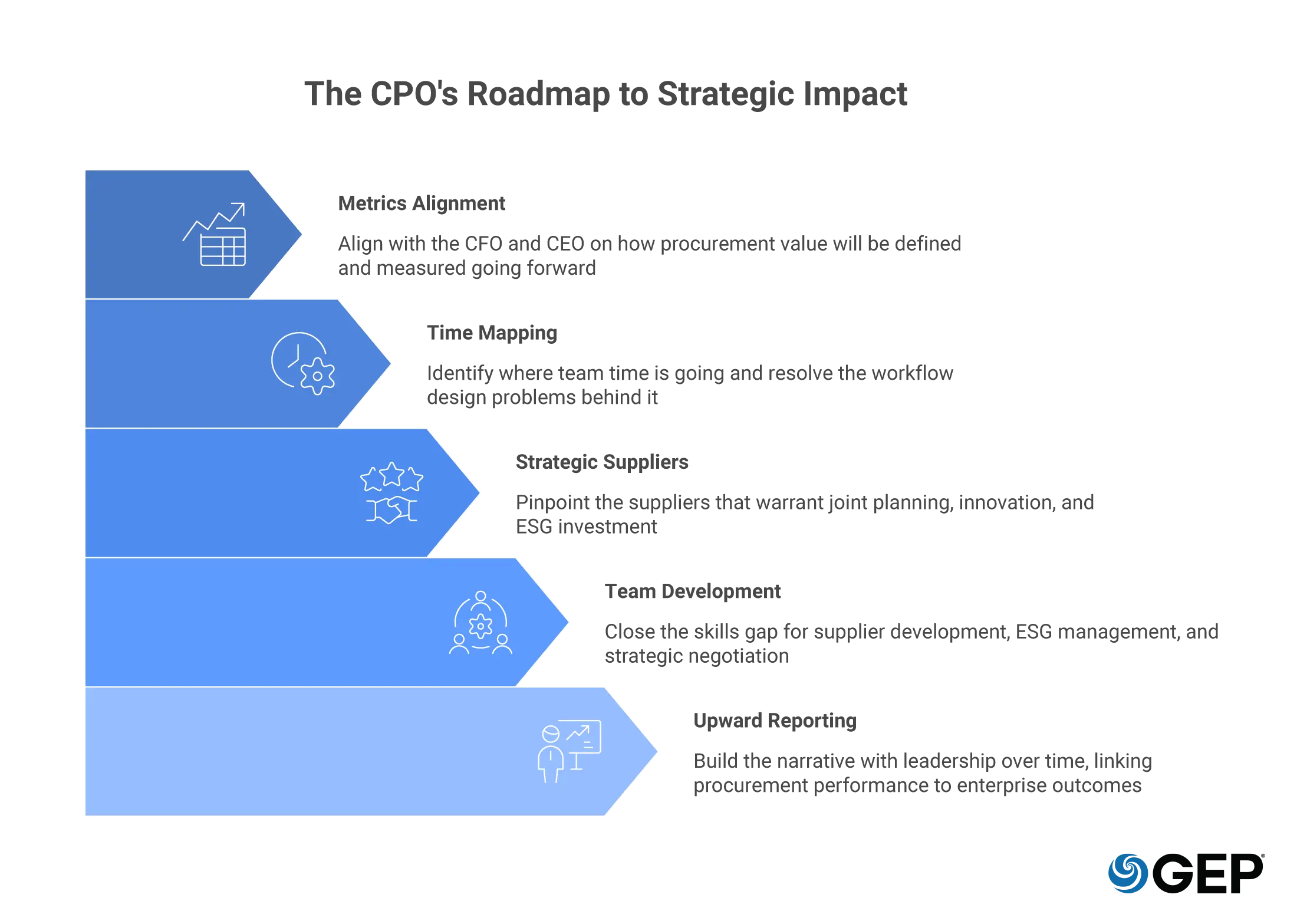
This is not a single project with a completion date. It is a set of choices that must be made in sequence and held consistently over time.
Align on metrics first: Before restructuring anything else, get to explicit agreement with the CFO and CEO about how procurement's contribution will be measured going forward. This sets the mandate and protects the investment in everything that follows.
Map where time is going: In most procurement organizations, a significant share of team time is absorbed by transaction processing and approval chasing. That is a workflow design problem, and it is largely solvable with the right technology. Fixing it creates the capacity for strategic work without requiring new headcount.
Identify which suppliers are genuinely strategic: Typically, somewhere between 10 and 15 percent of the supply base warrants real investment: joint business planning, innovation pipelines, ESG development programs. Knowing which suppliers those are and treating them differently is foundational to everything else.
Develop the team for the new scope: Procurement professionals who are strong cost negotiators may need real development to lead supplier innovation conversations or manage ESG data programs. That gap is worth addressing explicitly, not hoping it resolves on its own.
Report differently upward: CPOs who have made this transition stick tend to be consistent and deliberate about how they communicate with leadership, connecting procurement outcomes to business outcomes, showing the value that did not show up in savings, and building the narrative over multiple quarters until it becomes how leadership thinks about the function.
The Future-Proof CPO as an Enterprise Enabler
The CPO who owns cost savings alone is operating in a shrinking lane. Boards and CEOs are asking for procurement to account for supply chain resilience, ESG exposure, and supplier-driven growth in ways that a savings-only mandate simply cannot address. That is not a future shift; it is already the expectation in most large enterprises.
The functions that are ahead of this have already moved: different metrics, broader supplier relationships, AI-native technology underpinning their operations, and a CPO who is in the room for decisions that matter. Getting there is not easy, but the path is clear enough. Start with the conversation about what value means. Everything else follows from that.
If you want to explore how to operationalize this transition at scale, talk to us.




FAQs
Savings still matter, but the pressures on enterprises have changed what they need from procurement. Geopolitical disruption, ESG regulation, and supply chain volatility have made resilience, sustainability performance, and supplier collaboration just as business-critical as cost reduction. Organizations measuring procurement on savings alone are asking the function to optimize for the wrong thing.
When intake is automated, routing requests, flagging exceptions, and handling approvals without manual intervention, procurement teams stop spending their days on transaction management. That recaptured time is what makes strategic work possible: category planning, supplier development, and commercial engagement on deals that need attention. The operational efficiency is not the point; it is what efficiency makes room for.
The best suppliers have options. They make decisions about where to invest relationship capital, share early access to innovation, and go beyond contractual minimums. A procurement function that engages them purely in price and compliance terms signals a low ceiling for the relationship. When procurement operates strategically with joint planning, shared data, and genuine development investment, it becomes the kind of customer top-tier suppliers want to prioritize.
Legacy metrics, almost always. When the CFO and CEO are still evaluating procurement on savings targets, the internal incentive structure resists every other change, regardless of intent. CPOs who have navigated this successfully started by securing explicit alignment at the executive level on how value would be defined and measured going forward.