


Intake Management & Procurement Orchestration: Are You Solving the Right Problem?
- Intake management and procurement orchestration solve distinct problems — one fixes how requests enter your process, the other fixes how they flow through it.
- The right place to start depends on where your organization feels the most pain: with requesters who can't engage procurement, or with a procurement team drowning in manual handoffs.
- The market is converging toward platforms that do both, but technology should follow strategy — not lead it.
July 28, 2026 | Procurement Software 8 minutes read
Intake management and procurement orchestration. Some providers use them interchangeably. Some treat one as a subset of the other. And a few have even rebranded the same product under both labels, depending on which one is trending that week.
So, what's going on here? And more importantly — which one does your organization actually need?
Let's cut through the noise. First, let’s define the terms.
Intake Management: The Front Door to Procurement
Intake management is exactly what it sounds like — it's about how requests enter your procurement process.
Think about how a typical purchase request works in most organizations today. Someone in marketing needs a new software subscription. They email their manager. The manager forwards it to procurement. Procurement asks for a business justification. The requester sends a Word doc. Someone asks for vendor details. A week passes. You get the idea.
Intake management tools fix this. They give every stakeholder — from a junior analyst to a VP — a single, structured way to submit procurement requests. Instead of a chaotic inbox or a maze of email threads, you get a clean intake form (or a conversational interface, in more modern tools) that captures everything upfront: what's needed, why it's needed, the budget, the timeline, and the preferred vendor.
The goal is simple: better inputs lead to faster, smarter procurement decisions.
Procurement Orchestration: The Engine Behind the Scenes
Procurement orchestration is a broader concept. It's about coordinating all the moving parts of the procurement process — across people, systems, and workflows — so that everything flows smoothly from request to contract to payment.
If intake management is the front door, orchestration is everything that happens inside the house.
That means routing approvals to the right people, triggering sourcing events when spending thresholds are crossed, syncing data between your ERP and your sourcing tool, managing supplier onboarding workflows, and ensuring compliance checks happen at exactly the right moment — not as an afterthought.
Procurement orchestration is fundamentally about eliminating the handoff failures that cause delays, maverick spend, and compliance gaps.
From Tasks and Workflows to Agentic Orchestration
How GEP Quantum Intelligence is Redefining the Way Procurement Works
Why the Confusion?
The overlap between these two concepts is real, and here's why: every orchestration platform needs an intake layer, and every mature intake tool eventually needs orchestration capabilities.
A procurement orchestration platform without a good intake experience is like having a perfectly tuned engine with no steering wheel. And an intake tool that doesn't connect to the broader procurement workflow is just a fancy form builder.
This is why vendors blur the lines. They're either expanding their intake tools to add orchestration capabilities, or they're building orchestration platforms that lead with intake as the "user-friendly" entry point.
Neither approach is wrong. But it matters which lens you're buying through.
The Key Differences That Actually Matter
Let's break this down practically.
1. Scope of Coverage
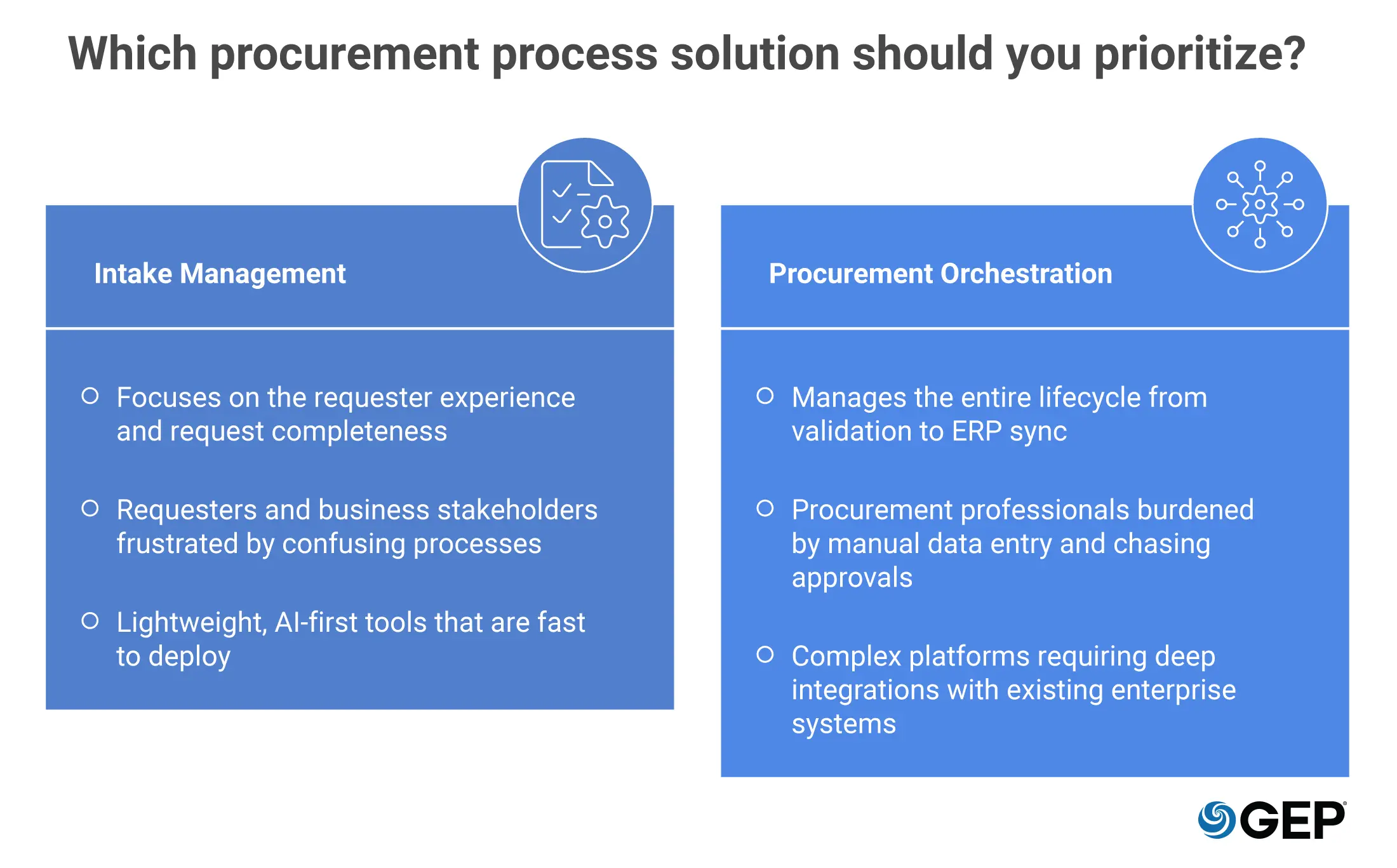
Intake management is primarily concerned with the requester experience. Who is asking? What do they need? Is the request complete enough to act on?
Procurement orchestration covers the entire lifecycle. It's asking: once a request is validated, what happens next? Who approves it? Does it trigger an RFP? Does it need legal review? Does it sync to the ERP? What's the status at any given moment?
If your biggest pain point is that requesters don't know where to submit requests — or that requests arrive incomplete and require multiple rounds of back-and-forth — you have an intake problem.
If your biggest pain point is that requests get submitted correctly but then fall into a black hole, or that your team is manually copying data between five different systems — you have an orchestration problem.
Most organizations, frankly, have both.
2. Who Feels the Pain
With intake management, the pain is most visible to requesters and business stakeholders. They're frustrated by confusing processes, lack of visibility, and slow response times. They've resorted to going around procurement entirely — which is how maverick spend happens.
With orchestration, the pain lands on procurement professionals themselves. They're the ones chasing approvals, manually triggering workflows, reconciling data discrepancies, and trying to maintain audit trails across disconnected tools.
This distinction matters when you're building a business case. Who's complaining the loudest? That often tells you where to start.
3. Technology Footprint
Intake management tools tend to be lightweight and faster to deploy. They sit in front of your existing tech stack and act as a coordination layer. Many modern intake tools are AI-first — using natural language interfaces or smart routing to guide requesters through the process.
Procurement orchestration platforms are typically more complex. They require deeper integration with your ERP, P2P tool, sourcing platform, contract management system, and supplier database. The value is enormous, but so is the implementation effort.
This doesn't mean you should always start with intake — but it's worth being realistic about organizational readiness.
A Tale of Two Organizations
Sometimes the best way to understand a distinction is through a real-world lens.
Organization A is a fast-growing tech company. They have 800 employees, a lean procurement team of three, and a culture where everyone is used to buying things quickly. The problem? Procurement is consistently bypassed. By the time the team hears about a new software contract, it's already been signed. When they dig in, they find that requesters simply didn't know how to engage procurement, so they didn't bother.
This organization's problem is intake. They need a frictionless, visible front door that makes it easier to involve procurement than to avoid it.
Organization B is a large manufacturer. They have a mature procurement team, a well-established P2P process, and clear policies. Requests come in fine. The problem is that every complex sourcing event still requires heavy manual coordination. The team spends 40% of their time chasing approvals, updating spreadsheets, and sending status updates. Their ERP doesn't talk to their sourcing tool, and their contract system is an island.
This organization's problem is orchestration. Their intake works. Their workflows don't.
Two very different diagnoses. Two very different solutions.
The Convergence Happening Right Now
Here's something worth paying attention to: the market is moving toward convergence.
The next generation of procurement platforms — many of them AI-native — are being designed with both intake and orchestration as core capabilities from day one. Rather than bolt one onto the other, they're built around the idea that the request experience and the workflow engine should be inseparable.
This is a meaningful shift. Historically, procurement technology was organized around transaction types: sourcing tools handled RFPs, P2P tools handled purchase orders, CLM tools handled contracts. The requester was always an afterthought — a user who had to navigate multiple systems to accomplish one goal.
The intake + orchestration paradigm flips this. It starts with the human need ("I need to buy something") and orchestrates everything downstream from that moment. The technology recedes into the background; the experience moves to the front.
For procurement leaders, this means the evaluation criteria for new tools should evolve. It's no longer enough to ask "how good is the sourcing module?" You should also be asking: "How does a request enter this system? How does it flow through it? What happens when it touches another system? And what does the requester see at every step?"
So, Which One Should You Prioritize?
Here's a simple framework to help you decide.
Prioritize intake management first if:
- Maverick spend is a persistent, growing problem
- Your procurement team struggles to get involved early enough in purchasing decisions
- Requesters frequently complain about not knowing how to engage procurement
- Your current intake process relies heavily on email, Slack messages, or informal conversations
- You're a smaller or scaling organization that needs quick wins
Prioritize orchestration first if:
- Intake is working, but downstream processes are chaotic and manual
- Your team is the bottleneck — not because of headcount, but because of process fragmentation
- You have significant system integration debt (tools that don't talk to each other)
- Audit, compliance, or reporting requirements are creating real risk
- You're a larger organization with complex approval hierarchies and multi-step workflows
Consider a combined approach if:
- You're investing in a net-new procurement transformation
- You're replacing a legacy P2P or ERP module and have the chance to rethink the whole experience
- You have budget and organizational appetite for a more holistic change
A Word of Caution
One trap to avoid: don't let technology lead the strategy.
It's easy to get seduced by a slick intake UI or an impressive orchestration demo and reverse-engineer a business case around it. But the most successful procurement transformations start with a clear understanding of where the friction lives — and then find the technology that removes it.
Talk to your requesters. Shadow your procurement team for a day. Map out an actual purchase request from start to finish and count the handoffs, the delays, and the manual steps. That exercise will tell you more about what you need than any analyst report or vendor pitch.
The Bottom Line
Intake management and procurement orchestration aren't competitors — they're complements. But they solve different problems, require different investments, and deliver value to different stakeholders.
Intake management is about making procurement accessible and frictionless for the people who need to buy things. Procurement orchestration is about making the process efficient, connected, and compliant for the people who manage it.
The best procurement organizations eventually need both. But knowing which problem is burning brightest right now — and solving that one first — is the difference between a transformation that sticks and a technology investment that disappoints.
Know your problem. Then choose your tool.Learn more about GEP’s AI-native intake and orchestration platform.




Frequently Asked Questions
Yes — and that's actually one of its biggest advantages. Most intake management tools are designed to sit on top of your existing stack rather than replace it. They act as a front-end layer that captures and routes requests, then hand off to whatever P2P, ERP, or sourcing tool you're already using. You get faster time-to-value without a rip-and-replace project. That said, the more connected your intake tool is to downstream systems, the more visibility and automation you unlock over time.
Not anymore. Orchestration used to be synonymous with heavyweight, enterprise-only platforms that required months of implementation and a dedicated IT team. That's changed. Newer platforms — especially AI-native ones — are bringing orchestration capabilities to mid-market organizations at a much lower entry point. If your team is spending significant time on manual handoffs, chasing approvals, or managing disconnected tools, orchestration is worth exploring regardless of company size. The question isn't "are we big enough?". It is "is the manual effort costing us more than the solution would?"
The metrics differ depending on which problem you're solving. For intake management, watch for reductions in maverick spend, faster time-to-first-response on requests, and requester satisfaction scores (a simple post-submission survey goes a long way). For orchestration, focus on cycle time reduction across sourcing and approval workflows, the percentage of spend under management, and how much time your procurement team reclaims from manual tasks. In both cases, establish a baseline before you go live — it's surprisingly common to implement a tool and then struggle to prove its value because no one measured the starting point.