


How an Integrated Supply Chain Drives Efficiency and Reduces Costs
- The best supply chain cost reduction program is better operational intelligence.
- Most supply chains are capable in parts. Integration makes them intelligent as a whole.
- Disruption becomes manageable when your supply chain operates as one connected system.
April 13, 2026 | Supply Chain Strategy 7 minutes read
For most enterprise organizations, the supply chain is the single largest source of unresolved operational costs. An integrated supply chain connects every function into a single, synchronized operating model that eliminates the fragmentation responsible for most of the avoidable cost and delay.
This fragmentation comes in many forms: procurement making sourcing decisions without real-time logistics constraints, or finance teams reconciling spend data that operations teams stopped trusting months ago.
The value of supply chain integration is well understood today, but most organizations pursue it the wrong way, treating it as a basic technology implementation rather than an operating model reengineering. Companies invest in platforms that connect data but leave decision-making siloed, or they automate individual workflows without addressing the upstream visibility gaps that make those decisions unreliable in the first place.
What an effective supply chain integration truly requires is a combination of unified data infrastructure, AI-driven intelligence, and agentic automation that allows the supply chain to not only share information but also act on it continuously and autonomously, while keeping processes cost-effective and compliant.
This article explains what an integrated supply chain is, why it matters, and what it takes to build one that delivers measurable, lasting improvements in supply chain efficiency and cost.
What is an Integrated Supply Chain?
An integrated supply chain is a unified operational framework in which all supply chain functions share a common data environment and operate from synchronized, real-time information.
Each function, be it procurement, manufacturing, inventory management, logistics, or demand planning, is integrated into a single source of truth that flows continuously across the organization. So, decisions at every level reflect current conditions, as and when they occur.
Scale Your Operations with an Integrated Supply Chain
Align your global sourcing and logistics into a single, high-performance engine.
Why Integrated Supply Chain Matters?
The distinction between a traditional supply chain and an integrated one is clearest at the decision layer. In a conventional model, information moves sequentially. But in an integrated supply chain, that latency is eliminated as functions operate concurrently on the same data.
This makes end-to-end supply chain visibility a genuine operational advantage, enabling coordinated responses to demand shifts, supply disruptions, and cost pressures in real time.
End-to-End Operational Efficiency
Enterprise supply chain inefficiency rarely arrives as a single, visible failure. It accumulates, and each friction point seems manageable individually. However, collectively, they represent a measurable drop in performance.
An integrated supply chain removes the structural conditions that produce that drop. Demand signals flow directly into procurement, and procurement decisions update logistics and inventory positions in real time.
Agentic AI further powers up what the system can do on its own: monitoring supplier performance, flagging lead time anomalies, reallocating inventory, and initiating procurement actions, all within defined parameters, without waiting for human escalation at every step.
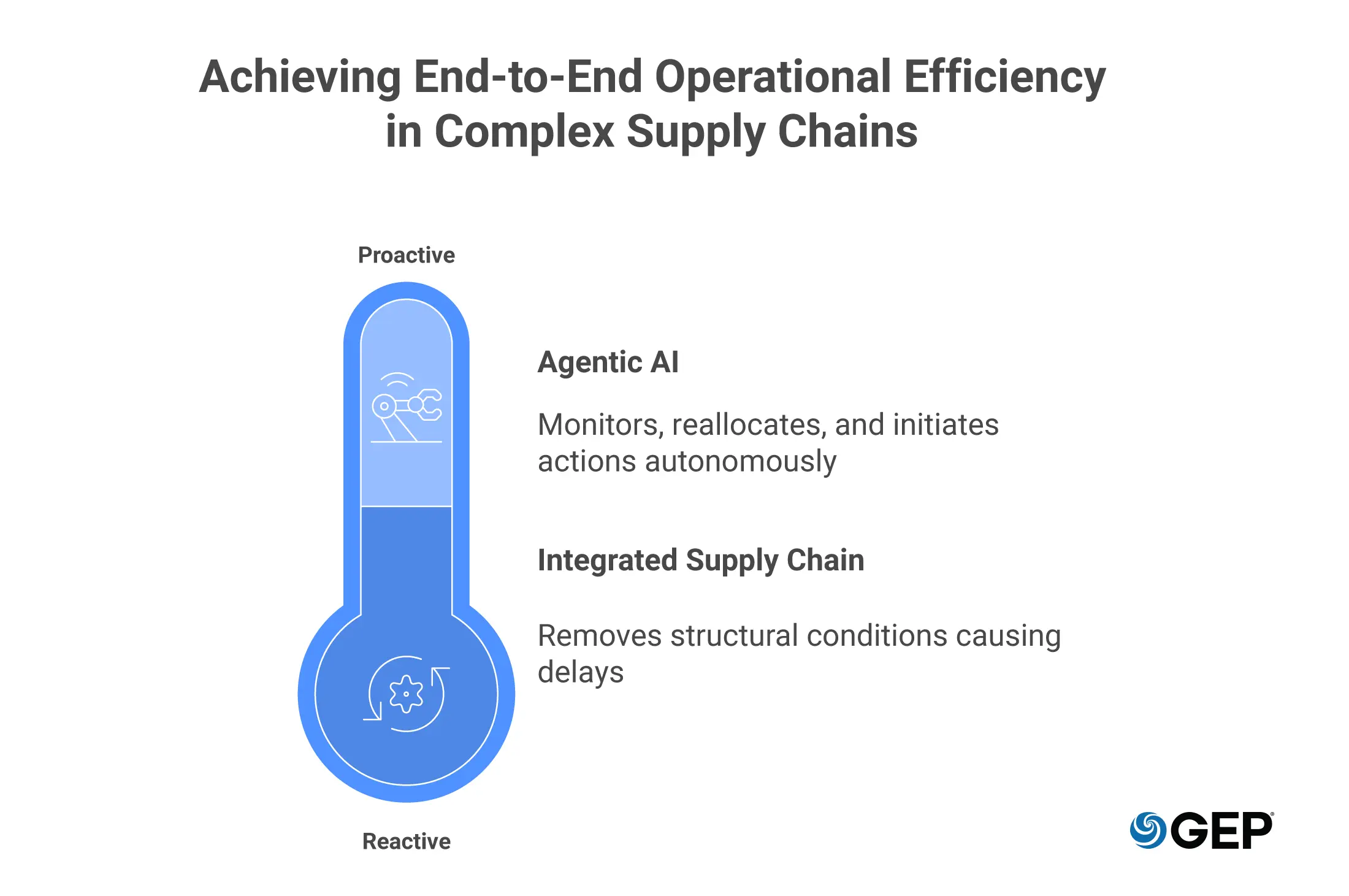
The operating model shifts from one that corrects problems after they occur to one that prevents them from compounding in the first place.
Reduced Costs Across Logistics and Operations
Most supply chain cost reduction programs target the visible: freight rates, supplier pricing, and headcount. The deeper and more durable savings are hidden deep within the decision architecture, and that is precisely where fragmented supply chains are most exposed.
Excess inventory carried against inaccurate forecasts, carrier selection made on incomplete data, procurement spend that is invisible in aggregate across business units: these are structural costs, and renegotiating contracts does not address them.
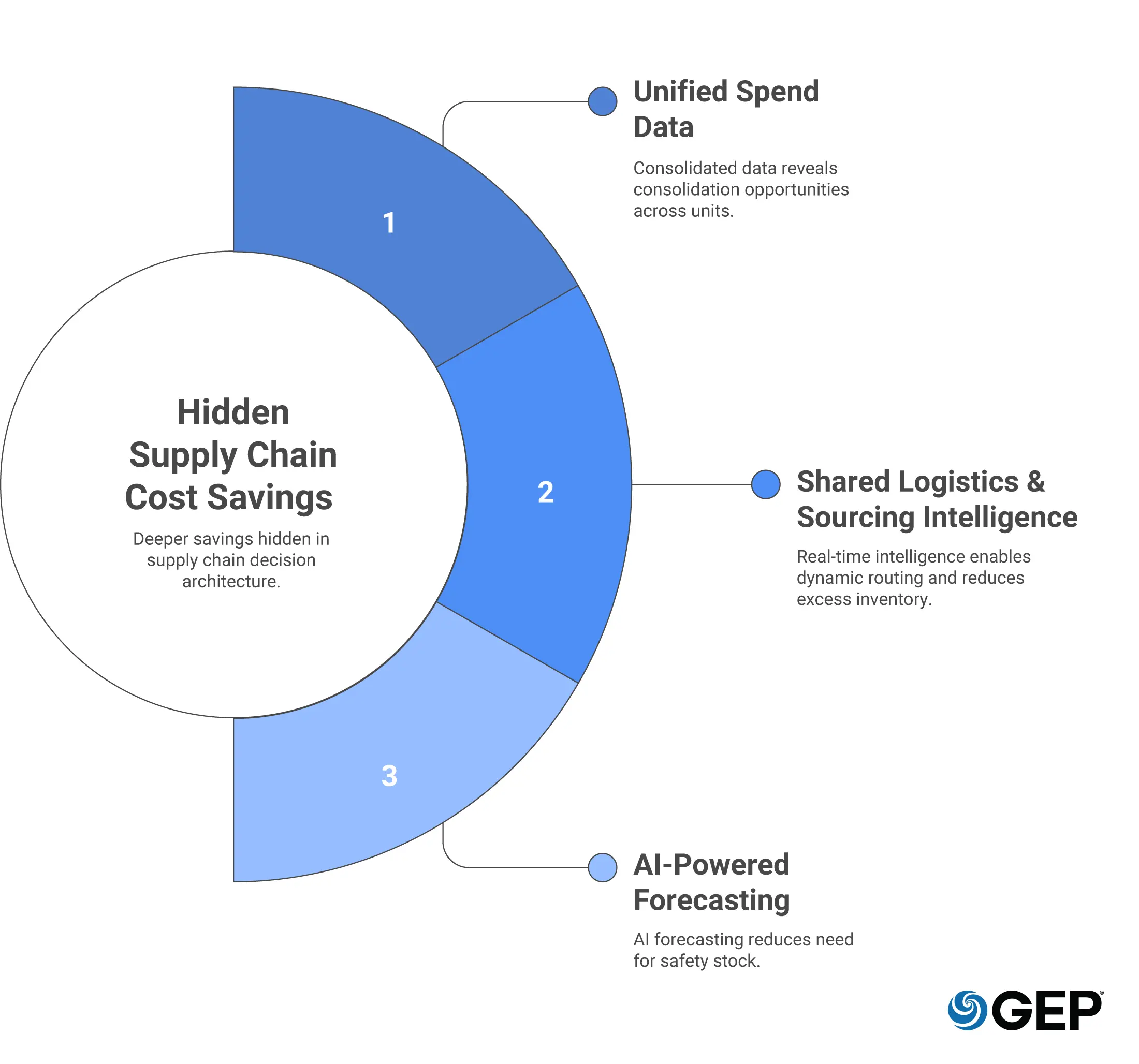
An integrated supply chain makes these costs visible and actionable.
- Unified spend data surfaces consolidation opportunities that siloed teams cannot see.
- Shared logistics and sourcing intelligence enables dynamic routing and inventory positioning based on live demand rather than outdated rules.
- AI-powered forecasting eliminates the need to hold safety stock as a hedge against poor visibility.
And because AI agents continuously refine their models as new data flows in, the cost improvements compound.
Key Components of an Integrated Supply Chain
The effectiveness of an integrated supply chain depends on the coherence of its constituent components.
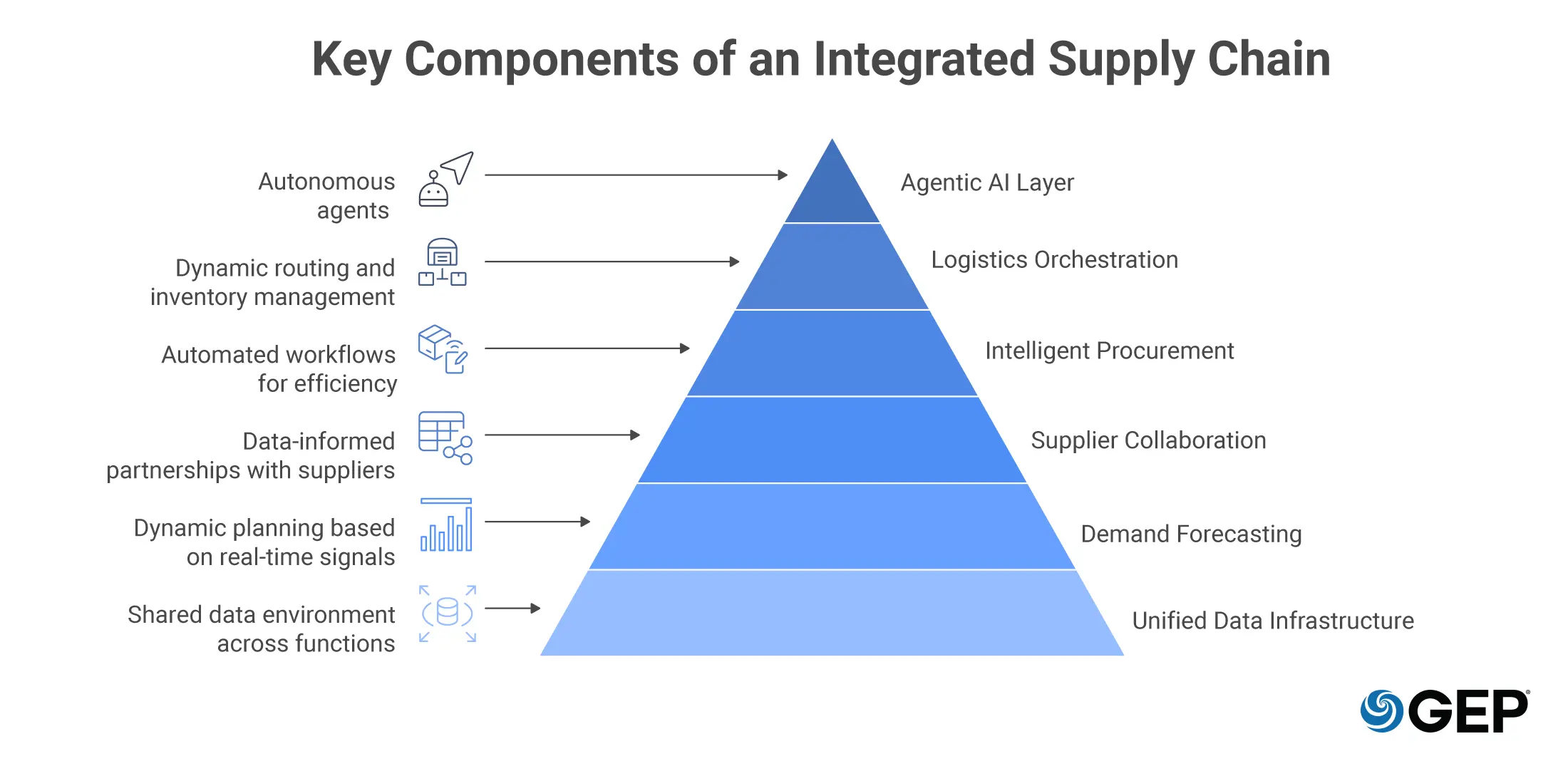
Each element contributes to the whole, and gaps in any one area will constrain the performance of the system overall:
Unified data infrastructure
Every function in your supply chain is generating valuable intelligence. The problem is that none of them is talking to the rest.
A unified data infrastructure fixes that at the root, keeping everything in one environment and offering a single version of reality shared across every function in real time. Everything else in this list depends on getting this right first.
Demand sensing and AI-driven forecasting
AI-driven demand forecasting continuously pulls information from live market signals and leading indicators, so inventory decisions and procurement are based on what is actually happening. It triggers alerts when consumption patterns change or geopolitical tensions arise, so teams can plan accordingly.
With advanced AI reasoning, leaders also receive recommendations on the next-best actions they can take to avoid pitfalls.
Supplier collaboration and performance management
Supplier risk does not announce itself in advance. By the time issues surface through traditional reporting, the cost of the problem is already locked in.
Real-time visibility into your supplier network helps you manage risk before it develops, not cleaning it up after it lands. You get insights on supplier capacity, lead times, compliance status, and risk exposure, helping you manage supplier relationships as active, data-informed partnerships.
Intelligent procurement workflows
Approval and sourcing cycles do not need to take as long as they do. Intelligent automation compresses those timelines significantly while keeping governance intact. Automated sourcing execution, contract lifecycle management, and approval workflows that reduce cycle times, without compromising governance or compliance requirements.
Logistics and fulfillment orchestration
Static routing rules are a form of technical debt. Dynamic orchestration allows your logistics layer to respond to live demand signals, adjusting positioning in real time rather than waiting for someone to update the model.
Carrier optimization and inventory positioning, driven by live demand signals, ensure that logistics decisions reflect current conditions and enable timely deliveries.
Agentic AI layer
Autonomous AI agents monitor conditions, evaluate options, and execute data-driven decisions within defined parameters across the supply chain. It orchestrates systems, workflows, and AI agents and only engages human judgment selectively at the points where it adds the most value.
This capability is what truly separates an integrated supply chain from a well-connected but still fundamentally manual operating model.
These components are individually valuable, but their combined effect within a fully integrated system is substantially greater than the sum of their parts. When each function both contributes to and draws from the same operational intelligence, the supply chain develops a capacity for anticipation and self-correction that no collection of discrete tools can replicate.
Best Practices for Building an Integrated Supply Chain for Long-Term Efficiency and Cost Control
Organizations that achieve durable results from a supply chain integration approach it as an operating model transformation rather than a technology deployment.
Data governance, cross-functional alignment, and executive sponsorship are central to the automation process. Organizations that invest in technical infrastructure while underinvesting in how teams operate within it consistently fall short of their integration objectives, because the platform enables what the organization still has to execute.
From a sequencing standpoint, establishing end-to-end supply chain visibility should precede any effort to optimize specific functions. Otherwise, you cannot act reliably on data you cannot see clearly or trust completely.
Build a clean, connected, real-time data foundation first, then layer in automation and AI where decision volume and cost impact are highest.
Agentic AI should be treated as a near-term operational priority, not a future roadmap item: the performance gap between organizations with autonomous supply chain intelligence and those without is already material and will continue to widen.
The Agentic AI Playbook for Procurement Pros
Your roadmap to move from pilots to production, with AI that adapts, learns, and delivers
The Integrated Supply Chain Is Now a Competitive Baseline
What was once considered an advanced operational capability is rapidly becoming the baseline expectation for enterprises that intend to compete on efficiency, resilience, and cost. The convergence of unified data infrastructure, AI-driven forecasting, and agentic automation makes the integrated supply chain an achievable near-term operating state.
Early adopters will naturally build strategic advantages that will be increasingly difficult for late movers to close.
Move from fragmented operations to a fully integrated model with a purpose-built integrated supply chain software that provides the architecture, intelligence, and scalability global enterprises need to compete and lead in an increasingly demanding operating environment.



FAQ's
The most significant challenges are data fragmentation, organizational misalignment, and legacy technology infrastructure that was never designed for cross-functional data sharing. Many enterprises also underestimate the change management dimension; effective integration requires procurement, logistics, finance, and operations to operate from shared data and shared accountability, which demands sustained leadership commitment rather than a one-time implementation effort. Supplier visibility beyond the first tier remains a persistent gap, as does the tendency to underinvest in the AI and automation layer that converts integrated data into operational action. Organizations that address all of these in parallel, rather than sequentially, tend to see the fastest and most durable results.
A conventional supply chain is a sequence of functions like sourcing, production, logistics, and delivery, each managed through its own systems and workflows, with information passed between them after the fact. The delays inherent in that model mean decisions are routinely made on data that is already incomplete or outdated. An integrated supply chain replaces that sequential handoff model with a concurrent one: all functions share a live data environment, and operational intelligence flows across the organization in real time. The result is measurably higher supply chain efficiency, more reliable cost control, and a supply chain that can adapt to changing conditions.
The benefits compound across operational, financial, and strategic dimensions simultaneously. Operationally, integration delivers the end-to-end supply chain visibility that eliminates blind spots responsible for stockouts, service failures, and delayed procurement cycles. Financially, supply chain cost reduction comes through smarter inventory positioning, unified spend visibility that enables sourcing consolidation, and automated workflows that lower the cost of procurement execution. Strategically, supply chain optimization through AI-driven forecasting and agentic decision-making repositions the supply chain as a proactive competitive asset for enterprises operating across multiple geographies and product categories.