


What Makes an AI-Native Procurement Platform Work?
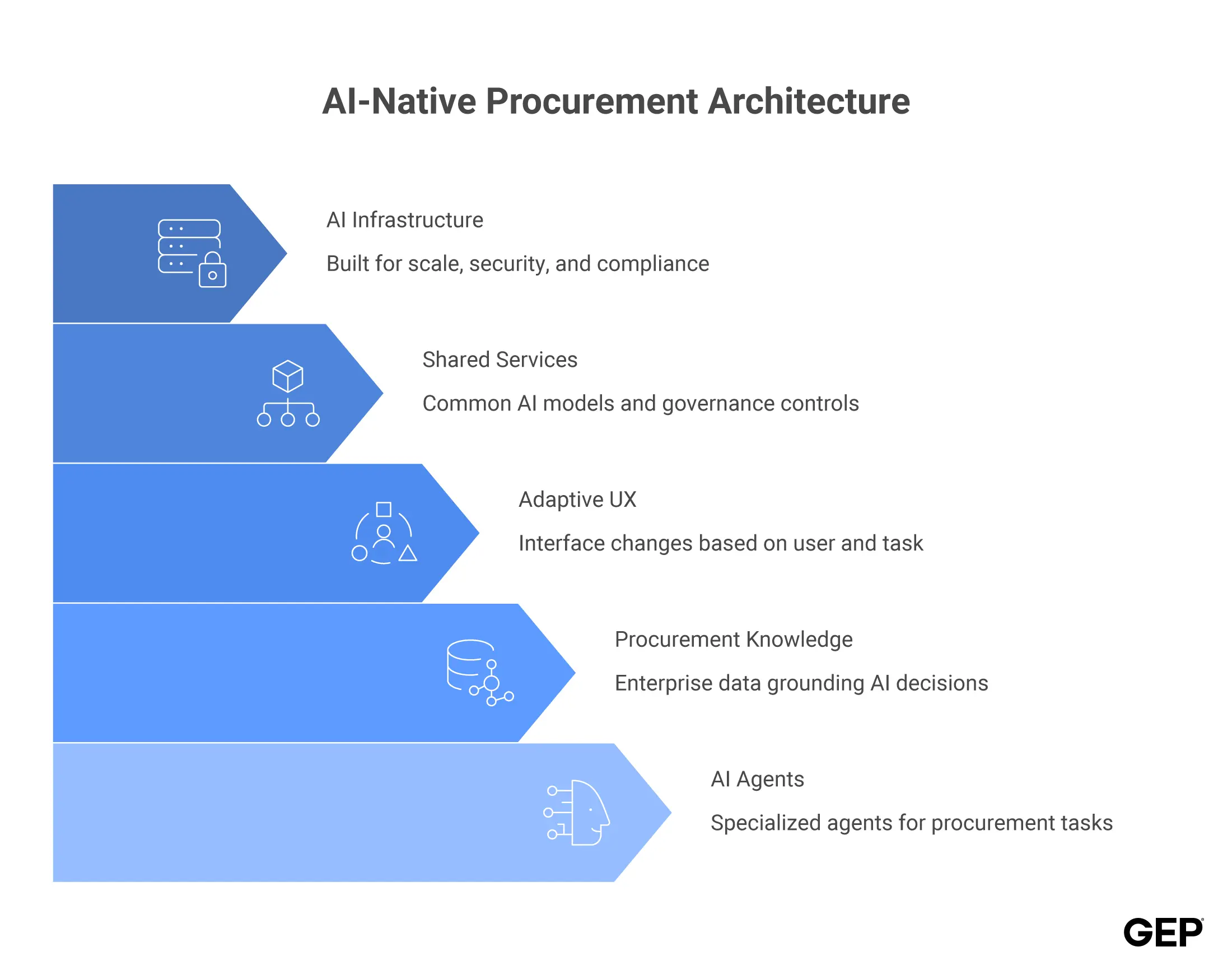
- AI-native platforms rely on five foundational architectural elements.
- Specialized agents outperform one-size-fits-all AI assistants.
- Strong foundations matter more than flashy AI features.
June 30, 2026 | Procurement Software 4 minutes read
Procurement software vendors are racing to add AI to their products. Many demonstrations look impressive. Fewer discussions focus on what sits underneath.
That matters because architecture determines whether AI can scale beyond isolated tasks.
An AI-native platform does not rely on a single assistant trying to handle everything. It combines several foundational elements that work together. When one piece is missing, performance suffers. When all five are in place, procurement teams can move from automation to execution.
AI-Native or Bolt-On Procurement Platform?
Find out what separates AI-powered tools from AI-native procurement platforms
Specialized Agents Instead of One General Assistant
Many AI tools rely on a single model to answer every question.
That approach rarely holds up in complex procurement environments.
AI-native platforms use purpose-built agents for different disciplines such as sourcing, contracting, supplier management, invoicing, and procure-to-pay processes. Each agent focuses on its own domain and accesses only the data and tools relevant to that task.
A coordinating layer sits above them. It determines which agents need to be involved and in what sequence. Think of it as the difference between one person trying to run an entire procurement function and a team of specialists working together. The second model usually produces better results.
Grounding AI in Procurement Reality
General AI models know procurement concepts. They do not know your business. Furthermore, they are unaware of your supplier relationships, approval thresholds, contract terms, category strategies, or sourcing history.
AI-native platforms address this by grounding decisions in enterprise data. Transaction history, supplier records, market intelligence, policies, and contracts become part of the reasoning process.
The result is more than accuracy. It creates accountability.
When procurement leaders ask why a supplier was recommended or why a sourcing strategy changed, the platform can point to the underlying evidence instead of generating a generic explanation.
Interfaces That Adapt to the User
Traditional procurement software treats everyone the same.
Category managers, sourcing professionals, contract managers, and even occasional users often navigate similar screens although their needs differ significantly.
AI-native architecture changes that model.
The interaction adapts based on the user, the task, and the required decision. A sourcing lead may see supplier comparisons and pricing insights. A contract manager may see renewal risks and clause analysis. Someone creating a requisition may simply describe the need in plain language and let the system determine the next step.
The focus shifts from navigating software to completing work.
Shared Services Behind the Scenes
One reason procurement technology becomes difficult to maintain is duplication.
Each new tool often brings separate integrations, controls, AI models, and monitoring requirements.
AI-native platforms avoid that problem through shared services. Agents draw from the same models, governance controls, quality checks, and system integrations. New capabilities can be added without rebuilding the underlying infrastructure every time.
That creates practical advantages.
Procurement teams gain new functionality faster. Organizations avoid maintaining disconnected AI tools. The platform can also adopt improvements in AI models without extensive redevelopment.
The architecture becomes more flexible as it grows.
Infrastructure Built for AI
The final layer receives less attention but may be the most important.
AI-native platforms require infrastructure designed specifically for AI workloads. That typically includes computing power, memory, secure storage, identity controls, audit logging, and support for regulatory requirements across geographies.
These capabilities are not optional.
Procurement systems handle supplier information, contracts, pricing data, and financial records. Governance and security cannot be added later as separate projects.
They need to be part of the foundation from the beginning.
Lead with Agentic AI
Drive smarter procurement and resilient supply chains through enterprise-proven technology
Finally: Why the Foundation Matters
Organizations often focus on AI features during software evaluations. Features change quickly. But architecture lasts much longer.
And there’s an important lesson: companies that rush to build AI agents before establishing the supporting data, infrastructure, and governance layers often end up with disconnected tools that struggle to work together. By contrast, AI-native platforms establish the foundation first and build capabilities on top of it.
That distinction becomes more important as procurement teams adopt agentic AI. The question is no longer whether software includes AI. Nearly every vendor claims that today. The real question is whether the platform was designed for AI from the start or whether AI was added later as another feature. And the answer determines how far the technology can go.
Explore GEP’s AI-Native Procurement Platform



FAQs
An AI-native architecture typically includes these five elements: specialized AI agents, enterprise-specific procurement knowledge, adaptive user interfaces, shared platform services, and AI-ready infrastructure. Together, these components support end-to-end execution rather than isolated automation tasks.
Specialized agents focus on specific procurement functions such as sourcing, contracts, or invoicing. As each agent operates within a defined domain, it can deliver more accurate and reliable results than a single general-purpose assistant attempting to manage every procurement task.
Infrastructure supports the computing, security, governance, and compliance requirements needed for AI operations. Without a strong foundation, organizations would end up with disconnected tools, fragmented data, and higher maintenance complexity.