


Procurement Agent: How Intelligent AI Agents Are Transforming the Procurement Game
- Put AI-native agents on repetitive source-to-pay work to cut the waiting time that slows every request.
- Apply policy at the moment of purchase, so maverick spend gets caught before it happens.
- Start with tight guardrails and human approval gates, then loosen them as results earn it.
November 10, 2026 | Source to Pay 5 minutes read
Picture a buyer on a Monday morning. Forty requisitions are open, three invoices don't match their POs, and a software contract renews on Friday. Nobody has looked at it yet.
That's the real cost of manual procurement. It isn't one big failure. It's a hundred small delays that pile up while strategic work sits untouched.
AI procurement agents are built for exactly this pile. Below, we cover what they are, how they work, where they pay off, and how to roll them out without losing control.
What is an AI Procurement Agent?
An AI procurement agent is software that takes a goal, works out the steps, and does the work inside your systems. Ask a chatbot about a supplier and it replies. Give an AI agent the same job and it pulls the financials, checks sanctions lists, and sends you a recommendation.
It follows your policies and hands off anything it can't settle on its own.
How do Procurement Agents Work?
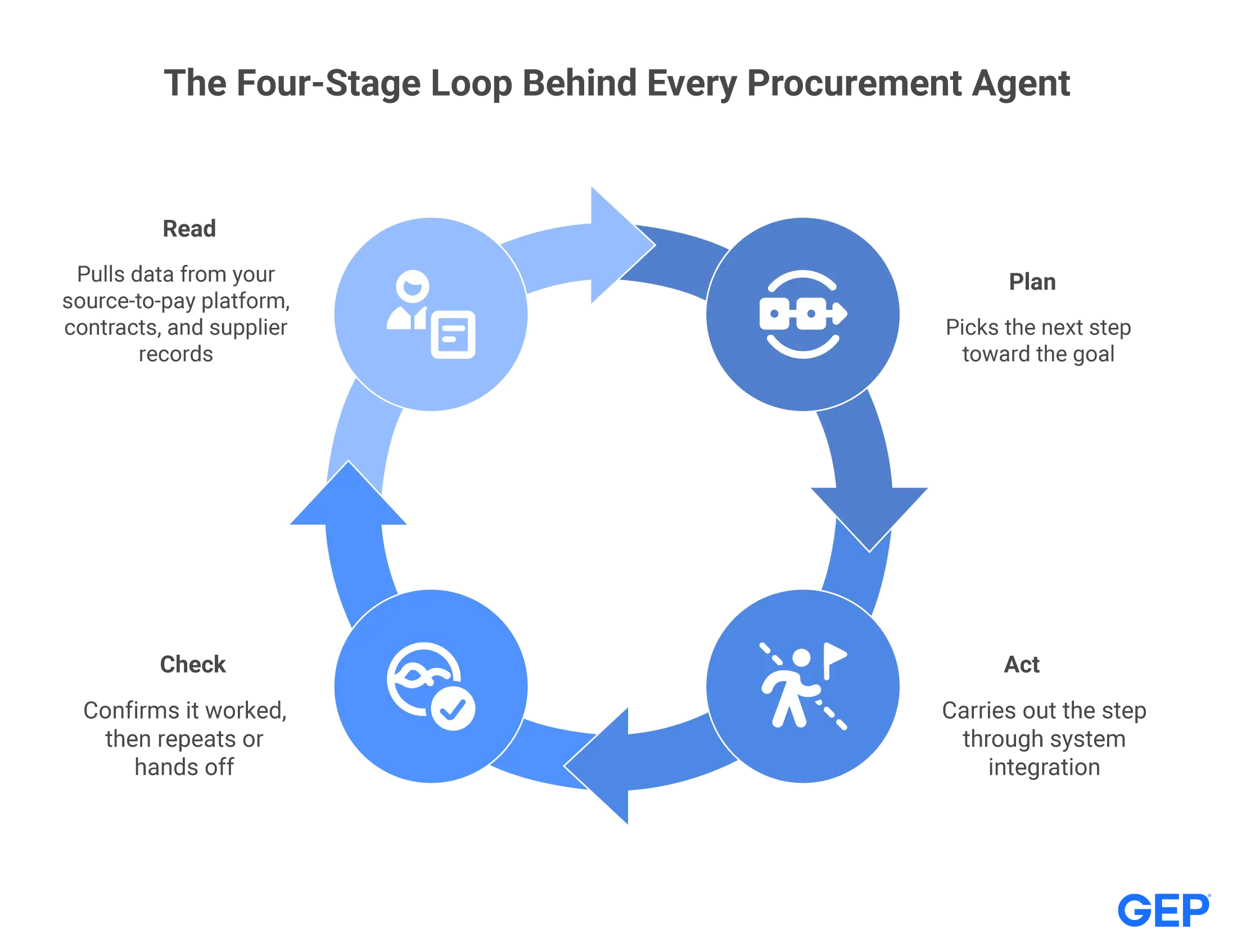
Think of a loop with four stages. The AI agent reads data from your source-to-pay platform, contracts, and supplier records. It picks the next step, takes it through system integrations, then checks whether it worked.
Rules sit around that loop. You decide what the AI agent can approve, what it can only suggest, and when it must stop and call a person. Every action gets logged, so anyone can see why a decision was made.
Move From AI Agent Hype to Real Results
Get practical guidance on deploying agentic AI across your source-to-pay stack, with real-world use cases and deployment advice for procurement leaders.
Core Capabilities: Where AI Procurement Agents Add Value Across the Source-to-Pay Lifecycle
Source-to-pay is full of handoffs, and every handoff is a place where work stalls. AI agents step into four of them, from the first request to the final award.
Autonomous Sourcing & Intake
Requesters describe what they need in plain language. The AI agent fills the gaps, picks the right category, and starts the sourcing event. Buyers stop retyping specs from emails.
Dynamic Vendor Discovery & Risk Vetting
AI agents search beyond your incumbent list and screen candidates for financial health, compliance flags, and location risk. A buyer gets a shortlist that's already been checked, not a pile of names.
Intelligent Contract Analytics
AI agents read agreements clause by clause and flag terms that stray from your standard. They also pull out obligations, like notice periods, that people tend to discover too late.
Autonomous Negotiation
For low-risk categories, an AI agent can run a structured negotiation within limits you set. Big strategic deals stay with category managers, where relationships matter most.
High-Impact Enterprise Use Cases for AI Procurement Agents
The strongest use cases share three traits: high volume, clear rules, and too little buyer time. Here are five AI agents that can carry the load.
Autonomous Tail Spend Management & Micro-Sourcing
Most teams ignore small purchases because none is worth a buyer's afternoon. AI agents run those mini events anyway, so scattered tail spend turns into competitive, documented buying.
Automated Invoice Exception Resolution & 3-Way Matching
When a PO, goods receipt, and invoice don't match, an AI agent finds the gap, fixes what they can, and routes the rest. AP spends less time chasing, and suppliers get paid sooner.
Real-Time Supplier Onboarding, Sanctions Screening, and Risk Vetting
AI agents gather documents, screen against sanctions lists, and clear clean suppliers in hours. A week-long queue shrinks to a same-day check for most.
Contract Expiration Tracking, Renewal Auditing, and Compliance Enforcement
An AI agent watches renewal dates and compares terms to actual spend. You get a nudge before an auto-renewal locks in last year's pricing.
Intelligent Requisition-to-PO Processing and Guided Buying Assistance
AI agents point requesters to preferred catalogs and contracts, then turn approved requisitions into compliant POs without a buyer touching them.
Also Read: Purchase Requisition Vs Purchase Order: Key Differences Explained
Key Operational Benefits of Deploying Intelligent Procurement Agents
The point is not to do the same work with fewer people. The gains show up in speed, spend control, and how buyers spend their day.
Drastic Reduction in Cycle Times
Work stops waiting in queues. Approvals, sourcing events, and onboarding move as soon as the data is ready. Everest Group named GEP the outright leader in its Innovation Watch on agentic AI applications in procurement, citing AI agents that improve speed, resilience, and data-driven decisions.
Eliminating Maverick Spend through Autonomous Policy Enforcement
Policy applies while the requisition is being written, not during an audit six months later.
Scalable Tail Spend Management
Volume can double without a matching rise in headcount, and coverage stays even.
Shift from Transactional Execution to Strategic Value Creation
Buyers get hours back for supplier strategy, negotiation, and innovation. That's the work they were hired to do.
Proactive Risk Mitigation and Real-Time Anomaly Detection
Duplicate invoices, odd price jumps, and supplier warning signs surface as they happen, not at quarter close.
Implementation Roadmap: Integrating AI Agents into Enterprise Procurement Operations
Rollouts succeed when autonomy grows in stages, as trust and data quality improve. Three areas decide whether an AI agent program sticks.
Establishing Guardrails: Defining Autonomous Action Limits vs. Human-in-the-Loop Gates
Begin with high-volume, low-risk tasks. Set spend thresholds and category limits, and decide which steps need a human sign-off. Loosen the limits only after the results justify it.
Overcoming Enterprise Friction: Data Silos, Legacy Systems, and Change Management
Messy data hurts more than a weak model. Connect your ERP and source-to-pay data first. Bring buyers into the pilot early so AI agents feel like helpers, not monitored.
Ensuring Security and Compliance: AI Ethics, Data Governance, and Auditability
Name an owner for each automated decision. Restrict data by role, and keep a full log so auditors can follow any outcome from start to finish.
Ready to Put AI Agents to Work in Procurement?
Explore how GEP helps enterprises deploy AI-native agents with the right guardrails across source-to-pay
From Task Management to Outcome Management
AI agents change what a procurement team spends its day on. Less chasing, more deciding.
Platforms like GEP Quantum Intelligence bundle sourcing, contract, risk, supplier, and procure-to-pay agents, so you don't have to stitch them together yourself. Start small, measure honestly, and expand where the numbers hold.



FAQs
Traditional automation follows fixed rules and stalls when an input changes. AI agents read context, choose between actions, and adjust, all inside the limits you set.
HITL means a person reviews or approves certain decisions before they take effect. It keeps accountability with your team and protects high-value or high-risk actions.
Set spend limits, pilot in controlled scenarios, and require approval for sensitive actions. Then review the audit logs and exceptions on a regular schedule and tighten the rules where you see gaps.