


Is Your Procurement Operating Model Built to Execute, or to Comply?
- Fragmented procurement systems create hidden costs that go well beyond inefficiency, eroding governance, delaying decisions, and frustrating the business users who need to move fast.
- Orchestration reframes how procurement operates by connecting intake, workflows, data, and decision intelligence into a single, continuous process layer.
- Organizations that embed AI-native orchestration into their operating model shift procurement from a compliance checkpoint to a competitive lever.
July 29, 2026 | Procurement Process and Excellence 7 minutes read
Procurement has spent a decade investing in platforms, from source-to-pay suites and supplier portals to spend analytics dashboards. The technology stack has grown, and in many organizations, so has the frustration.
The problem is not capability. Most enterprise procurement teams have enough tools, but those tools were never designed to work as a system. Intake lives in one place, contract approvals in another, and supplier risk assessments somewhere else entirely. The result is a procurement function that is technically sophisticated but operationally fragmented.
That fragmentation is no longer a tolerable inefficiency. In a business environment defined by compressed margins, regulatory complexity, and supply chain volatility, it has become a strategic liability.
This blog breaks down why traditional procurement operating models are failing to deliver on their potential, and how orchestration closes that gap, not as a software add-on, but as a structural shift in how procurement operates.
Connect the Process. Not Just the Platforms.
Learn how top organizations are bridging the procurement and supply chain gap through AI-native orchestration.
Why Are Most Procurement Operating Models Running on Assumptions?
The conventional procurement operating model was designed to enforce control. Policies, approval thresholds, and preferred supplier lists were all built to keep spend in check and audits manageable. That was the right design for a different era.
Today's operating environment demands something different. Business stakeholders expect fast, intuitive procurement experiences. Finance expects real-time spend visibility. Legal and compliance teams expect embedded governance, not end-of-quarter reviews. CPOs are being measured on resilience and value creation, not just cost reduction.
Most current operating models were not built for this. They rely on handoffs between teams that do not share data. They ask business users to navigate systems that were built for procurement specialists. And they treat exceptions (the rogue purchase, the unapproved supplier, the missed renewal) as individual failures rather than symptoms of a structural design gap.
The assumption that more tools will fix a coordination problem is the most common mistake procurement leaders make. It rarely does.
What Orchestration Actually Means in a Procurement Context
Orchestration is not a product category. It is an operating principle.
In procurement, orchestration means connecting every step of the process into a coherent, governed workflow. This spans from the moment a business user raises a request, all the way through sourcing, contracting, supplier onboarding, and payment. It means removing the handoff friction between teams, systems, and data sources that currently slows everything down.
Practically, orchestration sits as a coordination layer across existing infrastructure. It does not replace source-to-pay platforms or ERP systems. Instead, it makes them work together by directing requests to the appropriate processes, bringing forward the information that matters at each decision point, and embedding policy into the workflow so users never have to think about it.
The distinction matters because most organizations try to solve a coordination problem with more automation. Automation speeds up individual tasks. Orchestration redesigns how those tasks connect.
Also Read: Procurement Orchestration The Strategic Backbone of Your Enterprise
Where Operating Models Break Without It
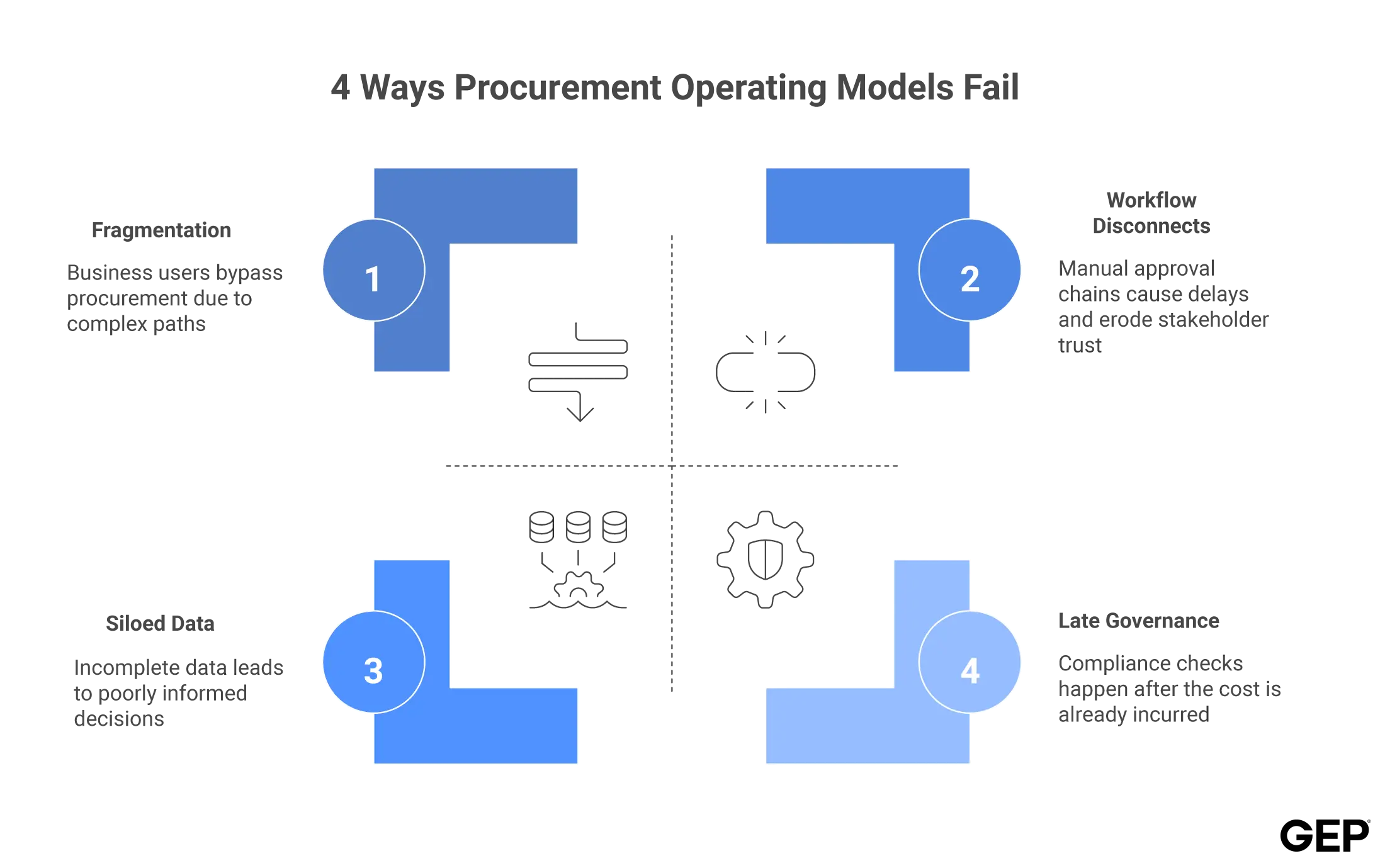
The failure modes are consistent across industries and geographies. They tend to appear in the same four places:
Intake fragmentation
Business users bypass procurement because the path is too complex. They raise purchase requests in ways that skip controls, bypass preferred suppliers, or create rework downstream. Maverick spend is almost always a symptom of poor intake design, not poor intent.
Workflow disconnects
When approval chains depend on manual follow-up, contract reviews pile up in shared inboxes, and supplier risk assessments happen after onboarding is already complete, the entire process pays the price. Delays compound at every stage, cycle times suffer, and the business begins to lose confidence in procurement's ability to move at the speed it needs.
Data that does not travel
Most procurement functions are not short on data. The problem is that the data does not travel. Spend sits in one system, contract terms in another, and supplier performance scores in a spreadsheet that only a few people can find. When information stays siloed instead of moving with the workflow, every decision gets made with an incomplete picture, and the cost of that incompleteness adds up fast.
Governance that comes too late
Most procurement governance is designed to catch problems after they happen rather than prevent them from occurring in the first place. Compliance checks that run at audit time, policy enforcement that depends on individuals remembering the rules, and reviews that happen weeks after a transaction closes all mean that the organization is constantly learning what went wrong instead of stopping it at the source.
Orchestration addresses all four failure modes by design. Not by building new controls on top of broken processes, but by embedding control into the flow of work itself.
A Framework for Building an Orchestration-First Operating Model
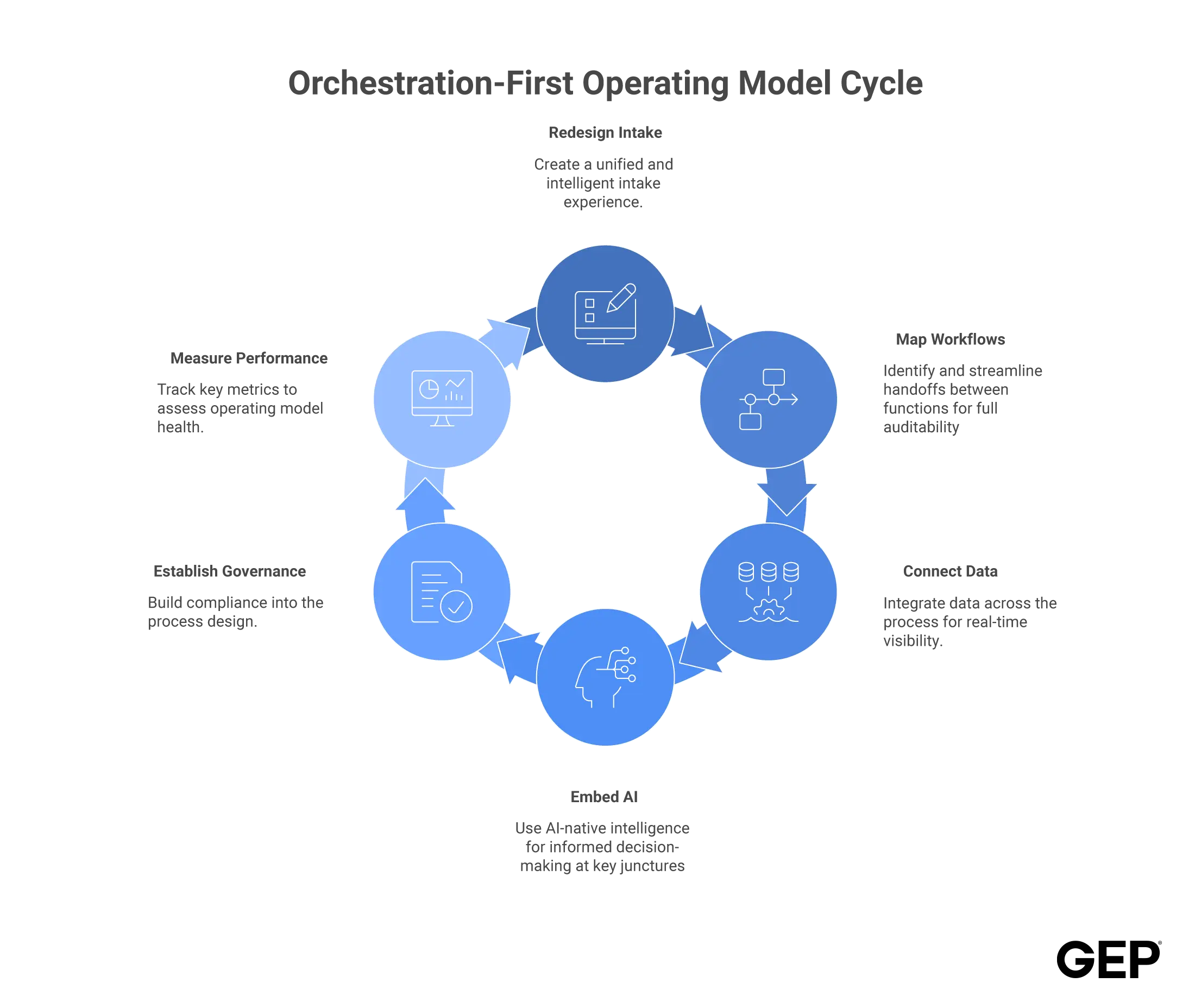
Shifting to an orchestration-first operating model is not a technology project. It is a structural redesign. Here is a practical starting point:
Redesign intake as the front door:
A single, intelligent intake experience that guides every business user to the right process, regardless of what they are buying or how much they spend. Compliance is built in, not bolted on.
Map workflows end-to-end, not function by function:
Identify every handoff between procurement, legal, finance, IT, and operations. Each handoff is a coordination cost. Orchestration makes those handoffs automatic and auditable.
Connect data across the process, not just at reporting time:
Spend data, contract data, supplier data, and risk data should travel with the workflow. Real-time visibility is only possible when data is integrated into the process, not extracted from it after the fact.
Embed AI-native decision intelligence at key junctures:
Procurement choices (e.g., supplier selection, risk assessment, contract routing) include more factors than any single person can properly track. At these points, reliance on manual judgement causes inconsistencies and slows the process. AI-native orchestration solves this by bringing relevant contextual data at the exact time a decision needs to be made, instead of forcing teams to stitch it together from reports examined long after the fact.
Establish governance through design, not through oversight:
Build policy into the structure. If the workflow is built right, compliant behavior is the default. Exception handling is an exception, not the rule.
Measure operating model performance, not just spend outcomes:
Cycle time, user adoption, exception rates, and first-pass approval rates are better indications of operating model health than cost savings alone. They let you know if the system is operating.
What This Means for Procurement Leaders
The conversation around procurement transformation has shifted. It is no longer about which platform to buy or how much to invest in automation. It is about whether the operating model is designed to support the speed and complexity that the business now requires.
Orchestration is the answer to that question, but only when it is treated as a strategic redesign rather than a technology deployment. The organizations making the most progress are not the ones with the biggest technology budgets. They are the ones that started by asking: how does workflow through procurement work today, and where does it break?
That question is harder to answer than it sounds. But it is the right place to start.
Procurement functions that build orchestration into their operating model architecture will be better positioned to manage disruption, enforce compliance at scale, and deliver the strategic value that the business increasingly expects from them.
The tools exist. Design thinking is what determines whether they work.




BLOG CATEGORIES
FAQs
Automation speeds up individual tasks within a process, such as approvals, matching, and notifications. Orchestration connects those tasks into a governed, end-to-end flow. Automation reduces manual effort. Orchestration reduces coordination failures, data gaps, and workflow breakdowns between teams and systems. Both matter, but orchestration addresses the structural problems that automation alone cannot fix.
The traditional tension between compliance and speed exists because governance is usually applied as a check after the fact, at an approval gate or an audit review. Orchestration embeds compliance into the workflow design itself, so that compliant behavior becomes the path of least resistance. Business users follow the right process not because they are forced to, but because it is the easiest route to getting what they need. Cycle times typically improve because exception rates fall.
No. Orchestration works across existing infrastructure. It is designed to connect source-to-pay platforms, ERP systems, supplier portals, and contract repositories rather than replace them. The value comes from making those systems work together in a coherent process, not from swapping them out.
Start with intake. The point at which a business user raises a need is where operating model design has the most leverage. If intake is fragmented, inconsistent, or user-hostile, everything downstream inherits that problem. A well-designed intake experience that routes every request to the right process is the single highest-value starting point for orchestration transformation.