


The 7 AI Trends Shaping Procurement & Supply Chain In 2026
- AI is becoming procurement's operating model, not a bolted-on feature.
- Domain-specific intelligence, unified data, and orchestrated agents now work as one system.
- Real value comes from governance, interoperability, and coordinated execution across the full source-to-pay cycle.
August 13, 2026 | Procurement Strategy 4 minutes read
Most leaders still treat AI as a single tool, not a system. They invest in narrow features without asking what sits underneath.
Procurement is changing fast. AI is no longer a feature you bolt on. It is becoming the operating model itself. Real value comes from orchestration, governance, and data working together, not isolated automation.
This article breaks down the seven shifts now separating the winners from everyone else.
A Buyer’s Guide to Intake & Orchestration Platforms
Evaluate platforms that support policy, workflows, and stakeholder coordination
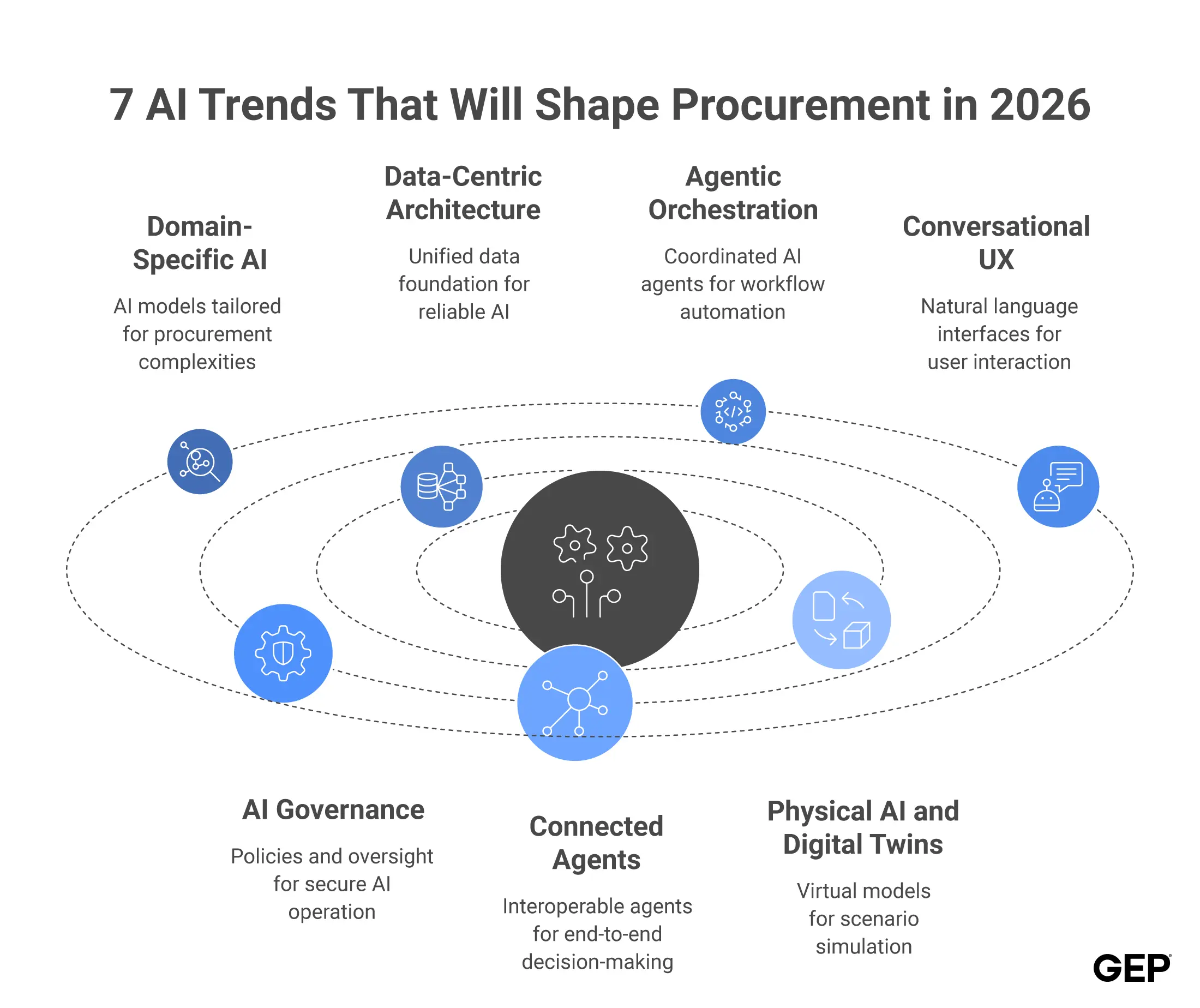
1. Domain-Specific Intelligence Replaces Generic AI
Generic AI gives generic answers. Your procurement decisions need more than that. Commodity dynamics, supplier dependencies, negotiation levers, and logistics costs all carry nuance.
A model trained on broad internet text misses that nuance. It might miss an entire contract clause or could confidently recommend the wrong supplier. In 2026, leaders demand intelligence specifically built for procurement, not adapted or retrofitted, but built for the function from the start.
2. Data Becomes Your Foundation
AI is only as good as its data. Most procurement data still lives in silos. Supplier records sit in one system. Spend data sits in another. Contracts live somewhere else entirely.
This fragmentation blocks any real intelligence from forming. Leaders are unifying these foundations now. A connected data layer lets AI actually reason. Without it, even the best algorithm guesses blindly.
3. Procurement Orchestration Moves Beyond Automation
Automation used to mean routing a single invoice. That bar is far too low for 2026. Real orchestration coordinates work across your entire source-to-pay cycle.
One process detects a supply disruption, while another checks dependencies and identifies alternative suppliers. Another agent works in parallel to look for gaps in existing contracts and negotiation opportunities.
This coordination removes friction from daily operations. Your team shifts from administrative work to strategic judgment.
4. Conversation Replaces Complexity
Procurement tools used to demand training and patience. Click here, then there, then somewhere else. That model is dying quickly.
Intent-driven interfaces let you simply state what you need. Say you need materials sourced within 90 days. The system handles policy compliance behind the scenes. Casual users no longer need deep system knowledge. This shift opens procurement access across your organization.
5. Governance Becomes Non-Negotiable
Uncontrolled AI decisions carry real financial risk. Procurement cannot afford unchecked autonomy at scale. Strong governance sets clear policy boundaries upfront. It defines guardrails against hallucination and bias.
Leaders identify exact junctions requiring human review. High-value decisions always get human eyes first. This is not bureaucracy for its own sake. It is the difference between trust and exposure.
6. AI Agents That Talk to Each Other
Isolated AI tools create isolated thinking. Connected agents change that equation entirely. Shared technical standards let agents exchange information freely. They become interoperable across vendors and systems.
A contract process can instantly alert a supplier process. If risk emerges during drafting, action happens immediately. This interconnection turns separate tools into a coordinated network. Your enterprise starts to think and act as one system.
7. Digital Twins Test Reality Before You Risk It
Physical disruptions used to mean expensive guesswork. When tariffs shift, or ports close and routes become unreliable overnight.
Digital twins simulate these scenarios before they happen. You can first test shipping routes virtually. You can model strategies without real exposure. This is especially valuable in supply-chain-heavy industries. Simulation lets you identify the least risky path before committing real resources.
Is Your Data Ready for Agentic Orchestration?
Assess how to manage your data for procurement workflows.
Where This Leaves You
These seven shifts share one theme. AI in procurement is no longer a tool. It is becoming the operating model itself. Leaders treating it that way will pull ahead. Those who wait will spend 2026 catching up. The choice is already in front of you.
Want a deeper look at these shifts?
Watch GEP's webcast, 7 Procurement Tech Trends That Will Separate Leaders from Laggards In 2026, for a closer look at what is coming next.


FAQs
Agentic AI refers to systems that act, not just answer. They detect issues, evaluate options, and take steps without constant prompting. In procurement, this means flagging a supply disruption and lining up alternatives on their own. You still set the boundaries. The system handles the execution within them.
Automation handles one task at a time, in isolation. Orchestration coordinates many tasks across your entire source-to-pay process. One part detects a problem while others respond in parallel. The result is coordinated execution, not isolated shortcuts.
More autonomy means more exposure if something goes wrong. Governance sets the boundaries before that happens. It defines where human review is required and where it is not. Without it, you are trusting outcomes you cannot fully explain.