Solving the Uncoordinated Orchestration Gap in Enterprise Procurement
- Most enterprises now run multiple AI agents across procurement. Few have built the coordination layer to connect them, creating an “orchestration gap” between automation and actual orchestration.
- Every disconnected bot deployed on top of legacy systems generates orchestration debt: hidden integration, governance and rework costs that compound with each new agent.
- Closing the gap requires an AI-native foundation where agents share one data fabric, one governance model and one view of the truth, rather than middleware stitched over disconnected tools.
August 25, 2026 | Procurement Software 6 minutes read
Uncoordinated procurement orchestration is a bit of a contradiction. Orchestration means coordination. If your agents aren’t coordinated, you don’t have orchestration with a problem. You don’t have orchestration at all.
You have agents. Plural. Running in parallel. Solving their own narrow problems in their own narrow silos. From the outside it looks like progress, because each bot works. From the inside it feels like a different kind of chaos, one that moves faster than the old kind and is harder to diagnose because every individual piece is technically performing.
This is the gap that procurement leaders are waking up to. Not a shortage of automation, but an absence of the connective tissue that turns automation into a system. And until that connective tissue exists, adding more agents only makes the problem worse.
What Is the Orchestration Gap, and Why Does It Threaten Multi-Agent Procurement?
The orchestration gap is the space between what individual AI agents can do and what the end-to-end process actually requires. An agent can approve an invoice. It cannot know that the supplier behind that invoice was flagged by a risk agent yesterday, unless something connects the two.
That “something” is orchestration. Orchestration unifies fragmented procurement processes under a shared intelligence layer, so agents act on the same data, follow the same policies and hand work to each other cleanly.
Without it, multi-agent procurement becomes a liability. Agents make locally correct decisions that are globally wrong. They duplicate work, contradict each other and create audit trails no one can reconcile. Gartner predicts that by 2030, half of AI agent deployment failures will stem from insufficient governance enforcement of agent capabilities and multisystem interoperability. In other words, the agents will fail because nothing coordinates them, not because they’re not smart enough.
Get the Playbook for Agentic AI
Is Your Orchestration Platform Actually Intelligent?
The Rise of Agentic Chaos: How Studio Bots Build Orchestration Debt
Why is the gap widening now? Because building an agent has never been easier.
Low-code agent studios let any team spin up a bot in an afternoon. Finance builds an invoice-matching agent. Category managers build a market intelligence agent. IT builds a contract extraction agent. Each solves a real problem, and each is built on a different platform, trained on a different data source and governed by a different set of rules, if it’s governed at all.
This is how an enterprise generates orchestration debt. Like technical debt, it accrues quietly. Every new studio bot adds another integration to maintain, another data sync to monitor, another exception path no one owns. The tenth agent is far more expensive than the first, because it must coexist with the nine already improvising around each other.
Middleware promises to tame this, but a translation layer over fragmented systems only relocates the problem. The agents still reason from different versions of the truth. The seams simply move somewhere harder to see.
What an Uncoordinated Orchestration Gap Actually Costs Procurement Teams
What are the real costs? They show up in four places.
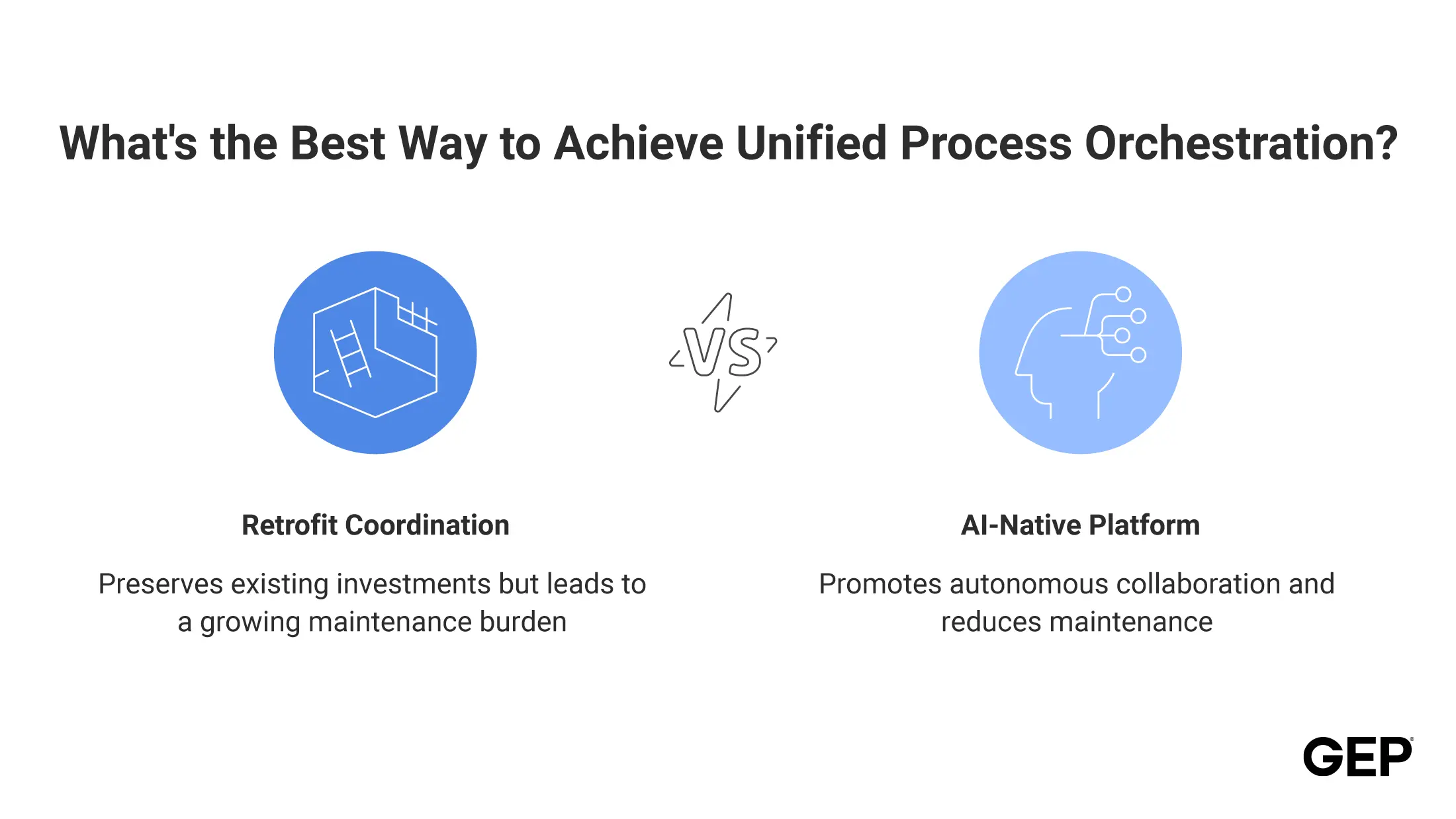
First, cycle time. Work stalls at every handoff between agents that don’t share context, and humans become the connective tissue, shuttling outputs from one bot to the next. That’s automation in name only.
Second, data integrity. When agents write to disconnected tools, procurement loses its single source of truth. Spend data, supplier records and contract terms drift apart, and every downstream decision inherits the drift.
Third, governance. Autonomous agents acting on inconsistent policies create compliance exposure that’s invisible until an audit finds it. No one can answer the basic question: which agent did what, based on which data, under whose authority?
Fourth, trust. When early agent deployments contradict each other or quietly break, stakeholders conclude that agentic AI doesn’t work. The technology takes the blame for an architecture problem.
Designing the Remedy: The Core Pillars of Unified Process Orchestration
Closing the gap starts with treating orchestration as a design requirement rather than an afterthought. Three pillars matter most.
A shared data fabric comes first. Every agent must reason from the same live records for suppliers, contracts, spend and risk. This is what restores a single source of truth across the process.
Unified governance comes second. Policies, approval thresholds and escalation rules should be defined once and enforced everywhere, so an agent in sourcing and an agent in payables operate under the same authority model.
End-to-end process awareness comes third. Agents need multi-dimensional intelligence: visibility into what happened upstream, what’s expected downstream and how their actions ripple across the workflow. That’s the difference between a collection of bots and genuine agentic orchestration.
Eliminating the Gap Natively: The Power of an Inherently Unified Platform
There are two ways to pursue these pillars. You can retrofit coordination onto fragmented systems, or you can build on a platform where coordination is inherent.
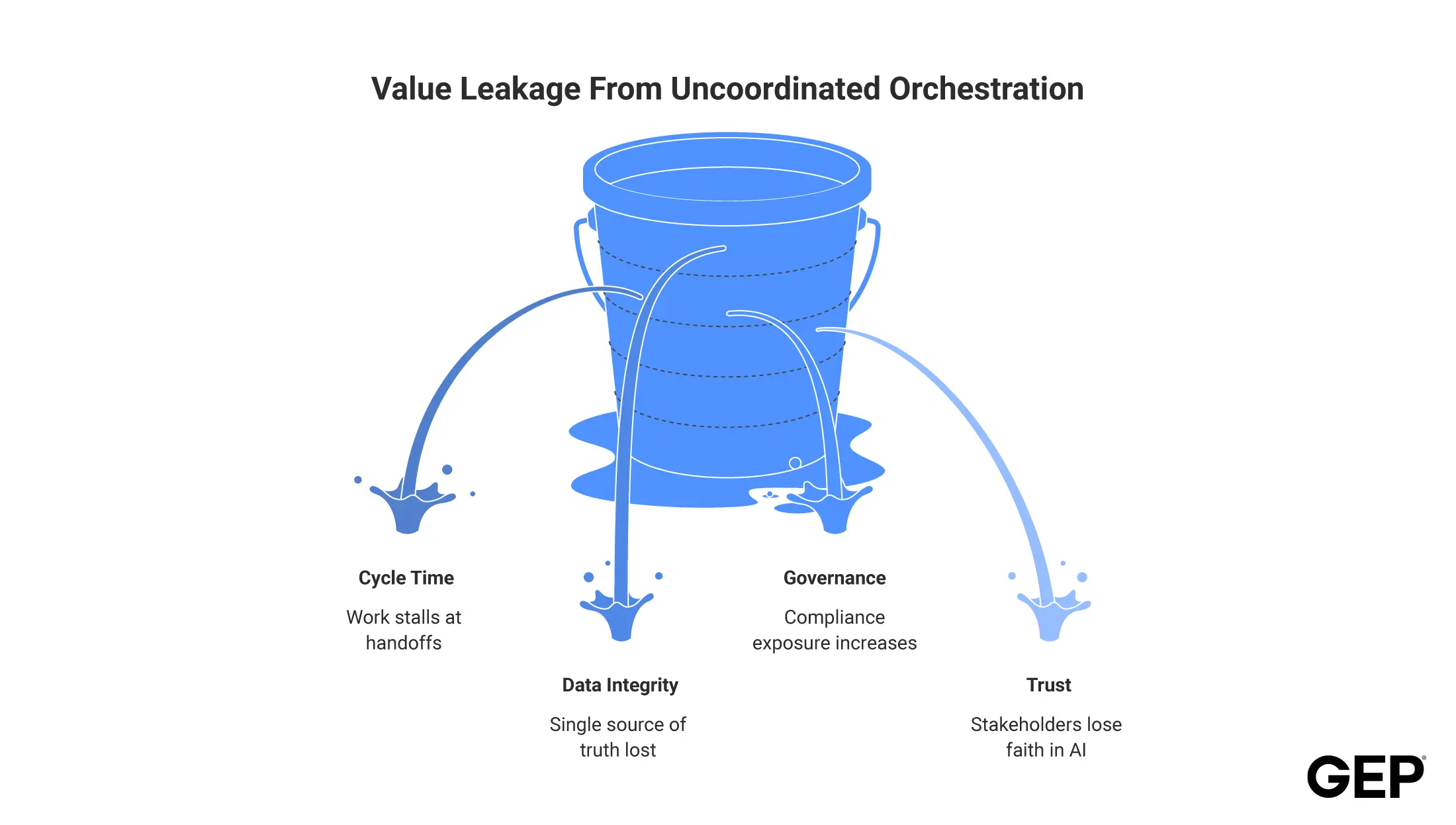
The retrofit path is seductive because it preserves existing investments. But stitching orchestration over disconnected tools means every policy, every data definition and every handoff must be translated at each seam, forever. The maintenance burden grows with each agent added.
An AI-native platform inverts the equation. When agents are born into a common environment, they inherit the same data model, the same governance and the same process context by default. Coordination isn’t an integration project. It’s a property of the architecture. Agents collaborate autonomously because nothing separates them in the first place.
How GEP Quantum Intelligence Coordinates Complex Workflows by Design
This is the principle behind GEP Quantum Intelligence, the AI-native foundation that unifies data, intelligence and agentic AI across procurement and supply chain processes.
Because agents operate on one platform with one data fabric, orchestration happens by design. A sourcing agent, a risk agent and a payables agent draw on the same live intelligence and hand work to each other without translation layers or brittle integrations. Predictive insights flow across the full workflow instead of stopping at application boundaries.
The orchestration gap never opens, because the conditions that create it never exist.Explore GEP’s: AI-Native Procurement Software
Unifying Your System Fabric for an Automated Future
Agentic AI will keep getting more capable. That only raises the stakes, because uncoordinated capability scales into uncoordinated consequences.
Procurement leaders who close the orchestration gap now will compound the returns of every agent they deploy afterward. Those who keep adding bots to fragmented systems will keep paying orchestration debt with interest. The agents aren’t a differentiator anymore; the data fabric beneath them is.
FAQs
Q: What is the difference between standard process fragmentation and the “Uncoordinated Orchestration Gap” in AI-driven procurement?
A: Standard fragmentation is passive: siloed systems that slow humans down. The orchestration gap is active. Autonomous agents act on fragmented data at machine speed, so inconsistencies propagate into decisions and transactions before anyone can intervene.
Q: Why can’t we solve the orchestration gap by deploying a low-code “Studio Bot” or middleware layer over our existing applications?
A: Middleware translates between systems but doesn’t unify them. Agents still reason from different data and different rules, so the gap persists beneath the translation layer while adding new integrations to maintain.
Q: What steps can procurement leaders take to close the orchestration gap?
A: Inventory every agent in use, map the data and governance each relies on, then consolidate onto a shared data fabric with unified policies. Prioritize an AI-native architecture where coordination is inherent rather than retrofitted.