



Data Fragmentation: The #1 Challenge in Agentic Procurement Orchestration
- Procurement data remains scattered across disconnected systems.
- Fragmentation undermines visibility, governance, and orchestration.
- Centralizing storage does not create context or interoperability.
- Agentic AI requires connected, trustworthy procurement data.
July 08, 2026 | Procurement Strategy 6 minutes read
Procurement data is scattered across systems. Quite often, they aren’t built to talk to each other. This fragmentation blocks procurement orchestration before it can even start.
Without connected data, agentic AI has nothing reliable to act on.
This article breaks down why data fragmentation persists, and how CXOs can fix it through deliberate, strategic data management.
What Is Procurement Orchestration?
Procurement orchestration is the coordination layer woven across your existing systems. It governs how work moves between them, while every step draws on the same data, captured, managed, and updated in real time.
Orchestration classifies incoming work, applies the right rules, and optimizes workflows while tracking everything through to completion.
Agentic orchestration deploys multiple specialized AI agents, each built to execute the workflow it knows best and trained to resolve any potential problems it could face. Even when they face competing versions of the same request, agents can adapt to changes in outcomes and rules, working well within the guardrails you set.
Why Is Data Fragmentation a Major Problem for Procurement Orchestration?
Fragmented data disrupts orchestration before it even starts, and the damage compounds once AI enters the picture. AI models depend on complete, consistent data to reason correctly. Feed them partial records, conflicting supplier names, or outdated contract terms, and the output degrades fast.
As more data comes in from different formats and systems, legacy architectures fall further behind. Moving everything into a data lake or warehouse does not fix this either.
A data lake can store vast amounts of information but can’t reconcile conflicting records, establish business context, or determine how data should be used across processes.
Centralizing storage does not create context or interoperability. Without a shared understanding of how data relates across functions, AI has nothing solid to act on.
A Buyer’s Guide to Intake & Orchestration Platforms
Evaluate platforms that support policy, workflows, and stakeholder coordination
The Foundation of Agentic Procurement
Agentic orchestration depends on more than AI models. It depends on context.
Unified procurement intelligence is not a dashboard or a bigger database. It is a layer that understands how procurement entities relate to one another: which supplier sits under which contract, which category that contract belongs to, which budget it draws from, and which risk profile it carries.
That relational understanding has to live somewhere specific inside an orchestration framework, and it sits in the data layer, beneath the workflow and decisioning layers that depend on it.
Most orchestration frameworks run on three working layers.
- The data layer ingests and reconciles information from every connected system, resolving duplicate suppliers, mismatched IDs, and inconsistent taxonomies into one coherent model.
- The intelligence layer reads that model to interpret context, weighing related signals like spend, risk, and contract terms together instead of in isolation.
- The workflow layer then acts on that interpretation, routing the request, applying policy, and engaging the right stakeholders.
Without a properly built data layer, the layers above have nothing trustworthy to draw on.
An intelligence layer fed broken data will misread context every time, no matter how advanced the underlying AI model is. This is why domain-specific intelligence matters more than general-purpose AI.
The data layer is not the least important part of the stack. It is the layer on which everything else stands. Without a trusted data layer, intelligence becomes unreliable, and workflows become automated guesswork.
Why Domain Intelligence Matters More Than General AI
General-purpose AI can understand language. Procurement requires understanding relationships. This becomes critical with agentic AI.
A procurement decision rarely exists in isolation. Every decision affects the next.An AI system trained to understand procurement relationships can evaluate those variables together and recognize dependencies, assess implications, and act within established governance frameworks.
An AI system that only understands procurement terminology lacks that depth of context. This is why domain intelligence increasingly separates successful procurement automation initiatives from unsuccessful ones.
The objective is not to build AI that reads procurement data but to understand what that data means.How Does Unified, Domain-Specific Procurement Intelligence Solve Data Fragmentation?
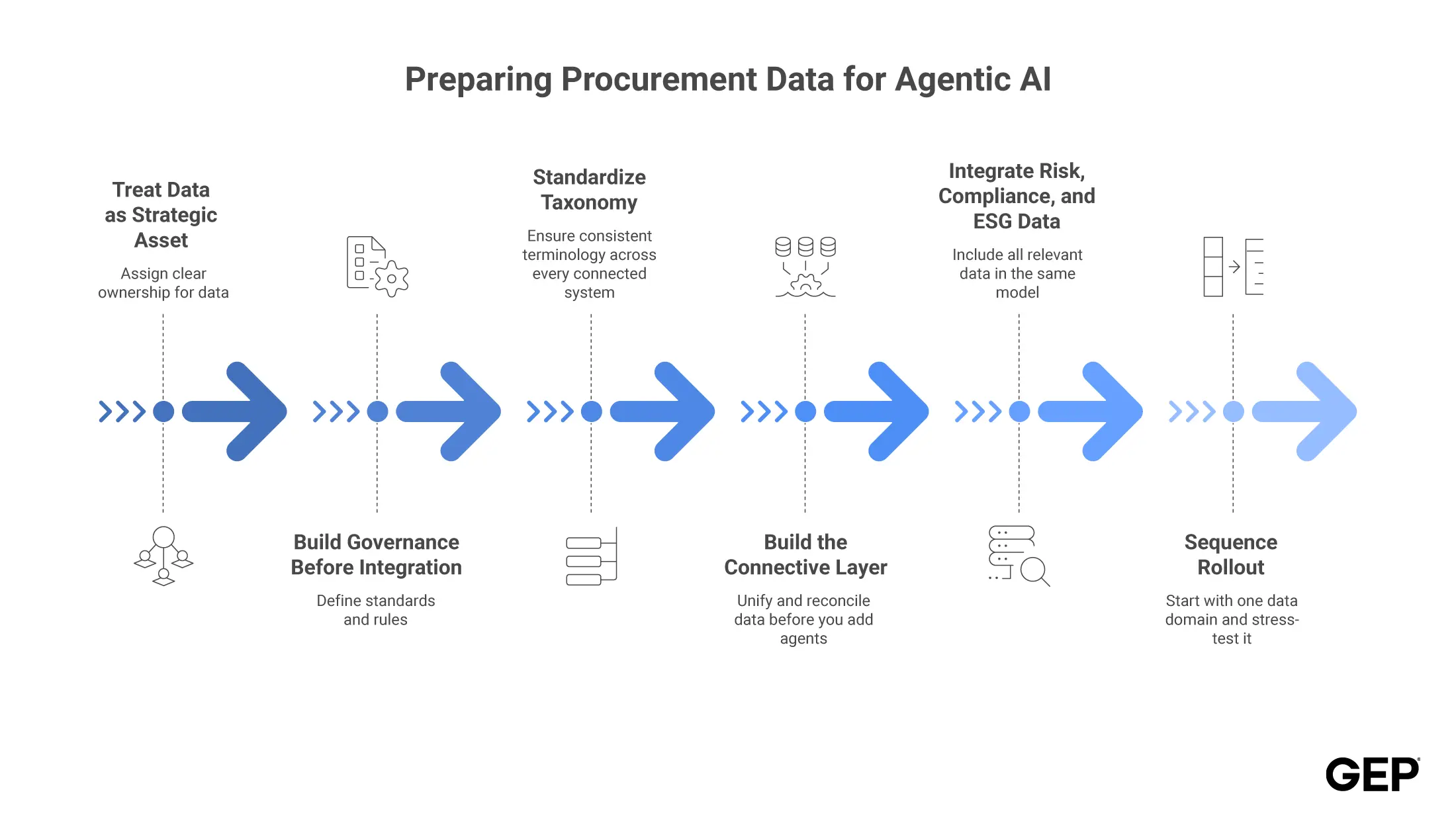
Getting procurement data ready for agentic AI is less about new technology and more about discipline. Six moves separate the platforms that scale from the ones that stall.
1. Treat data as a strategic asset, not a transactional byproduct
Assign clear ownership for supplier, contract, and category data. Data without an owner drifts.
2. Build governance before integration
Define entry standards, validation rules, and who can change what, before you connect systems. Integrating first and governing later just moves the mess faster and locks it into more places.
3. Standardize your taxonomy across every connected system
Supplier names, category codes, and contract terms need to mean the same thing everywhere. It is the step most organizations skip, and the one that breaks every AI model downstream when they skip it.
4. Build the connective layer before you add agents
Orchestration has to unify and reconcile data first. Adding AI agents on top of disconnected systems just automates the inconsistency you already have, faster and at scale.
5. Bring risk, compliance, and ESG data into the same model
Don’t treat them as separate feeds bolted on after. A renewal decision that ignores supplier risk is not really a complete decision. The data foundation needs to hold all of it together, not just spend and category data.
6. Sequence the rollout
Pick one data domain, prove the foundation holds up under real volume, then expand. Trying to unify every system in one move multiplies risk and delays the value you are trying to capture.
These steps are not technically complex. They are the difference between agentic AI that compounds in value and AI that compounds your cleanup work.
Is Your Data Ready for Agentic Orchestration?
Assess how to manage your data for procurement workflows.
Solving Procurement's #1 Data Management Challenge
As agentic AI takes on more decision-making in your workflows, the quality of your underlying data determines how many of those decisions you can trust.
Data orchestration is what makes that trust possible at scale, keeping every connected system aligned on the same facts as they change. Clean, connected, contextual data is what allows that foundation to compound in value.
The next phase of procurement technology will be defined by how well your data orchestration holds up as AI models take on more complex work. AI agents must work in parallel, spanning suppliers, contracts, risk, and spend, all at once, and fast.
An AI-native procurement platform built for this will treat data as critical infrastructure. To see how this plays out in practice, talk to us.




FAQs
Data fragmentation happens when the systems running procurement, logistics, supplier management, and finance operate as disconnected, siloed systems instead of one connected view. The same supplier or shipment can exist as separate, conflicting records in each system, eroding visibility and responsiveness, and making it hard to see total spend, true risk exposure, or performance trends because every team works from a different, partial picture.
Data orchestration is the coordinated management of data flows across systems, processes, and tools. It organizes, transforms, and synchronizes data so it arrives ready for use instead of needing manual reconciliation. It is no longer a fringe capability either; recent industry research found that roughly three out of four large enterprises have already implemented some form of it.
Automation speeds up one task inside one system. Orchestration is the overarching practice that governs how data moves and stays consistent across every connected system and process. That is why agentic AI depends on orchestration, not just faster automation.
Data orchestration eliminates the silos that trap data in disparate systems, automates quality checks to improve consistency and freshness, and helps organizations scale as data volume and complexity grow. It supports AI-ready datasets, creates the audit trail governance teams need, and frees procurement teams to focus on strategy instead of cleanup.