Intake Management Software: What It Is, Why It Matters and What to Look For
- Most enterprises already own the procurement tools they need. The problem is that those tools do not connect, and the employee experience suffers as a result.
- A front door that routes requests is a usability improvement. A platform that understands the request and improves the decision is something else entirely.
- The features that separate a basic intake layer from an enterprise-ready orchestration platform are not always visible in a demo. Knowing what to look for changes the evaluation.
August 25, 2026 | Procurement Software 5 minutes read
Ask a business stakeholder in a large enterprise how they request a new software tool, onboard a supplier or renew a contract. The answer is usually the same: it depends. It depends on who they know, which system their team uses and whether they have time to figure out the right process.
That variability is not a people problem. It is a process design problem, and procurement intake and orchestration software exists to fix it.
Not all intake platforms are built the same way. Some give employees a cleaner place to start. Others change what happens after the request is submitted. Understanding the difference matters before you evaluate vendors.
Why Procurement Intake Breaks Down
Most large enterprises are not short on procurement technology. They have sourcing tools, contract management, supplier portals and ERP systems. The problem is that none of them were designed to work together, and the gap between those systems is where procurement loses control.
When an employee cannot figure out where to start, they do not wait. They send an email, find the fastest path to a yes or buy outside the process entirely. By the time the request is visible to procurement, the supplier is chosen, the scope is set and the budget is assumed. Procurement is left to process a decision that has already been made.
That is the orchestration gap. Intake management software exists to close it, but only if it does more than create a tidier entry point.
The 2026 Intake & Orchestration Buyer's Guide Is Here
Learn how to navigate the crowded intake and orchestration market
What Intake Management Software Actually Does
At its most basic, an intake platform creates a single entry point for procurement-related requests, regardless of type. A software purchase, a new supplier onboarding, a contract renewal, a tail spend buy: each is a different procurement process, but they all start the same way. Someone in the business needs something.
A good intake platform captures that need clearly, guides the user through the right questions and routes the work to the right downstream process without requiring the requestor to understand how procurement works internally.
The most capable platforms go further. They do not just route the request. They understand it, applying policy, surfacing existing contracts and preferred suppliers, and triggering the right downstream workflows. That shift from capturing demand to improving decisions is what separates a basic intake layer from a true orchestration platform.
Core Features to Evaluate
Here are the capabilities that matter when you push beyond the demo.
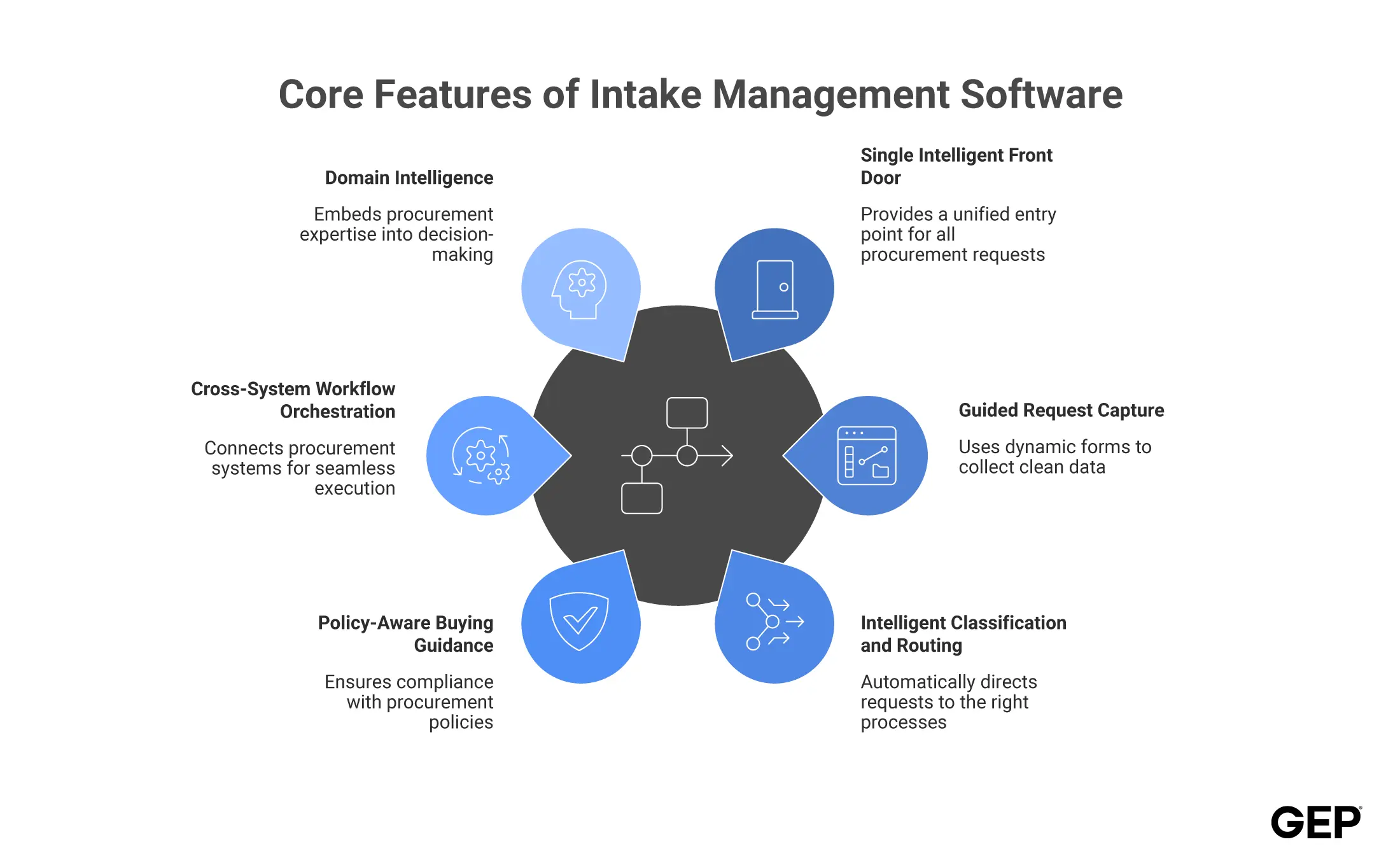
A single intelligent front door
Employees should be able to start any procurement request from one place, whether through a web portal, email, Microsoft Teams or another collaboration tool they already use. The platform should meet users where they are. When people avoid the intake process, procurement loses visibility before any work even begins.
Guided request capture with dynamic forms
Static forms do not account for the variety of procurement requests. Dynamic forms that adjust based on category, spend level or supplier status are far more effective at capturing clean data upfront. Better data at intake means fewer delays and cleaner downstream execution.
Intelligent classification and routing
Routing based on predefined rules is a start. Routing based on real procurement context, covering category, spend threshold, supplier risk and contract status, is a genuine capability. The platform should direct work to the right downstream process automatically, without relying on procurement to manually triage every incoming request.
Policy-aware buying guidance
An intake platform should know when an existing contract covers the need, which suppliers are preferred, and when competitive bidding is required. Stakeholders should not need to understand procurement’s internal logic to make a compliant request. The platform should carry that knowledge and apply it while the request is being shaped, not after it has hardened into a commitment.
Cross-system workflow orchestration
Intake is only valuable if the work that enters the platform reaches the right place. A mature platform connects to ERP, sourcing, contract lifecycle management, supplier management and AP systems, coordinating execution without manual handoffs. The best orchestration platforms sit above existing systems and connect them, rather than requiring a rip-and-replace of what is already in place.
Domain intelligence, not just workflow automation
This is where the most significant capability gap in the market shows up. Many platforms improve the front-end experience. Fewer improve the procurement decision itself.
A software renewal and a logistics contract look similar in a workflow diagram. They require completely different expertise. Category cost drivers, supplier risk profiles, contract obligations and approval thresholds are not just data fields. They are judgment calls. A platform with genuine domain intelligence embeds that expertise into the moment the decision is made. Without it, agentic AI risks becoming another layer over fragmented workflows rather than a genuine improvement in outcomes.
Unlock the Potential with GEP’s AI-Native Procurement Software
Red Flags to Watch For
A few patterns signal risk in any vendor evaluation.
Intake-only scope
The platform captures requests but cannot coordinate what happens afterward. It creates a cleaner front door without changing the process behind it.
AI as a bolt-on
AI features summarize or suggest, but the intelligence is not built into how the platform understands requests, applies policies or learns from outcomes.
No unified data layer
Supplier data lives in one system, contracts in another and policies in a shared drive. An orchestration layer with no native procurement brain cannot recommend confidently or act reliably.
Heavy IT dependency
Every workflow change requires an IT project, slowing adoption and preventing procurement from keeping the platform aligned with how the business operates.
Setting the Right Standard
Two questions cut through the noise in any intake and orchestration evaluation. Does the platform understand procurement well enough to improve the decision, not just route the request cleanly? Is the AI built into the architecture so the value compounds over time, or bolted on top where it fragments and cost climbs?
The organizations getting the most from these platforms are not just improving how work enters procurement. They are changing how procurement work gets done, with faster cycle times, stronger policy compliance and a measurably better stakeholder experience.
The intake screen is where evaluation starts. What sits behind it determines whether you are buying a foundation that appreciates or a configuration you will spend years maintaining.