



How to Build an RFP Evaluation Matrix for Complex Enterprise Sourcing
- RFP evaluation criteria prevent expensive, hard-to-reverse vendor mistakes
- Weighted scoring matrices turn evaluation into a defensible, auditable process
- AI-native platforms score RFPs faster without sacrificing consistency or rigor
November 10, 2026 | Inventory Management 8 minutes read
How a vendor scores on paper and how they perform in practice is what a rigorous evaluation process is built to close. But most procurement teams never build a strategic supplier scoring framework. They either wing it or retrofit AI into legacy tools, which means the AI ends up automating inconsistency instead of removing it.
When you lack strategic RFP evaluation criteria, you risk rigid vendor contracts or AI capabilities that don't fit your organization's complexity. The wrong vendor is an expensive error that costs years to unwind. Teams doing this right skip the retrofit and choose platforms built with procurement intelligence native to the sourcing workflow.
While sourcing teams work across several RFx formats, this guide focuses specifically on RFP evaluation, walking through the core criteria categories and how to build a defensible scoring matrix with an AI-native sourcing platform.
What Is RFP Evaluation and Why Is It Important to Strategic Sourcing?
RFP evaluation is the structured process of scoring and comparing vendor responses to a Request for Proposal against predefined, weighted criteria. It typically covers technical capability, cost, risk, compliance, and delivery capacity, converting subjective judgment into a repeatable score every stakeholder can review.
Done well, it turns a stack of vendor documents into a transparent, auditable decision trail instead of a call made informally in a conference room.
Strategic sourcing decisions carry weight well beyond the initial contract value. A poorly scored RFP can lock your organization into years of underperformance, hidden costs, or compliance exposure, and the damage rarely shows up until long after the contract is signed.
A well-rounded evaluation criteria gives sourcing teams a shared language for that decision, reducing individual bias and making it easier to defend a vendor choice to finance, legal, and the board.
As procurement functions increasingly answer for cost savings and risk exposure, a rigorous evaluation process separates sourcing that holds up under audit from sourcing that gets questioned after the fact.
Core Categories of RFP Evaluation Criteria
Most RFP scoring failures trace back to one root cause: the criteria were never clearly defined before responses came in.
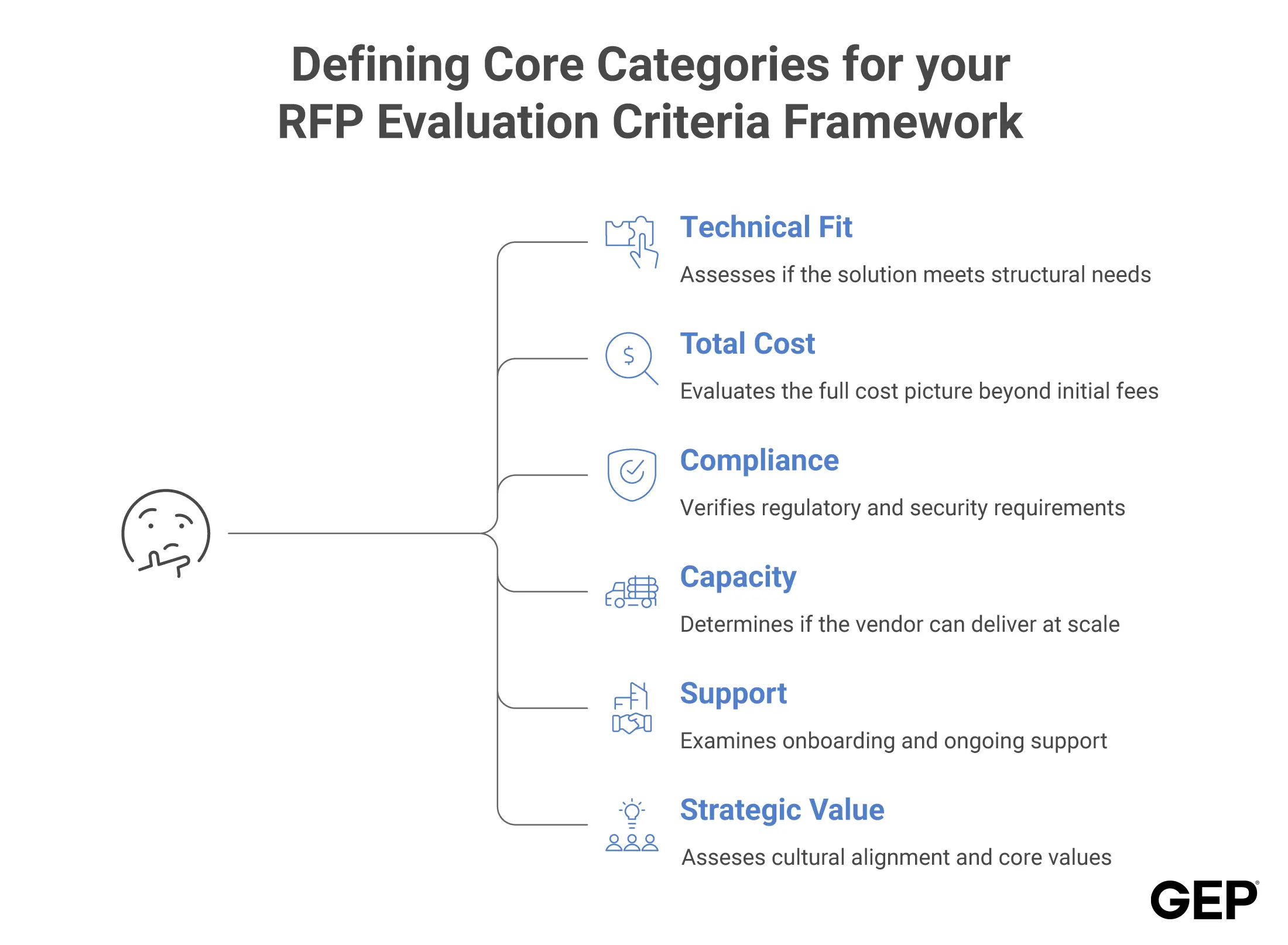
A strong RFP evaluation framework groups criteria into categories your team weights according to what matters most for the specific sourcing event:
Technical Fit and Capability
Does the proposed solution solve the problem defined in the scope of work at a structural level, or does it require significant customization to get there?
Total Cost of Ownership (TCO)
Beyond the initial licensing or implementation fee, what does the full cost picture look like across integrations, training, support, and the hidden fees that accumulate over a multi-year contract?
Security, Governance, and Compliance
Can the vendor meet your regulatory, security, and data-handling requirements, backed by a well-documented compliance posture and a real disaster recovery framework?
Delivery Capacity and Operational Agility
Does the vendor have the financial standing and track record to deliver at your scale, and how strong is their transition roadmap, change management support, and time-to-value history?
Implementation and Support Model
What does onboarding actually look like, and what ongoing support is built into the relationship after go-live?
Strategic Value and Cultural Alignment
Will this vendor operate as a genuine extension of your team, or will every interaction require oversight? What’s their sustainability score?
Weighing these categories before you send the RFP, not after responses land, is what keeps the process objective.
Example of an RFP Scoring Matrix
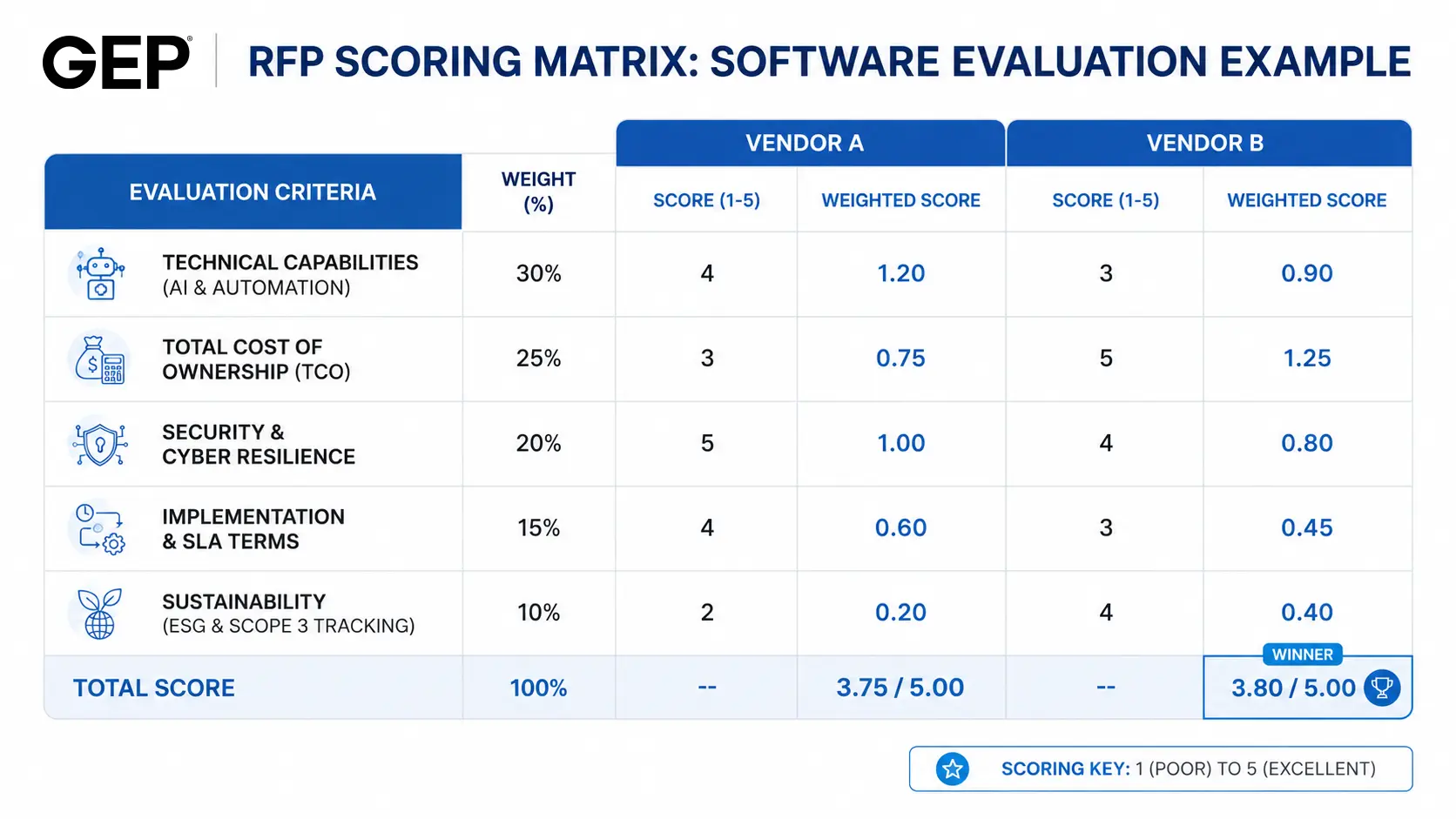
In this example, vendors are scored on a scale of 1 to 5 (1 = Poor, 5 = Excellent). The score is multiplied by the category weight to get the weighted score.
The Core Components
Evaluation Criteria: The specific requirements the vendor must meet, which are usually broken down into highly detailed sub-categories in a real matrix. Example: Technical Capabilities might be split into 10 separate line items.
Weight (%): The relative importance of each criterion to the business. If cutting costs is the primary goal, TCO gets the highest weight. If modernizing a tech stack is the goal, technical capabilities weigh the most.
Raw Score: The grade assigned by the evaluation committee based on the vendor's proposal and demonstrations. Typically, a rubric is used where 5: Exceeds requirements, 3: Meets requirements, and 1 = Fails to meet requirements.
Weighted Score: The mathematical result of multiplying the raw score by the weight.
In the example above, even though Vendor A had better technology and security, Vendor B won the overall bid by slightly edging them out in pricing and sustainability capabilities.
Is Your Procurement Platform AI-Native?
Use a practical framework to evaluate vendor claims with confidence
How to Build an RFP Scoring Matrix: Weighted Scoring Models and Scale Frameworks
A scoring matrix turns your evaluation categories into a defensible, numerical outcome. Building one that holds up requires a few deliberate steps.
Assign Weights Based on Strategic Priority
Not every category deserves equal influence. If security compliance is non-negotiable, it might carry 25% of the total score while implementation support carries 10%. Set these weights with finance, legal, and the business unit before evaluation begins, so nobody adjusts the math after seeing results.
Define a Consistent Scoring Scale
Most enterprise sourcing teams use a 1-to-5 or 1-to-10 scale per criterion. The scale matters less than what each number means: a 3 scored by one evaluator should represent the same performance level as a 3 scored by another.
Write Scale Anchors for Every Criterion
This is the step teams skip most often, and the one that causes disputes later. A one-line description of what a 1, a 3, and a 5 look like keeps scoring consistent across evaluators who may never have scored an RFP together before.
Calculate Weighted Totals, Not Raw Averages
Multiply each criterion's raw score by its assigned weight, then sum per vendor. This allows a lower-priced vendor with weaker technical fit to rank below a higher-priced vendor who scores stronger where it counts.
Normalize Across Evaluators Before Finalizing
Individual evaluators drift toward leniency or severity over time. A short calibration session, comparing how evaluators scored the same vendor on the same criterion, catches that drift before it skews the ranking.
This step carries the most weight in the process, because every downstream decision inherits whatever rigor went into building the matrix.
SOW and RFP Evaluation Mistakes
A Statement of Work (SOW) is a legally binding document that defines the entire scope of a project between a buyer and a vendor or service provider.
SOWs matter in RFP and vendor selection. Before you issue an RFP, you need a baseline statement of work that spells out exactly what capabilities and deliverables you require.
Vendors bid against this SOW, which is what lets you compare proposals on the same terms instead of comparing apples to oranges. Once you select a vendor, that SOW gets built directly into the master services agreement, where it governs how the contract actually gets executed.
Even well-intentioned evaluation processes break down in predictable ways:
Scoring without weights, which flattens the distinction between what's critical and what's merely nice to have.
Letting one voice dominate the committee, so a senior stakeholder's opinion quietly overrides a structured score.
Confusing price with value, when the lowest bid frequently loses on total cost of ownership once implementation and support are factored in.
Skipping scale anchors, leaving results that reflect individual mood more than vendor performance.
Ignoring alignment with the statement of work, so a proposal scores well on paper while quietly deviating from the scope, an inconsistency that only surfaces after signature.
Treating evaluation as a static template, reusing criteria built for one sourcing event on a different category where weights should shift with context.
Also Read: How to Write a Procurement SOW
Accelerating RFP Scoring with AI-Native E-Sourcing
A bolt-on tool adds a single AI feature, like automated document parsing, on top of a sourcing process that otherwise stays manual. An AI-native platform is different because domain-specific procurement knowledge is built directly into how the system operates, not added as a plug-in after the fact.
With domain-specific knowledge explicitly coded into its architecture, when you introduce agentic AI into your e-sourcing workflows, the system does not just passively store vendor responses. Agentic AI actively contextualizes the evaluation.
Through GEP Quantum Intelligence, complex workflows run simultaneously. The system can autonomously parse vendor documentation, extract relevant data points, map them directly to your weighted scoring matrix, and pre-score the technical baselines.
Because the compliance rules are built into the agentic orchestration, the platform instantly flags deviations, risk factors, and missing information before a human evaluator even opens the file. This eliminates administrative fatigue and allows your strategic leaders to focus purely on high-level negotiation and relationship architecture.
Ready to Fix Your RFP Scoring Process?
Build a weighted evaluation framework that fits your sourcing complexity
Driving Transparent, Audit-Ready Vendor Selection
RFP evaluation is only going to get more scrutinized as procurement teams take on greater accountability for risk, compliance, and cost of ownership.
The ability to show exactly how and why a vendor was selected will matter as much as the vendor selection. Weighted scoring matrices and calibrated committees are no longer nice-to-have practices. They're what a defensible sourcing decision looks like when it gets questioned six months or six years later.
The next step for procurement leaders is treating evaluation criteria as a living framework rather than a document built once and reused indefinitely. Revisit weights as strategic priorities shift, build scale anchors into every future RFP template, and look closely at where AI can remove inconsistency from the process rather than simply speeding it up.
If your team is still scoring RFPs manually or piecing together AI features on top of static spreadsheets, it's worth evaluating what an AI Sourcing Management Software Solution built for this exact workflow can do differently.




Frequently Asked Questions
Most enterprise sourcing teams default to either a 1-to-5 or 1-to-10 numerical scale per criterion, then weighted and summed into a total score per vendor. The 1-to-5 scale is more common because it's easier to write clear anchors for each point. What matters more than the scale itself is whether every evaluator is scoring against the same defined anchors.
Sharing the evaluation categories and their relative weights with vendors upfront is widely considered best practice. It results in stronger, more targeted proposals, and it protects the buying organization from accusations of an unfair or opaque process. What typically stays internal is the granular scoring scale and anchor definitions used by the committee.
Yes, and increasingly it's expected rather than optional. AI can extract and structure vendor responses against your defined criteria, flag compliance gaps, and apply weighted scoring consistently without the fatigue that affects human evaluators reviewing dozens of documents. The caveat is that AI scoring is only as reliable as the criteria and weights it's built on, so the framework still needs to be defined by the sourcing team first.
Most enterprise RFPs are scored by a committee of four to seven evaluators representing the functions with a stake in the outcome: procurement, the requesting business unit, finance, legal, and IT or security where relevant. Fewer than four risks concentrating influence in one or two opinions, while significantly more tends to slow consensus without improving accuracy.