



The 5 Bets Global Procurement Leaders Are Making in 2026
- 72% of organizations planning to adopt agentic AI rate their intake and orchestration capabilities as immature or very immature.
- On average, only 43% of purchasing categories have proactive risk monitoring in place.
- 78% of leaders consider orchestration highly important to their overall strategy, yet system fragmentation and cross-functional alignment gaps remain widespread.
August 25, 2026 | Procurement Software 4 minutes read
Procurement leaders are navigating supply disruptions, geopolitical instability, commodity volatility, and a technology landscape shifting faster than most teams can absorb. The pressure to do more with less, while also being more strategic, data-driven, and agile, has never been greater.
Something had to change at the foundational level.
The 2026 Procurement Executive Insight Report, developed by The Hackett Group in partnership with GEP, maps the priorities, investments, and operating model shifts leading organizations are making right now. 94% of respondents manage organizations with over $1B in annual revenue, and 67% oversee more than $1B in annual spend.
Here are the five themes defining procurement’s future.
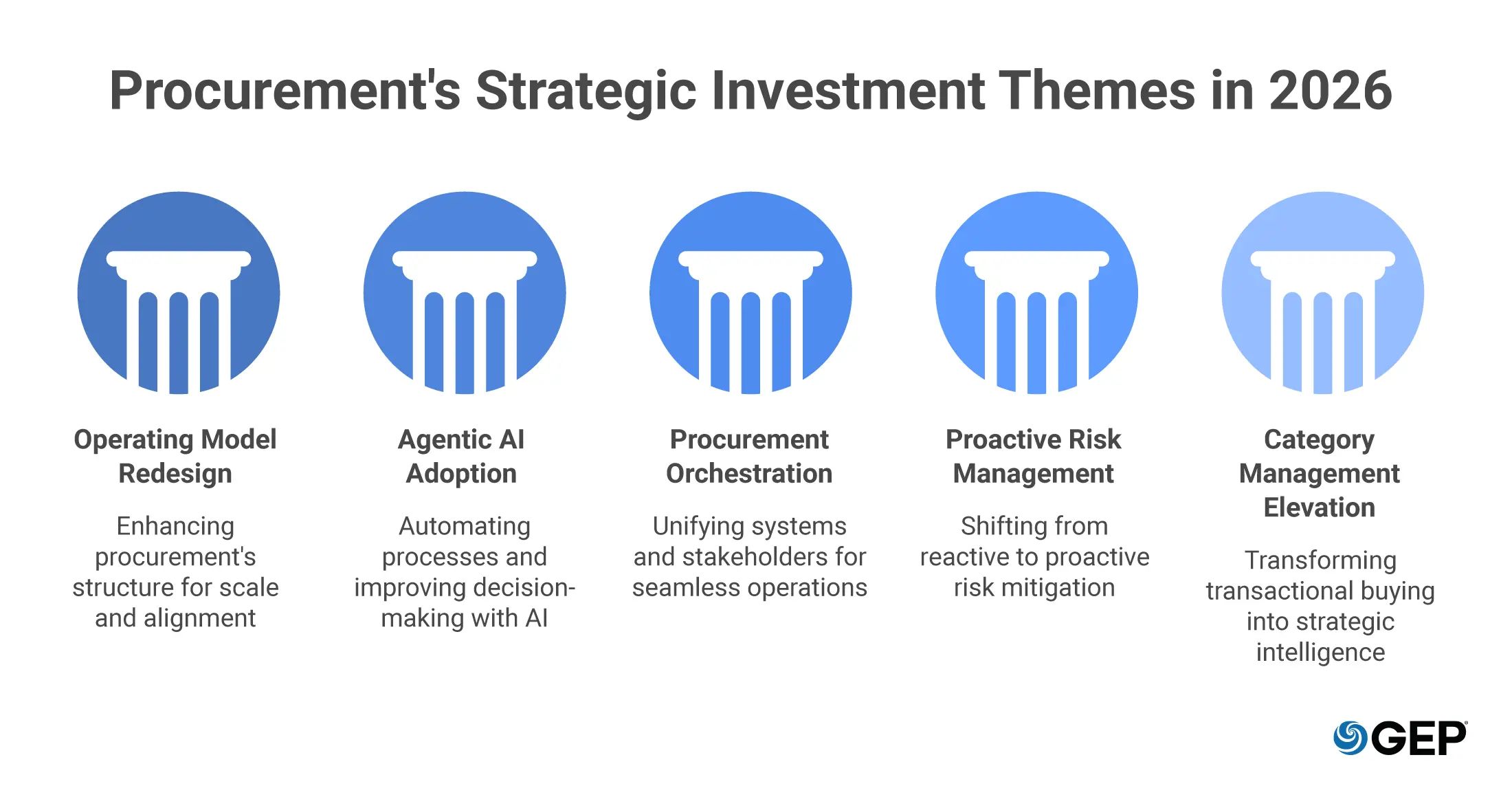
Bet 1: Reinventing the Operating Model
Most procurement operating models were designed for a world that no longer exists. The gap between what businesses need from procurement and what current structures can deliver is widening, and closing it requires more than tooling upgrades or headcount adjustments.
Research participants expect near-term change to concentrate in two key areas of the operating model, with transformation going well beyond incremental improvements. Notably, the areas of lowest planned change are equally revealing, signaling where organizations are choosing to hold steady and where that decision may carry risk.
Leaders agree that success is multidimensional. Understanding which levers to pull and in what sequence is where real strategic advantage lies.
Bet 2: Moving from AI Tools to AI Agents
Agentic AI doesn’t just assist, it executes. These systems can autonomously manage multi-step procurement workflows, make decisions from live data, and act across platforms without waiting for human instruction. For procurement, this marks a shift from AI as a productivity aid to AI as an operational participant in the source-to-pay cycle.
Adoption is already underway: a significant share of organizations are beyond evaluation, actively piloting or deploying agentic AI.
Expected benefits range from process efficiency to improved data quality. But adoption is stalling for a consistent reason: not lack of appetite (every organization surveyed has plans for agentic AI), but foundational readiness.
Immaturity in intake and orchestration capabilities is the bottleneck, and it surfaces across every section of the report.
Bet 3: Making Orchestration the Backbone
Procurement orchestration is the integration of systems, workflows, data, and stakeholders from intake to payment. It is now a strategic imperative.
Without it, procurement is a series of disconnected steps in which requests get lost, compliance breaks down, and visibility is fragmented. With it, procurement becomes a structured, scalable, and increasingly automated engine.
78% of leaders rate orchestration as highly or extensively important to their strategy, and not a single respondent rated it as limited in importance. That level of consensus among senior executives is remarkable.
The research maps where orchestration is being applied and what outcomes leaders are targeting, making clear that orchestration is no longer just an internal process goal. It is the infrastructure layer that enables AI, compliance, and cross-functional collaboration to operate at scale.
The Agentic AI Playbook for Procurement Pros
Your roadmap to move from pilots to production, with AI that adapts, learns, and delivers
Bet 4: Building Real Risk Visibility
Most procurement teams believe they have risk management in place. The data tells a different story.
At the median organization, most purchasing categories have no proactive risk monitoring. Teams watch their top-spend, high-visibility categories and largely ignore the rest: until something breaks.
The gap between median and top-quartile performance in risk visibility and response capability is significant, evident in both the systems organizations use and the confidence of the teams using them.
The top five enterprise risks flagged for 2026, ranging from cybersecurity to macroeconomic instability, are largely systemic rather than category-specific, which demands a fundamentally different monitoring approach than most organizations currently use.
Bet 5: Closing the Intelligence Gap in Category Management
Category management now involves integrating market intelligence, supplier data, spend analysis, and business requirements into coherent plans. Most organizations have built solid structural foundations. The category ownership is defined, governance is in place, and business relationships are strong.
But the gap is not structural. It is intelligence. Most organizations know what they’re spending. Far fewer can say their category strategies reflect current market conditions, supplier risk exposure, or emerging regulatory pressures. That’s where value is quietly leaking. Top performers are closing this gap by being deliberate. They now focus on high-spend, high-risk categories rather than trying to improve everything at once.
Make Procurement Decisions Faster with Agentic AI
Orchestrated teams act on real-time sourcing intelligence across volatile global markets
Looking Ahead: Fix the Foundation First
Across all five themes, the report points to a single underlying reality: the organizations pulling ahead are not doing more of everything; they are fixing the foundations that make everything else possible.
Orchestration and agentic AI emerge as the critical enablers of speed and scalability across the source-to-pay lifecycle, but only for organizations that have done the foundational work to support them.
The leaders interviewed are not waiting for certainty. The specific investments they are prioritizing, the metrics that separate top performers, and the complete data behind each theme are available in the 2026 Procurement Executive Insight Report.



Frequently Asked Questions
Traditional AI surfaces insights; agentic AI acts on them. It can receive a request, evaluate suppliers, run a bid, and route approvals without waiting for human instruction at each step. This shifts AI from a productivity tool to an active participant in the source-to-pay cycle. Most organizations want it, but weak intake and orchestration foundations are slowing them down.
Intake is how procurement captures business requests: requisitions, sourcing needs, contracts, and supplier onboarding. Orchestration connects intake to everything downstream, linking systems, approvals, compliance checks, and payments into one coherent process. The two are interdependent: good orchestration starts with clean intake. Together, they are the foundation that agentic AI requires to function reliably at scale.