


Emotional Intelligence: The New Must-Have Skill for Procurement Leaders
- Human-centric soft skills are becoming as vital as technical data analysis for procurement pros.
- High emotional intelligence enables procurement leaders to build resilient supplier relationships that can withstand global market volatility.
- Integrating emotional intelligence with digital tools allows professionals to navigate complex negotiations and manage internal stakeholders more effectively.
January 14, 2026 | Procurement Strategy 5 minutes read
In an era of global supply chain complexity, the value of leveraging procurement data to analyze and predict disruptions, price shifts and supplier performance can’t be understated.
However, it’s not everything. Emotional intelligence (EI) is emerging as a differentiator for procurement professionals.
What is Emotional Intelligence?
Emotional intelligence is your ability to understand and manage emotions, both your own and other people's. It's not about being "nice." It's a psychological toolkit that includes self-awareness, self-regulation, motivation, empathy and social skills.
For a procurement leader, emotional intelligence means recognizing when a tough negotiation makes you defensive. It means staying calm and focused on your goal.
It’s also about reading the room: understanding what a supplier or stakeholder needs, even when they don't say it out loud. When you master these skills, you can navigate human behavior as well as you navigate a balance sheet.
Why Emotional Intelligence Matters in Procurement
Procurement runs on relationships. You're always dealing with internal budget owners or external vendors, and your success depends on influencing people.
Emotional intelligence is the glue holding together a complex network of human interests. It helps you stay calm under pressure, which is critical during high-stakes contract renewals or supply chain disruptions.
Leaders with high emotional intelligence build stronger supplier relationships. They move past "us vs. them" thinking toward real partnerships that create mutual trust. When working with partners they trust, rather than fear, suppliers are more likely to share early warnings about problems.
Key Components of Emotional Intelligence in Procurement
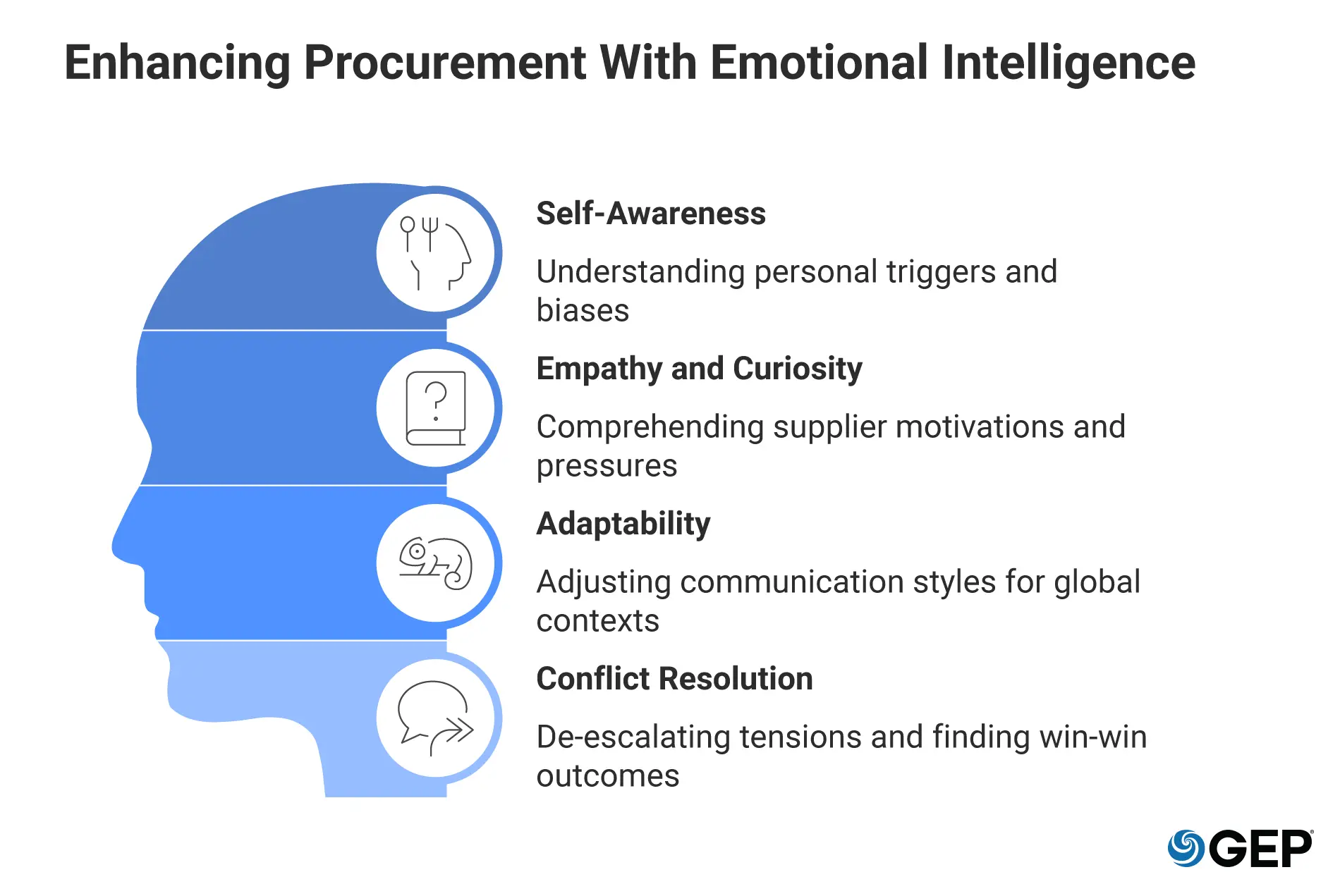
To excel, procurement professionals need specific emotional intelligence skills that affect their daily work:
• Self-Awareness
Know how your triggers and biases shape your decisions.
• Empathy and Curiosity
Try to understand what motivates your suppliers and what pressures they face. Don't make assumptions.
• Adaptability
Change your communication style based on cultural or emotional context in a global market.
• Conflict Resolution
De-escalate tensions and find win-win outcomes in difficult negotiations.
AI-powered systems are now able to handle the tedious, manual procurement work. That makes the soft skills required to manage the human elements of procurement more important than ever. Focus on these components to ensure your team actively manages the human side of business.
SWOT Analysis for Emotional Intelligence in Procurement
To understand the strategic landscape of EI, we can look at a brief SWOT analysis:
| Strengths | Weaknesses |
| Improved negotiation outcomes and better supplier collaboration | High EI is harder to quantify in traditional procurement KPIs than cost savings |
| Opportunities | Threats |
| Redefining procurement as a strategic value-driver within the organization | Traditional "old-school" corporate cultures may view EI as a "soft" or unnecessary skill |
How to Develop Emotional Intelligence in Procurement
The good news is that EI is not a fixed trait; it can be developed over time with intentional practice. To develop emotional intelligence for procurement leaders, organizations should encourage:
1. Active Listening
Focusing entirely on what the other party is saying without immediately preparing a rebuttal.
2. Feedback Loops
Implementing regular reviews where team members and even suppliers can provide honest feedback on communication styles.
3. Stress Management Training
Providing tools to help staff remain composed during the intense cycles of the procurement year.
4. Empathy Exercises
Encouraging teams to "walk in the shoes" of a supplier to understand their operational hurdles.
Building self-awareness is the first step. When a leader understands their own emotional landscape, they are far better equipped to guide their team through the turbulent waters of modern trade.
Key Benefits of Emotional Intelligence in Procurement
The ROI of a high-EI procurement team can be substantial. First, procurement professionals with high emotional intelligence are better able to understand the motivations of their counterparts, leading to more successful and durable negotiations.
Second, EI fosters innovation. When suppliers feel a sense of psychological safety and trust, they are more willing to bring new ideas, technologies and "first-look" opportunities to the table.
Finally, it leads to better internal alignment. Procurement often struggles to get buy-in from other departments; an emotionally intelligent leader knows how to frame procurement goals in a way that resonates with the specific needs of IT, HR or Operations.
How to Deploy Agentic AI in Procurement
Get the Essential Implementation Guide to Move From Hype to Results
Download the Playbook
Real-World Applications of Emotional Intelligence in Procurement
Imagine a global shipping crisis that delays a critical component for several months. A low-EI team might focus purely on the contract's penalty clauses, further straining an already stressed supplier. An emotionally intelligent team could use the opportunity to collaborate, perhaps identifying alternative shipping routes or temporarily adjusting specifications to keep production moving.
Or a procurement lead might use conflict resolution skills to mediate between a CFO who wants deep cuts and a department head who insists on a premium vendor. By empathizing with both the need for fiscal discipline and the need for quality, the procurement lead can facilitate a compromise that satisfies both parties’ underlying concerns.
In the Age of AI, EI Is Even More Important
While artificial intelligence can handle data crunching and routine automation, it cannot replace the human touch required to navigate complex ethics, build trust, and resolve deep-seated conflicts. Investing in these skills will help organizations improve their culture and build a more resilient, innovative and competitive supply chain.
For those looking to transform their strategic approach, exploring procurement consulting services can provide the framework needed to integrate these human-centric skills into a modern procurement strategy.



FAQ's
Emotional intelligence allows negotiators to read non-verbal cues and understand the underlying motivations of the other party, enabling them to move past deadlocks toward mutually beneficial agreements.
While harder to track than raw savings, the impact of EI can be measured through improved supplier performance scores, higher internal stakeholder satisfaction ratings and reduced contract dispute frequencies. Long-term indicators also include increased innovation sharing from key strategic partners.
Self-awareness, empathy and conflict resolution are the most critical competencies, as they directly impact a professional's ability to manage high-pressure situations and build trust. Adaptability is also essential for navigating the diverse cultural and economic landscapes of global supply chains.
While artificial intelligence excels at processing vast amounts of data and identifying trends, emotional intelligence provides the human judgment and relationship management needed to act on those insights. EI ensures that the "human element" remains at the center of data-driven decision-making.