



How Can a Company Improve Efficiency in P2P and Reduce Cycle Time?
- Most P2P delays are administrative and solvable through automation and integration.
- Supplier clarity and internal collaboration reduce invoice processing friction more than policy enforcement alone.
- Continuous monitoring keeps P2P gains from quietly eroding over time.
February 11, 2026 | Procurement Strategy 4 minutes read
If you work in procurement or finance long enough, you stop thinking about procure-to-pay as a neat process on a slide. You experience it as reality. Purchase requisitions that stall. Invoice processing that takes too long. Vendor payments that generate more emails than value.
The procure-to-pay cycle sits at the intersection of operational efficiency, working capital, compliance and trust between teams. When it works well, nobody notices. When it does not, everyone feels it.
Improving efficiency in the procure-to-pay process is not about chasing perfection. It is about removing friction that has quietly become normal. The companies that shorten cycle time consistently are not working harder. They are designing an optimized P2P cycle that reflects how work actually happens today.
Streamline your procure-to-pay process with intelligence built for real workflows
See what modern P2P looks like
Contact Us
Leverage AI and Automation
Most P2P delays are not strategic. They are administrative. Manual data entry. Chasing approvals. Matching invoices line by line.
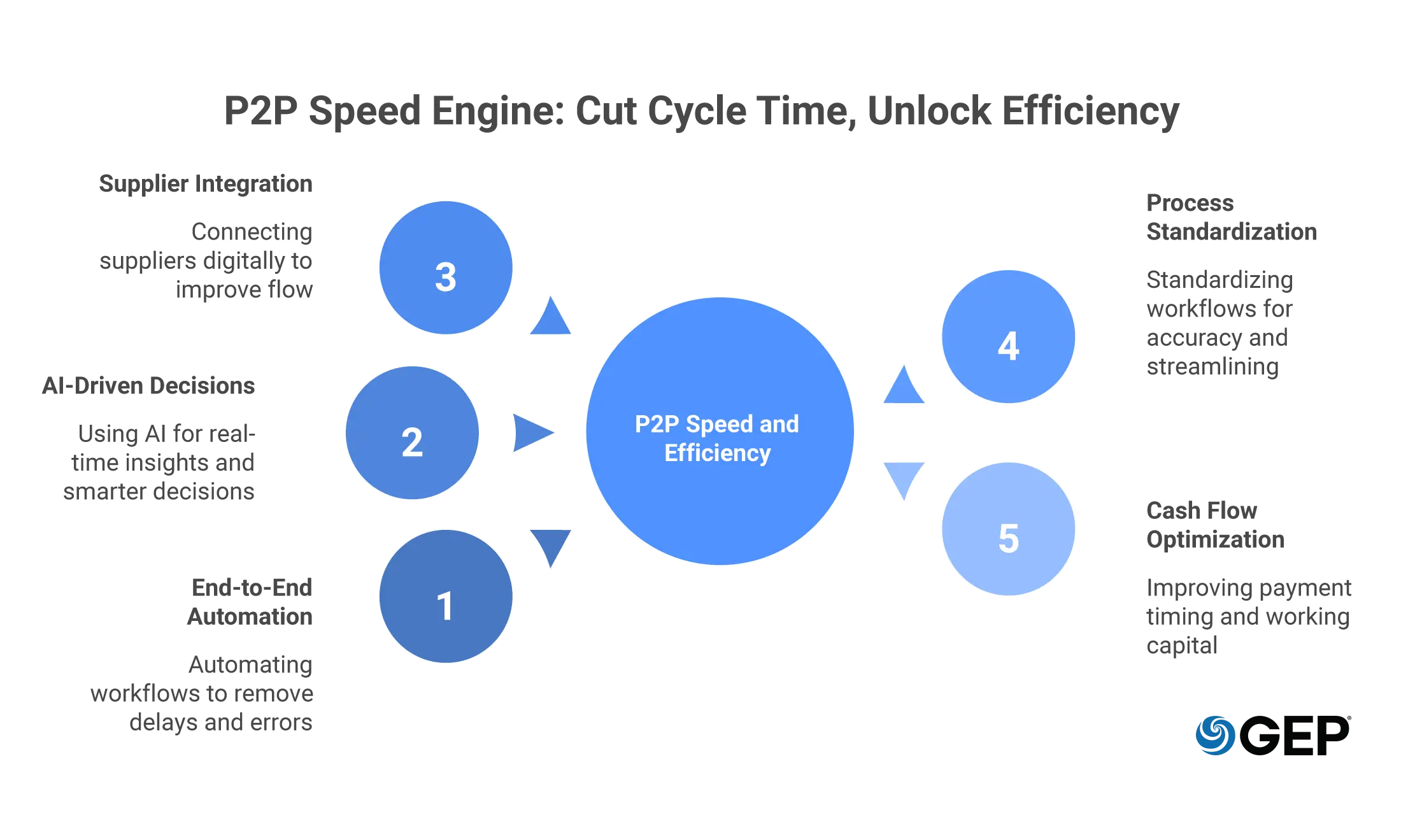
By utilizing advanced automation technology, companies remove these delays at the source. AI driven tools can create purchase requisitions automatically from demand signals. Invoice processing can be touchless for the majority of compliant invoices. Invoice approval workflows can route themselves based on value, risk and policy.
When approval routing is automated, cycle time drops because people only see what truly requires judgment. The finance team stops acting as a traffic controller and starts acting as a value steward.
Automation does not replace accountability. It enforces it consistently across the procure-to-pay process.
Enhance Supplier Relationship Management
Supplier friction is one of the most underestimated causes of slow P2P cycles. Poor data quality. Inconsistent invoicing formats. Unclear payment terms.
Strong supplier relationship management simplifies vendor payments because expectations are aligned upfront. Suppliers understand how to submit invoices correctly. They know where to check payment status. They are less likely to escalate issues through informal channels.
When suppliers trust the payment process, invoice approval becomes faster and exception rates fall. That directly improves operational efficiency across accounts payable and procurement teams alike.
Utilize Advanced Analytics
You cannot improve what you cannot see clearly. Advanced analytics turn the procure-to-pay cycle from a black box into a measurable system.
Analytics highlight where purchase requisitions slow down. Where invoice processing creates bottlenecks. Which approval steps add value and which exist out of habit.
The most effective teams use analytics not to assign blame but to redesign flow. They focus on trends rather than individual errors. Over time, the P2P process helps leadership make decisions based on facts rather than anecdotes.
Engage in Continuous Monitoring and Optimization
P2P improvement is not a one-time project. It is an operating discipline.
Continuous monitoring ensures that gains do not erode quietly. Cycle times drift. Workarounds reappear. Exceptions increase.
High-performing organizations review P2P metrics the same way they review cost or service levels. They treat the procure-to-pay cycle as a living system that requires tuning as the business changes.
Stay ahead of shifting spend dynamics across key categories
Explore the GEP Spend Category Outlook to inform data driven decisions
Download the Report
Implement AI-Powered Procure-to-Pay Software
Improvements in the P2P process can be achieved through automation and integration, but only if the technology reflects real workflows.
AI-powered procure-to-pay software connects purchase requisition creation, invoice processing, invoice approval and vendor payments into one coherent experience. It eliminates handoffs that slow the payment process and frustrate the finance team.
The goal is not feature richness. The goal is flow. An optimized P2P cycle feels simple because complexity is handled by the system rather than the people.
Improve Stakeholder Collaboration
Procurement cannot fix P2P alone. Neither can finance.
The procure-to-pay process spans budget owners, buyers, suppliers and accounts payable. When stakeholder collaboration is weak, delays multiply. When it is strong, cycle time compresses naturally.
Clear roles. Shared metrics. Transparent escalation paths. These elements matter more than most organizations realize. P2P efficiency improves quickly when teams stop optimizing locally and start optimizing end-to-end.
Integrate Systems
Disconnected systems create invisible delays. Data re-entry. Manual reconciliations. Email based approvals.
System integration allows data to flow seamlessly and be reused everywhere. Purchase requisitions feed contracts. Contracts feed invoices. Invoices feed vendor payments without rework.
When systems are integrated, operational efficiency improves not because people move faster but because work simply moves less.
Improving Efficiency in the P2P cycle
The best P2P leaders do not chase speed for its own sake. They remove friction deliberately. They design processes that reflect reality. They use automation to support judgment rather than replace it.
When done well, the P2P process helps the business move faster without feeling rushed and spend smarter without feeling constrained.




FAQ
A slow procure-to-pay cycle delays visibility into liabilities and disrupts vendor payments. This creates forecasting uncertainty, increases exception handling and weakens supplier trust. Over time, it limits working capital flexibility and raises the true cost of operations even if unit prices remain unchanged.