


Challenges That Undermine Procure-to-Pay System Implementations (and how to overcome them)
- P2P projects stall when process gaps surface late and ownership stays unclear across teams.
- Data, adoption, and integration cause most failures long after technical go-live milestones pass.
- Agentic AI changes execution, not just workflows by handling exceptions without constant redesign.
January 22, 2026 | Procurement Strategy 4 minutes read
Procure-to-pay projects usually start with confidence. Leadership approves the budget. Vendors promise fast deployment. Teams expect cleaner spend data and fewer invoice errors. Then reality hits. Adoption lags. Exceptions pile up. Manual work creeps back in.
Most organizations do not fail because they chose the wrong P2P software. They struggle because P2P exposes deeper issues. Fragmented processes. Poor data discipline. Conflicting ownership between procurement, finance, and IT. Once those surface, timelines stretch and trust erodes.
Industry data supports this pattern. GEP research shows that while most enterprises deploy P2P tools, fewer than half achieve end-to-end automation across requisitioning, invoicing, and payments. Gartner reports that user adoption and process alignment remain the top barriers to realizing ROI from procurement technology.
Understanding the Procure-to-Pay System
Procure-to-pay connects how an organization buys to how it pays. The flow starts with intake and requisitioning, moves through sourcing and contract use, and ends with invoice processing and supplier payment.
On paper, the flow looks linear. In practice, it rarely behaves that way. Requests arrive incomplete. Contracts sit outside the system. Invoices fail three-way match due to bad master data. Each break forces manual intervention.
A P2P system only works when policies, data, and roles line up across functions. Procurement controls buying. Finance controls payment. IT controls systems. Suppliers operate outside all three. Any misalignment shows up immediately in P2P.
Don’t Wait To Be Disrupted
Explore how autonomous AI agents are driving procurement transformation
ASK US NOW
Common Challenges in Implementing Procure-to-Pay Systems
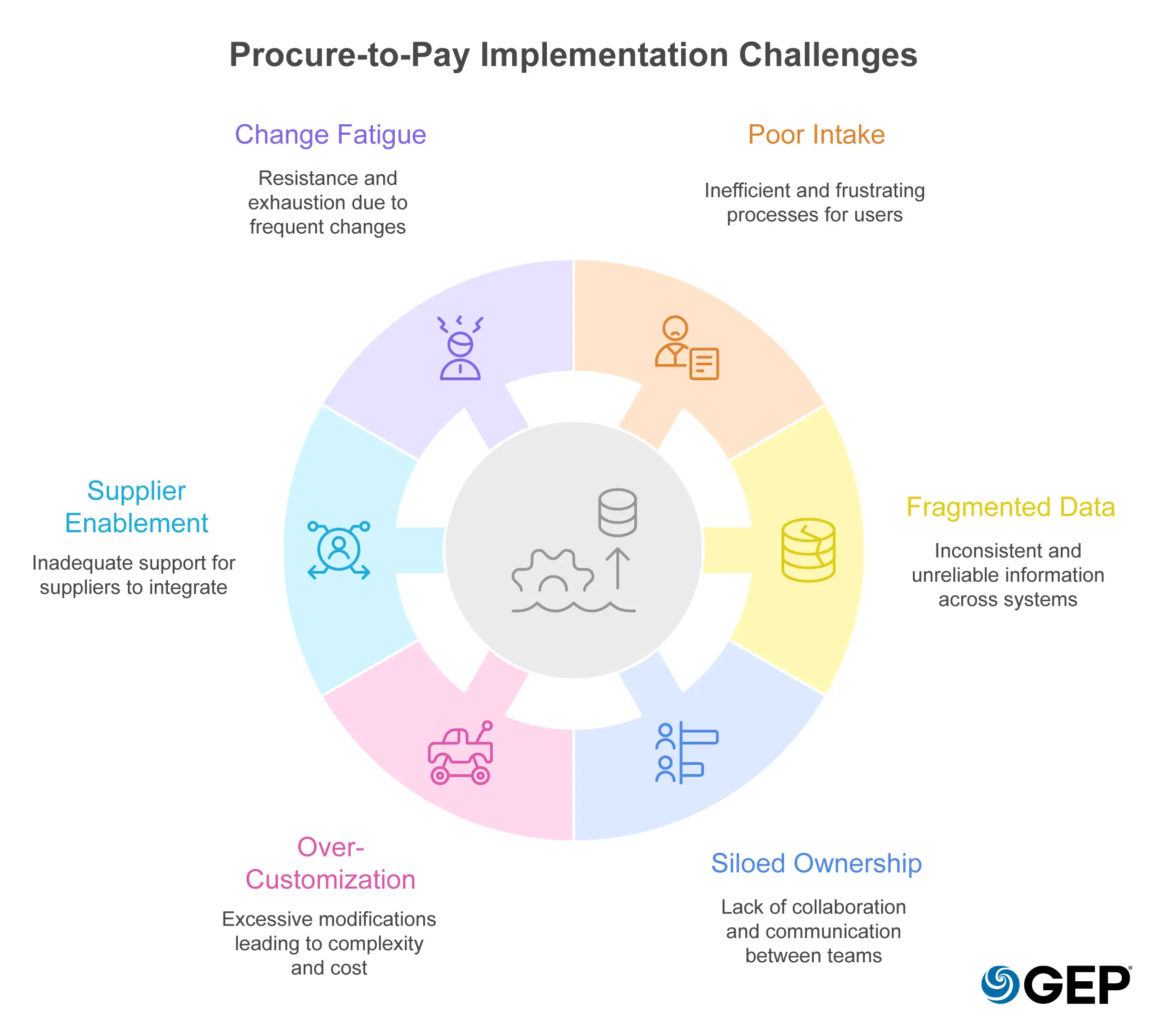
1. Poor Intake and User Experience
Many P2P programs begin with the back end. Invoicing automation gets priority. Intake receives little attention. Employees face long forms, unclear catalogs, or rigid workflows. They bypass the system and buy off contract.
That behavior drives maverick spend and breaks compliance before procurement ever sees the request. Gartner estimates that poor user experience accounts for a large share of off-system spend in mature organizations.
2. Fragmented and Low-Quality Data
P2P depends on clean supplier, item, price, and tax data. Most organizations do not have it. Supplier records differ across ERP, sourcing tools, and finance systems. Contract pricing does not match catalogs. Tax and banking details go stale.
Automation fails when data fails. Three-way match rates drop. Invoice exceptions rise. AP teams revert to email and spreadsheets to keep payments moving.
3. Siloed Ownership Between Teams
Procurement owns buying rules. Finance owns payment controls. AP owns invoice resolution. When something breaks, no single team owns the fix.
This slows decisions. Approvals bounce between functions. Policy exceptions pile up. GEP studies consistently show that lack of cross-functional ownership delays P2P stabilization more than technical issues.
4. Over-Customization During Implementation
Many organizations try to replicate old processes inside new systems. They customize workflows to match legacy approval paths and exception handling. That increases cost and complexity.
Those customizations also limit upgrades and block future automation. Everest Group notes that heavily customized P2P environments show slower innovation adoption and higher support costs over time.
5. Supplier Enablement Gaps
P2P systems depend on suppliers submitting compliant invoices. Many suppliers lack the tools or motivation to change. Enablement stalls. AP teams accept PDFs and emails to keep relationships intact.
Without broad supplier adoption, invoice automation plateaus. Manual handling stays high. Payment delays continue.
6. Change Fatigue and Skill Gaps
Employees already juggle multiple systems. Another rollout meets resistance. Training focuses on clicks, not outcomes. Teams do not understand why the process changed.
Over time, workarounds replace standard workflows. The system technically runs. The process does not improve.
GEP Outlook Report 2026
Explore the dynamics shaping procurement & supply chain and know how to navigate them in 2026
EXPLORE THE REPORT
Best Practices to Overcome P2P Challenges with Agentic AI
Traditional automation follows rules. Agentic AI observes, decides, and acts within guardrails. That difference matters in P2P.
Redesign Intake Around Behavior
Agentic AI simplifies intake by interpreting free-text requests, matching them to catalogs or contracts, and guiding users to compliant paths. The system adapts to how people request goods, rather than forcing rigid forms. That reduces off-system buying and shortens requisition cycles.
Repair Data Continuously
Instead of waiting for data cleanup projects, agentic AI flags inconsistencies as they appear. It detects price mismatches, duplicate suppliers, and missing fields. It corrects low-risk issues automatically and escalates others. This keeps match rates high without constant manual audits.
Orchestrate Across Functions
Agentic AI works across procurement, finance, and AP systems. It routes exceptions to the right owner based on context, not static rules. It learns which approvals add value and which cause delay.
GEP research shows organizations using AI-driven orchestration cut invoice cycle times significantly by reducing unnecessary approvals.
Reduce Customization Pressure
Agentic systems adapt without hard-coded workflows. They follow policy intent rather than brittle rules. That lowers the need for custom builds and keeps the platform upgrade-ready.
Accelerate Supplier Enablement
AI agents guide suppliers through onboarding, validate invoice formats, and flag errors before submission. Over time, suppliers learn the correct behavior through feedback loops.
That raises electronic invoice adoption without constant outreach.
Support Change Through Feedback
Agentic AI explains its actions. Users see why a request routed a certain way or why an invoice failed. That transparency builds trust and speeds adoption.
Conclusion
Procure-to-pay systems fail quietly. They do not crash. They decay. Manual work returns. Compliance weakens. Teams stop believing the data.
Most challenges do not come from technology limits. They come from static automation applied to dynamic processes. Agentic AI changes that equation. It allows P2P systems to adjust, learn, and enforce policy without constant redesign.
Organizations that treat P2P as an execution layer, not a workflow diagram, see different results. Fewer exceptions. Faster cycles. Cleaner data. That is where P2P finally delivers.


FAQ's
Automation removes manual steps, but agentic automation goes further by handling exceptions and adapting to real behavior. It improves data quality, routing, and compliance without rigid workflows. Over time, it reduces rework and keeps the P2P process stable as conditions change.