



Best Practices for Professional Services Procurement in 2026
- Professional services procurement succeeds or fails on clarity of outcomes, not cost or credentials.
- Structure in sourcing and governance enables better delivery, not bureaucracy.
- Continuous performance management is what turns one-off services spend into long-term strategic value.
February 18, 2026 | Procurement Strategy 5 minutes read
Leaders, stop thinking of professional services as “spend” and start thinking of them as leverage.
Consultants, legal advisors, engineers, IT specialists, auditors, marketing agencies: these are not commodities. You are not buying hours. You are buying judgment, experience, and the ability to solve problems that your internal teams cannot or should not handle alone.
That is exactly why professional services procurement is harder than it looks. There are fewer benchmarks, more opinions, and higher risk if things go wrong. But when it is done well, it quietly becomes one of the most strategic capabilities in the organization.
Let’s break down the best practices for professional services procurement in a way that feels realistic, not theoretical.
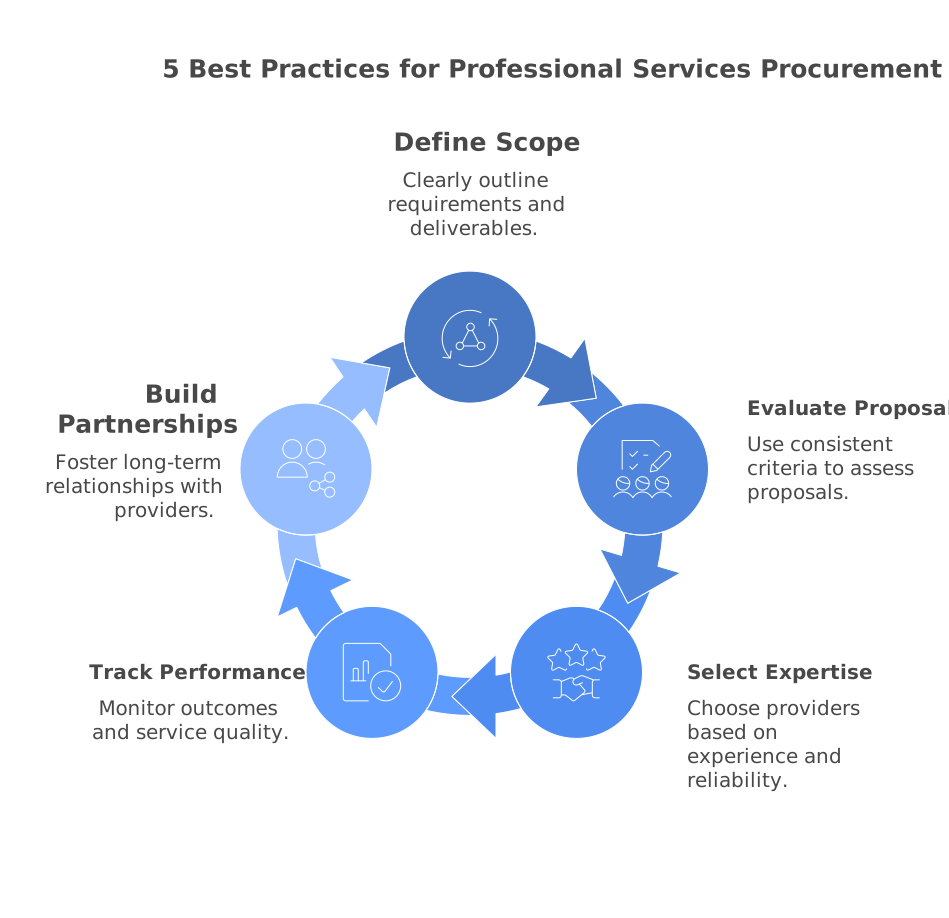
Define Requirements for Professional Services Procurement Clearly
Most professional services sourcing problems do not start with suppliers. They start with unclear thinking.
If the requirement is vague, the outcome will be vague. When stakeholders say they need “support” or “expertise,” procurement has a responsibility to slow things down and ask better questions.
What problems are we actually trying to solve. What will success look like in three, six, or twelve months. What decisions will be easier once this engagement is complete.
Clear requirements shift the conversation from activities to outcomes. That single shift improves the entire professional services procurement process. Suppliers respond with better solutions. Evaluations become more objective. Contracts become easier to manage.
It also forces internal alignment. Writing things down has a way of revealing assumptions that were never discussed out loud.
Conduct Market Research
Market research in services procurement is not about building a long supplier list. It is about understanding how value is delivered in the market.
Different providers solve similar problems in very different ways. Some lead with proprietary frameworks. Others lead with talent depth or industry specialization. Some price for flexibility, others for predictability.
When procurement invests time in market research, it strengthens strategic sourcing for services. You learn where innovation is happening, where risk is hiding, and where stakeholders may be paying a premium without realizing it.
This step also supports risk mitigation in professional services procurement. Understanding supplier capacity, dependency risks, and market dynamics helps avoid engagements that look good on paper but struggle in delivery.
Turn professional services procurement into strategic advantage
See how GEP helps teams source, manage, and deliver services with confidence
Contact Us
Develop a Comprehensive RFP for Professional Services Procurement
A good RFP does not feel like an exam. It feels like a conversation with structure.
The purpose of an RFP is not to force every supplier into the same answer. It is to make sure they are responding to the same problem.
Clear scope boundaries, timelines, governance expectations, and success criteria help suppliers focus on what matters. Being transparent about evaluation criteria improves response quality and saves time for everyone involved.
This is where service procurement tools really earn their keep. They bring consistency, auditability, and collaboration into a process that is often fragmented across email threads and spreadsheets.
More importantly, they create data. And data is what allows procurement to improve over time, not just run events.
Evaluate Proposals Objectively During Professional Services Procurement
Evaluating professional services proposals is where emotion tends to creep in.
A well-known brand feels safer. A confident presenter sounds more convincing. A stakeholder’s preferred supplier suddenly seems “strategic.”
Best practice means separating confidence from capability.
Use structured scorecards. Balance commercial considerations with delivery approach, team quality, risk management, and cultural fit. Look closely at assumptions and dependencies, not just headline pricing.
Supplier performance evaluation should start here, not after the contract is signed. How suppliers propose to deliver tells you a lot about how they will behave once the work begins.
This is also where procurement performance management becomes real. If you cannot explain why one supplier won over another, you cannot explain success or failure later.
Discover Now GEP’s – Procurement Services
Negotiate Clear Contract Terms
Contracts for professional services should enable delivery, not just protect against worst-case scenarios.
Clarity beats complexity every time. Roles, responsibilities, decision rights, escalation paths, and change control mechanisms should be easy to understand, even for someone joining the project midstream.
Risk mitigation in professional services procurement lives in the details. How scope changes are handled. How intellectual property is treated. What happens if key personnel change. How either party can exit without damaging the business.
Well-structured contracts also create a foundation for ongoing supplier performance evaluation. When expectations are clear, conversations about performance become constructive instead of confrontational.
Establish Communication Protocols for Effective Services
Professional services fail more often from poor communication than from poor capability.
That is why governance matters. Who owns the relationship. How progress is reviewed. How decisions are documented. How issues are escalated.
Clear communication protocols align procurement, business stakeholders, and suppliers around the same operating rhythm. They reduce surprises and prevent small issues from turning into major delays.
From a services procurement best practices perspective, this is where mature organizations quietly outperform others. They do not rely on heroics. They rely on structure.
Stay ahead of shifting spend dynamics across key categories
Explore the GEP Spend Category Outlook to inform data driven decisions
Download Now
Monitor Service Provider’s Performance
The contract signature is not the finish line. It is the starting point.
Ongoing performance management ensures that services deliver the outcomes they were hired to achieve. This includes tracking delivery milestones, quality, responsiveness, and stakeholder satisfaction.
Supplier performance evaluation should be regular and transparent. Not just at the end of the engagement, but throughout it.
This is where procurement performance management becomes strategic. Performance insights inform future sourcing decisions, supplier relationships, and demand planning.
Modern service procurement tools make this easier by providing visibility across spend, performance, and risk. That visibility allows procurement to move from reactive problem-solving to proactive value creation.
Where This Really Pays Off
When professional services procurement is treated as a repeatable capability rather than a one-time event, everything changes. Stakeholders get faster access to the right expertise, suppliers show up more accountable, and procurement gains credibility as a strategic partner instead of a last-minute checkpoint.
Clear requirements, disciplined evaluation, strong governance, and ongoing performance management create a flywheel effect where each engagement improves the next one. Over time, the organization stops relearning the same lessons and starts compounding value, which is exactly where modern procurement earns its seat at the table.




FAQs
The most common challenges include unclear requirements, subjective decision-making, unmanaged scope changes, and weak performance tracking. These can be addressed by focusing on outcome-based requirements, structured evaluations, clear governance, and continuous performance management.
Technology brings consistency and transparency to a complex process. It supports sourcing, contracting, supplier performance evaluation, and analytics. More importantly, it enables procurement teams to learn from past engagements and continuously improve how professional services are sourced and managed.