



7 Ways IT Hardware Procurement Services Differ from Traditional Hardware Procurement Methods
- Traditional procurement optimizes transactions while IT hardware procurement services optimize outcomes.
- Automation and lifecycle visibility are central to improving operational efficiency.
- Managed services shift focus from unit price to total cost of ownership
February 02, 2026 | Procurement Strategy 4 minutes read
If you have been in procurement for a while, you already know that hardware buying is rarely about just buying hardware. Laptops, servers, networking gear and peripherals sit at the intersection of cost pressure, risk, compliance and speed. What has changed is how much complexity now sits inside the procurement process itself.
Traditional procurement models were built for predictability and control. IT hardware procurement services are designed for volatility, scale and data-driven decisions. That difference matters more than ever as refresh cycles shorten, vendor ecosystems fragment and security expectations rise.
This article walks through those differences in practical terms: no theory overload, just the realities a modern procurement team deals with every day.
Ready to modernize your IT hardware procurement process?
Reduce complexity across your hardware procurement process
What are IT Hardware Procurement Services?
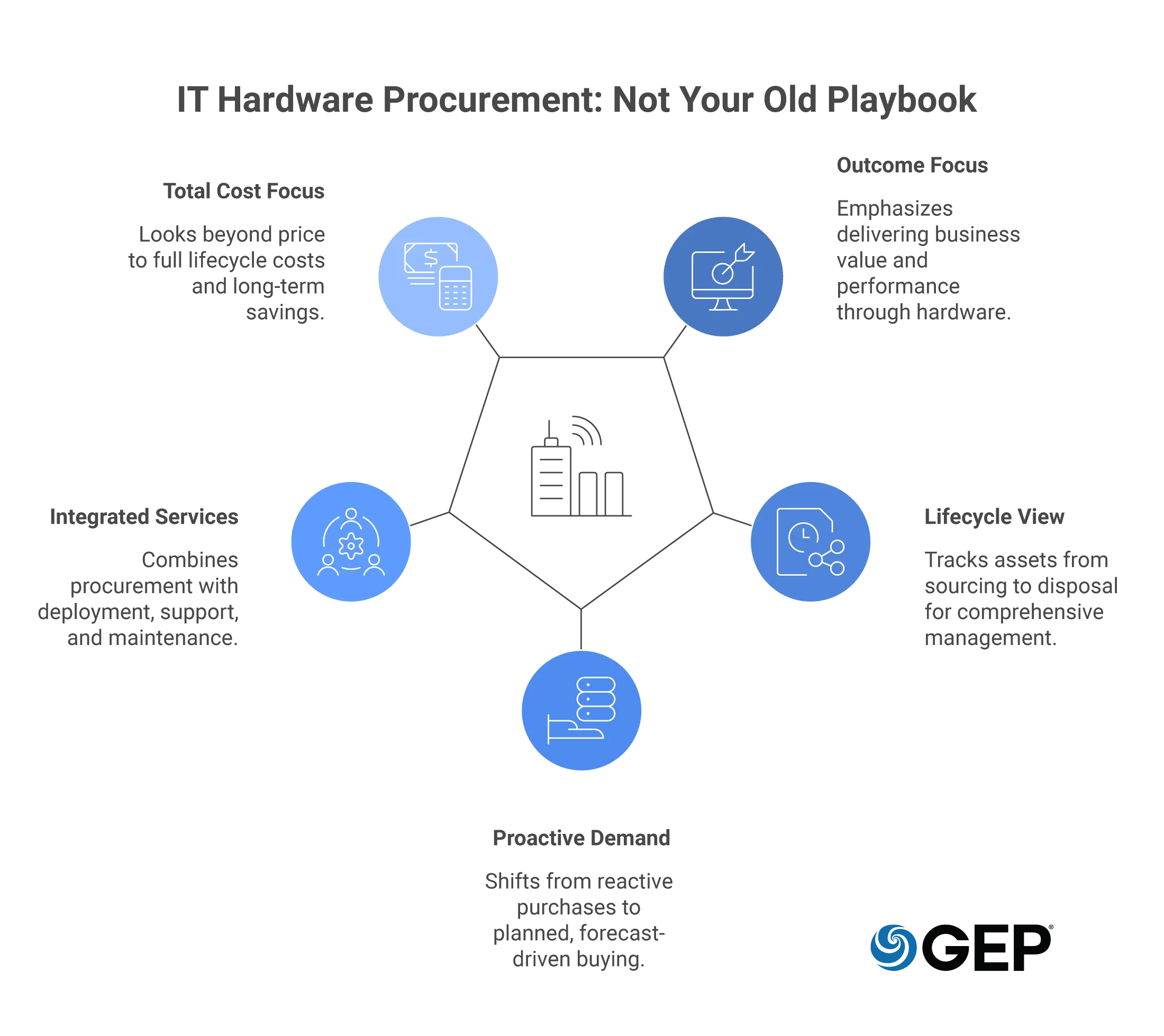
IT hardware procurement services are managed or outsourced solutions that take ownership of the entire procurement process for hardware. Instead of treating procurement as a series of transactions, these services manage demand intake, vendor selection, pricing, contracting, fulfillment, lifecycle management and disposal as one connected process.
Unlike traditional procurement, the objective is not simply to secure the lowest unit price. The real goal is to optimize total cost of ownership while improving operational efficiency and ensuring compliance across regions and business units.
Most services combine category expertise, vendor management, contract management, data analytics and technology platforms that automate key procurement activities. The result is fewer manual steps, better visibility and the ability to make more informed decisions at scale.
IT Hardware Procurement: Traditional Vs Managed Service Providers
1. Scope
Traditional procurement typically focuses on sourcing and purchasing. The procurement team issues RFQs, negotiates pricing, raises POs and coordinates delivery. Activities beyond purchasing are often fragmented across IT, finance and asset management.
IT hardware procurement services expand the scope significantly. They cover demand forecasting, standardization, supplier onboarding, lifecycle tracking, refresh planning and end of life disposal. Broader scope allows the procurement process to connect decisions made early with outcomes that show up years later.
2. Service Model
Traditional procurement is internally managed. Success depends heavily on the experience and capacity of the procurement team, as well as established vendor relationships.
Managed service providers operate as an extension of your team. They bring prebuilt processes, specialist resources and technology platforms designed to automate repetitive work. Outsourcing does not remove control; it shifts execution to a model built for scale and speed.
3. Focus
In traditional procurement, the focus often lands on short-term savings and transaction completion. That is understandable when teams are stretched and demand is urgent.
IT hardware procurement services focus on long-term value. Decisions are evaluated through the lens of total cost of ownership, lifecycle efficiency and risk reduction. This shift changes which suppliers are selected and how tradeoffs are made.
4. Scalability
Scaling traditional procurement usually means adding people or accepting delays. During growth periods or refresh cycles, bottlenecks appear quickly.
Managed services are designed to scale demand without linear headcount growth. Standard workflows, automation and centralized vendor management allow the procurement process to absorb volume spikes without compromising control or service levels.
5. Lifecycle Management
Traditional procurement often stops once goods are delivered. Asset tracking, refresh planning and disposal are handled elsewhere or not handled consistently at all.
IT hardware procurement services manage the full lifecycle, from initial procure decisions through deployment, refresh and retirement. Lifecycle visibility reduces waste, improves compliance and supports more accurate budgeting.
6. Cost Structure
Traditional procurement costs are mostly visible as headcount and negotiated pricing. Hidden costs often sit in expediting, rework, non-standard purchases and underutilized assets.
Managed services may look more expensive at first glance; however, when reduced maverick spend, better demand planning and lower total cost of ownership are factored in, the economics often favor the managed model.
7. Expertise
Traditional procurement teams are typically generalists supporting multiple categories. Deep IT hardware expertise is difficult to sustain internally.
IT hardware procurement services bring category specialists who track vendor roadmaps, supply chain risks and technology trends. This expertise strengthens vendor relationships and improves negotiation outcomes over time.
Stay ahead of shifting spend dynamics across key categories
Explore the GEP Spend Category Outlook to inform data driven decisions
Getting IT Hardware Procurement Right
The difference between traditional procurement and IT hardware procurement services is not about replacing procurement professionals. It is about enabling them to operate at a higher level.
Traditional procurement still works in stable environments with predictable demand. As complexity increases, managed services offer a way to automate execution, strengthen vendor management and improve operational efficiency without losing governance.
For procurement leaders under pressure to deliver savings, speed and compliance at the same time, the managed service model is less about outsourcing and more about upgrading the procurement process itself.
Unlock strategic value with GEP’s procurement services.



FAQs
They improve visibility, automate procurement activities, strengthen vendor relationships and reduce total cost of ownership while freeing the procurement team to focus on strategy.
Outsourced services embed standardized controls, documentation and approval workflows that help ensure compliance across regions and regulatory frameworks.
Beyond price, consider lifecycle costs, compatibility, vendor reliability, security standards and the ability to scale and support assets over time.
They reduce hidden costs through standardization, demand forecasting, lifecycle management and data analytics rather than relying only on unit price reductions.
They use integrated platforms to automate sourcing, approvals, ordering and tracking while applying category expertise to optimize decisions across the entire procurement process.