



Stakeholder RFP Management: Challenges and Tips to Overcome them
- Strong RFP outcomes depend less on document quality and more on how well stakeholders are aligned before requirements are finalized.
- Most RFP delays come from unclear decision rights and late input, not from suppliers or sourcing complexity.
- Procurement creates the most value when it structures stakeholder engagement early and uses process and tools to turn competing priorities into clear decisions.
January 22, 2026 | Procurement Strategy 5 minutes read
If you have spent any meaningful time in procurement, you already know this. Writing an RFP is rarely the hardest part. Managing the people around it is.
Every request for proposal pulls in a mix of finance, legal, IT, operations, and business leaders. Each group has valid goals. Each also brings different timelines, incentives, and definitions of success.
When those differences are not managed deliberately, even a well-designed RFP can stall or fail to deliver value.
Stakeholder RFP management sits at the center of that complexity. It determines whether the RFP process produces clear decisions or endless revisions. It also determines how procurement is perceived internally, as a strategic partner or as an administrative bottleneck.
In an environment where sourcing cycles are under pressure and supplier markets are volatile, this matters more than ever. Strong stakeholder engagement is no longer a soft skill. It is a performance driver.
What is Stakeholder RFP Management?
Stakeholder RFP management is the discipline of aligning internal stakeholders throughout the full RFP process, from early requirement definition to evaluation and final award.
This includes clarifying business needs, coordinating inputs, managing tradeoffs, and ensuring stakeholders stay engaged at the right time rather than all at once. The goal is not consensus on every detail. The goal is informed decision-making that moves forward.
Effective stakeholder engagement means procurement is not just collecting requirements and sending out RFQs or RFPs. It is translating business intent into structured, supplier-ready documents and guiding stakeholders through choices they may not fully see at the start.
At a practical level, stakeholder RFP management answers three questions:
- What problem are we trying to solve
- Who needs to be involved, and when
- How will decisions be made and communicated
When those questions are answered early, the RFP process becomes focused and predictable. When they are not, procurement spends its time chasing feedback, mediating conflict, and resetting expectations midstream.
Also Read: RFI, RFP, and RFQ in Procurement and Supply Chain
Bring Clarity to Stakeholder-Heavy RFPs
Align stakeholders, streamline RFPs, and drive better sourcing decisions
Contact Us
Key Challenges in Stakeholder RFP Management
Most procurement teams understand the mechanics of an RFP. The real challenges show up in how stakeholders interact with the process.
Misaligned Expectations
Stakeholders often expect an RFP to deliver cost savings, innovation, speed, and risk reduction all at once. Without early prioritization, the RFP becomes overloaded. Suppliers struggle to respond clearly, and evaluation becomes subjective.
This is one of the fastest ways to weaken RFP responses and lose internal confidence in the outcome.
Late or Incomplete Input
One of the most common breakdowns in stakeholder engagement is timing. Requirements arrive late. Feedback appears after drafts are finalized. Changes cascade downstream.
Each delay compounds. Timelines slip, suppliers lose patience, and procurement credibility takes a hit.
Too Many Decision Makers
In many organizations, accountability in the RFP process is unclear. Everyone has a voice, but no one owns the decision. Reviews stretch on, feedback conflicts, and escalation becomes inevitable.
Without defined decision rights, even simple RFPs can stall.
Lack of Transparency
Stakeholders disengage when they do not understand how input is being used. If scoring criteria, weightings, or evaluation logic are opaque, trust erodes quickly.
This often leads to last-minute objections or second-guessing after suppliers are shortlisted.
Manual Coordination and Fragmented Tools
Email threads, spreadsheets, and disconnected documents create friction. Version control becomes an issue. Context gets lost. Procurement spends more time managing logistics than driving outcomes.
As RFP volumes grow, these inefficiencies scale fast.
Also Read: AI Integration in RFP Process
Ready to put agentic AI to work in procurement?
Get the Agentic AI Playbook to see leaders moving from automation to autonomy
Download Now
Overcoming Stakeholder RFP Management Challenges
Organizations that handle stakeholder RFP management well tend to follow a few consistent principles. They treat engagement as part of the process design, not something to manage reactively.
Adopt a Consultative Approach Early
Before drafting the RFP, invest time in structured stakeholder conversations. Ask why a requirement exists, not just what it is. Surface assumptions, constraints, and tradeoffs upfront.
This consultative approach helps reduce unnecessary complexity and aligns stakeholder expectations before suppliers even see the document.
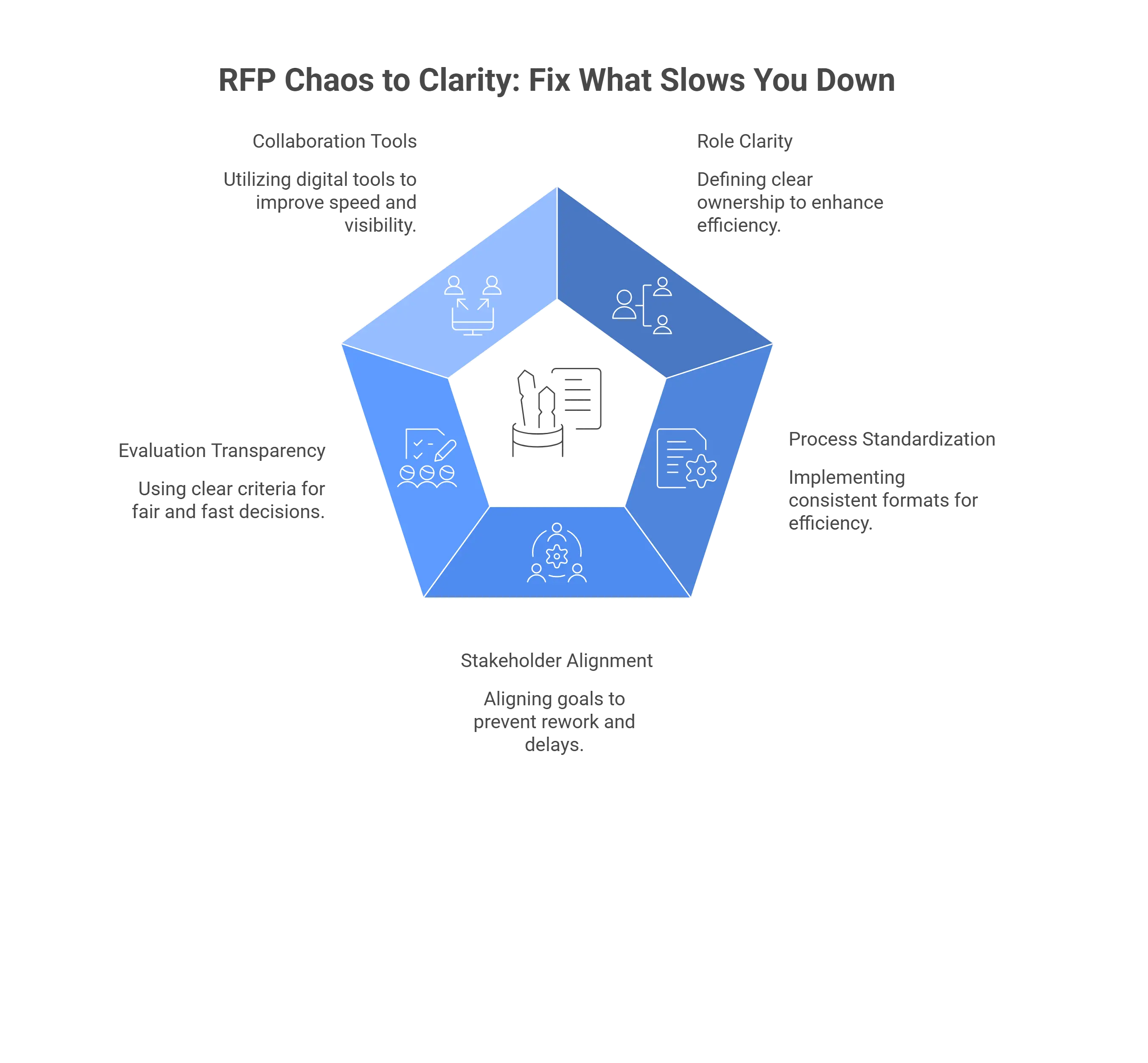
Define Roles and Decision Rights Clearly
Every RFP needs a clear owner, contributors, and approvers. Not every stakeholder needs equal influence at every stage.
Simple role clarity keeps the RFP process moving and prevents late-stage derailment. It also helps stakeholders understand where they provide input versus where decisions are finalized.
Standardize the Process, not the Thinking
A consistent RFP framework creates discipline. It also reduces confusion for stakeholders who participate across multiple sourcing events.
That said, standardization should not eliminate flexibility. The best teams frequently review and revise procurement policies to ensure they support business needs rather than constrain them.
Make Evaluation Criteria Visible
Transparency drives engagement. Share scoring models early. Explain how criteria will be weighted. Walk stakeholders through how supplier responses will be assessed.
When people understand the rules of the game, they are far more likely to support the outcome, even if it involves compromise.
Use Technology to Enable Collaboration
Modern RFP management tools remove much of the friction that undermines stakeholder engagement. Centralized workflows, controlled access, and collaborative authoring reduce manual coordination and version chaos.
This is where procurement teams shift from managing documents to managing decisions. Encouraging proactive procurement starts with giving teams the tools to focus on insight rather than administration.
Capture Feedback and Institutionalize Learning
After each RFP, review what worked and what did not. Where did stakeholder engagement break down? Where did it accelerate progress?
Over time, these insights turn stakeholder RFP management into a repeatable, scalable capability rather than a series of one-off fixes.
Getting it Right
Stakeholder RFP management is not about pleasing everyone. It is about creating clarity, momentum, and trust in a process that touches many parts of the organization.
When done well, RFPs become sharper, evaluation improves, and supplier outcomes align more closely with business needs. Procurement earns credibility as a strategic partner rather than a transactional function.
If your team feels overwhelmed by RFPs, the answer is rarely more effort. It is better structure, clearer engagement, and smarter enablement.
Stakeholders will always have competing priorities. The role of procurement is to turn that complexity into decisions that move the business forward.




FAQs
Start with a consistent RFP framework, clear role definitions, and transparent evaluation criteria. Support it with collaboration tools that provide visibility across regions while allowing local flexibility.
Track cycle times, stakeholder satisfaction, quality of RFP responses, and post-award outcomes. Trends over time reveal whether engagement in the RFP process is improving or simply consuming effort.