


AI Agents for Carbon Footprint Monitoring
- AI agents collect, clean and validate emissions data to monitor carbon footprint in real time.
- Deploying specialized AI agents for data fusion and Scope 3 modeling makes it easier for companies to drive regulatory compliance and strategic decarbonization.
- While AI’s energy consumption is a challenge, AI-driven efficiencies in operations and grid management offer a path to reduce net carbon impact.
December 04, 2025 | Supply Chain Software 5 minutes read
The race to net-zero is a race for data accuracy. Corporate sustainability targets are shifting from vague promises to hard numbers that need verification and auditing.
The problem? Most companies still rely on manual processes and disconnected software systems that can't keep up. True compliance and meaningful carbon reduction requires technology that can handle massive amounts of complex data in real time.
That's where AI agents can deliver the speed, precision and autonomy needed to accurately track and reduce a company's carbon footprint.
Introducing AI Agents in Carbon Footprint Tracking & Monitoring
An AI agent uses advanced models and tools to act and make decisions toward a specific goal. For environmental sustainability, this means the agent can find, clean and validate emissions data on its own without someone constantly managing it.
Why do you need agents? Manual methods for carbon footprint data collection and analysis fall short on the detail and consistency required for effective tracking.
AI agents are changing this by transforming emissions tracking from a backward-looking manual task into a proactive discipline that can handle complex global supply chains.
AI Agent Architectural Framework Used in Carbon Footprint Monitoring
The real strength of AI agents is in having multiple specialized agents working together.
For carbon monitoring, this setup breaks down data silos by assigning different agents to each emission scope:
Scope 1 Agent
Tracks your direct emissions—everything from facility meters and company vehicles to boilers and generators.
Scope 2 Agent
Handles purchased energy, keeping tabs on utility bills and figuring out when to use power most efficiently.
Scope 3 Agent
Takes on the messy stuff in your supply chain, reading through supplier invoices and shipping documents to track emissions that are notoriously hard to pin down.
What makes this work well is that these agents don't depend on each other to function. One agent can go down for maintenance or get an update without taking out your whole monitoring system. They communicate and coordinate, but they're independent enough to keep your data flowing no matter what.
Technical Capabilities of AI Agents Used in Carbon Footprint Monitoring
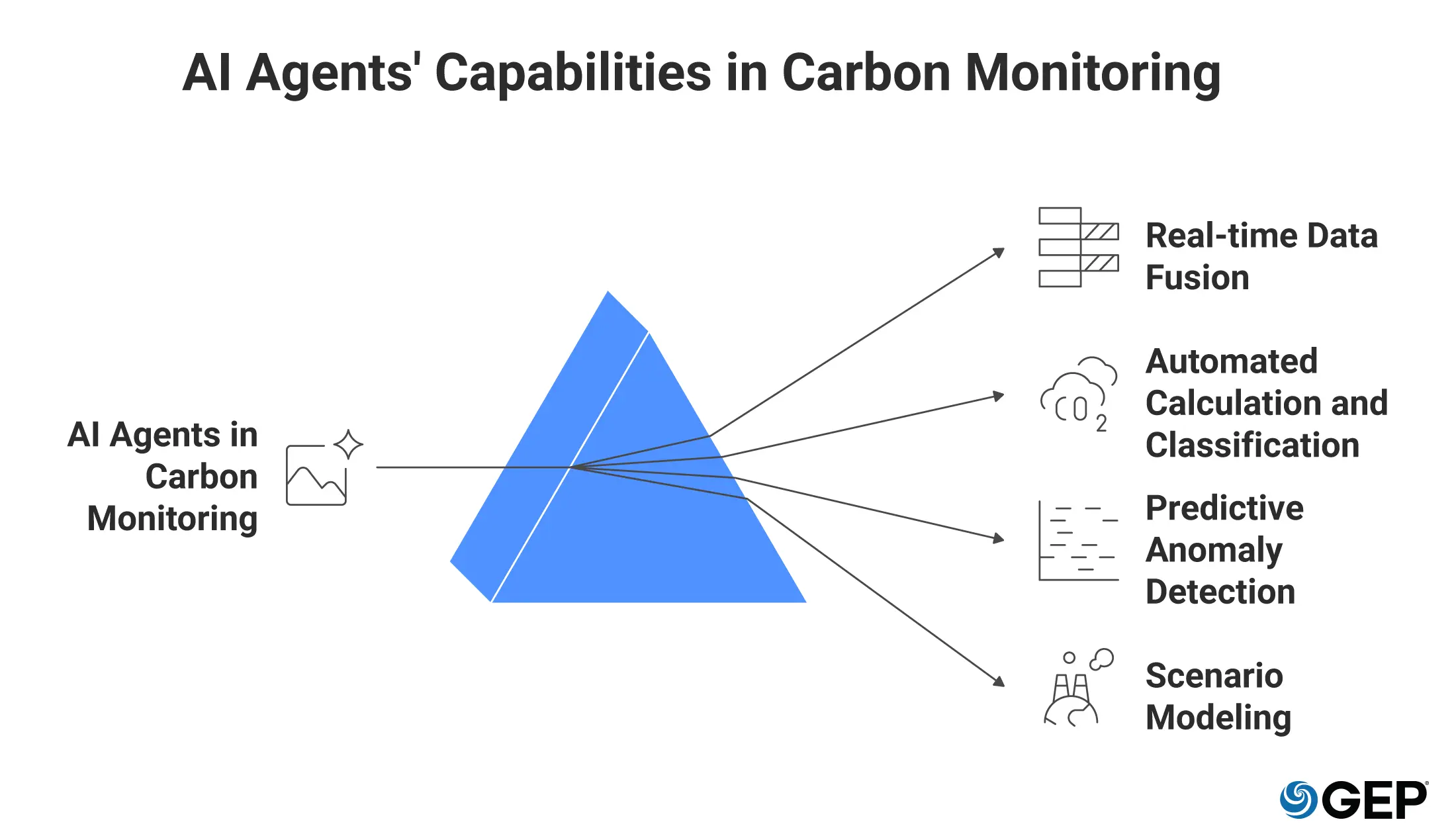
What can these agent systems actually do that your current software can't? Here's where things get practical:
Real-time Data Fusion
Think about all the places where your emissions data lives—your ERP system, IoT sensors scattered across facilities, supplier portals, accounting software. AI agents pull data from all these simultaneously, clean up the inconsistencies, and standardize everything automatically. You're not stuck copying and pasting data between spreadsheets anymore.
Automated Calculation and Classification
The agents do the math using current emission factors that vary by location and source. More importantly, they figure out whether something belongs in Scope 1, 2, or 3—which matters a lot when regulators come knocking. The rules keep changing, and the agents keep up.
Predictive Anomaly Detection
The agents learn what normal looks like for your operations. When something's off, such as a sudden spike, an unexpected drop, or numbers that don't add up, they flag it before you submit a report with bad data.
Scenario Modeling
Want to know what happens to your emissions if you switch to a different supplier or convert half your delivery fleet to electric? The agents can run those scenarios and show you the numbers before you commit to anything.
Decarbonize Your Supply Chain
High-Impact Strategies to Cut Your Supply Chain’s Carbon Footprint
Key Benefits of Implementing AI Agents in Carbon Footprint Monitoring
Beyond regulatory compliance though, implementing AI agents is a strategic business advantage that drives efficiency and improves long-term profitability.
The primary benefit is operational cost reduction. Gartner reports that 54% of Infrastructure and Operations leaders already use AI to cut spending by automating routine operations. For sustainability, this means automated data collection that frees up valuable staff time.
There’s also benefits from optimizing energy consumption: AI-driven automation can reduce a building's energy consumption by optimizing HVAC systems and scheduling predictive maintenance. Lower energy use means lower costs.
AI agents also deliver audit readiness and stakeholder trust. By providing a comprehensive, time-stamped audit trail for every carbon emissions data point, companies can meet the growing requirements of regulators, investors and customers.
This precision improves ESG ratings, which helps enterprises get better access to capital and increase market appeal. The ability to transparently track progress strengthens brand reputation.
AI Agents: The Leap Enterprises Need for Carbon Monitoring
AI agents are the technological leap organizations need to handle the complexity of modern environmental monitoring. By providing real-time insights into carbon emissions, they transform corporate sustainability from historical accounting to strategic optimization.
But it’s important to acknowledge that the energy demands of data centers powering this AI explosion are themselves a growing source of carbon emissions.
The International Energy Agency projects that electricity consumption from data centers will more than double globally by 2030, though Goldman Sachs predicts that by that time, new nuclear energy investments and advances in AI could decrease the overall carbon footprint of AI.
The future of sustainability depends on AI agents solving the very problem they contribute to. By deploying intelligent systems to manage energy grids, predict maintenance needs and drive operational efficiencies that reduce energy consumption, AI agents will ultimately be the key tool that helps companies reduce carbon footprints at the scale and speed the planet requires AI.




FAQ
Traditional software relies on user input and pre-set rules. It's basically a calculator and reporting tool. An AI agent system is autonomous and dynamic in that it actively seeks out, cleans, validates and models data in real time, making decisions and generating forecasts without constant human intervention.
Absolutely. This is where AI agents really shine. Scope 3 emissions are notoriously difficult to track because the data is all over the place—buried in supplier emails, invoices, shipping documents, and expense reports. AI agents can dig through all that unstructured mess, fill in gaps where data is missing, and create a clear audit trail. It's exactly the kind of heavy lifting that would take a human team weeks or months to do manually.
It varies depending on how complex your data systems are. The good news is that you don't have to do everything at once. Most companies start with the easier stuff, like Scope 1 and 2 emissions, and get that running in a few weeks to a couple of months. Then they expand into Scope 3 tracking as they go. A modular approach means you can roll things out in phases rather than waiting for one massive implementation to be perfect.