



Why You Need AI Agents for RFP & RFQ Response Evaluation
- AI agents can read and understand RFP and RFQ responses just like a human would, but in hours or minutes, instead of days.
- Nobody wants to spend their workday manually comparing hundreds of pages of proposals. AI handles that work so your team can focus on strategic decisions.
- Getting RFP and RFQ response evaluation right requires some planning. You need to have clear goals and train the AI agent to make sure it works smoothly with legacy tools.
December 18, 2025 | Procurement Software 5 minutes read
Responding to and evaluating Requests for Proposals (RFPs) and Requests for Quotes (RFQs) is an intensive process. Procurement needs to understand the requirements, compare documents carefully and score everything objectively, all under tight deadlines.
This complex, document-heavy workflow is perfect for AI agents. These intelligent tools automate the high-volume, repetitive tasks that bog down evaluation. They transform RFx evaluation from a slow, manual slog into something efficient, accurate and data-driven.
Introduction to AI in RFP & RFQ Response Evaluation
Historically, evaluating vendor responses meant procurement teams manually reviewing dozens or even hundreds of documents to check compliance, technical feasibility and alignment with requirements. This traditional process was notoriously slow and prone to human error.
AI agents are a big step forward for vendor evaluation. They use sophisticated natural language processing (NLP) and machine learning techniques to understand the nuanced language in both the original requests and the vendor responses that follow.
Unlike simple document search tools or basic scoring features, an AI agent works semi-autonomously. It's designed to analyze and understand RFP or RFQ documents, make decisions based on defined goals and act without constant human oversight.
How AI Agents Automate RFP and RFQ Response Evaluation
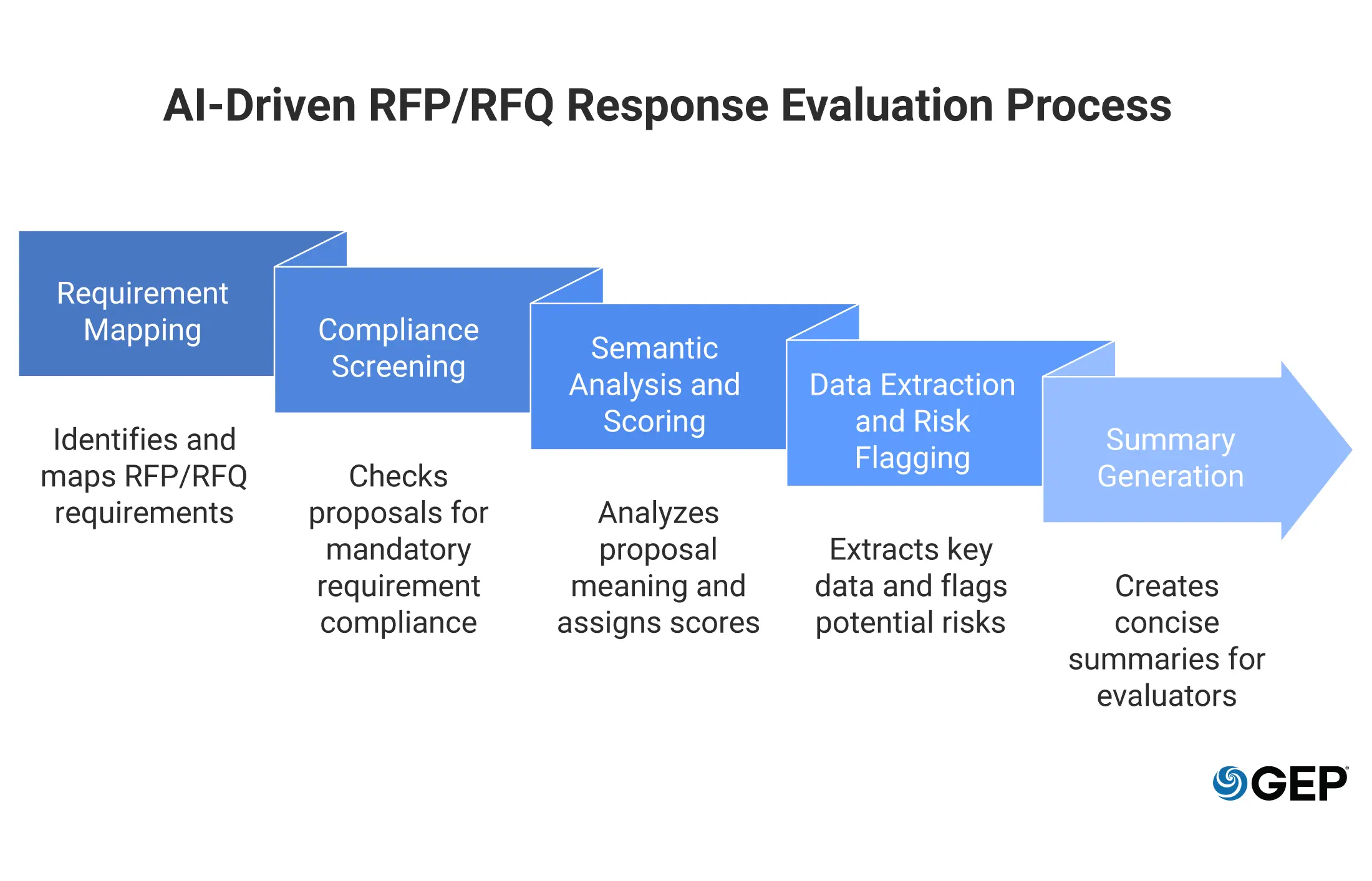
AI agents streamline the response workflow by breaking down response documents into measurable, scorable components. This typically includes several key functions:
Requirement Mapping
The agent processes the original RFP or RFQ document. It identifies and extracts all mandatory and desirable requirements, after which it builds a digital map of the criteria for measuring vendor responses.
Compliance Screening
It scans the vendor's proposal for explicit confirmation that it meets every mandatory requirement.
Semantic Analysis and Scoring
Using NLP, the agent performs semantic analysis. It goes beyond keyword matching to analyze the meaning and context of the vendor's answers. Based on pre-defined scoring models, the AI agent then assigns scores to individual sections or overall proposals.
Data Extraction and Risk Flagging
The agent efficiently extracts key data points from unstructured text: think pricing, proposed timelines and technical specifications. It flags potential risks like contradictory statements or missing documentation. Then it generates concise summaries for human evaluators.
This automated process speeds up decision-making. It assesses all proposals against the exact same criteria, which eliminates subjective bias.
Discover now - RFP Software for Collaborative RFP Authoring
Best Practices of Implementing AI Agents for RFP and RFQ Response Evaluation
To get the most out of these tools, organizations should focus on these four implementation tips:
Define clear objectives
Before deployment, clearly articulate what the AI agent should achieve. Are you trying to reduce evaluation time by a certain percentage? Increase scoring consistency? Be specific.
Start small and iterate
Deploy the agent on specific, lower-risk evaluation types first, like routine RFQs. Use those results to refine the model's accuracy before scaling up to complex, high-value RFPs.
Establish continuous training and feedback
AI agents are only as good as the data they're trained on. Human evaluators must regularly review the agent's scores and classifications. This feedback loop improves the model over time.
Ensure data quality
The underlying data must be clean, consistent, and well-structured. This includes past RFPs, successful responses, and evaluation guidelines. Without quality data, you can't effectively train the agent.
Key Challenges in AI Agent-Driven RFP and RFQ Response Evaluation
While the benefits are substantial, a significant hurdle in deploying AI agents is the initial setup and training cost. Developing a custom AI model that understands your specific industry and organizational compliance rules requires investment in data preparation and expert training.
Another issue is maintaining accuracy in novel scenarios. If an RFP or RFQ response introduces completely new technology or an unexpected business model, the AI agent may struggle. Without prior exposure to similar data, it can't accurately score or classify the response.
Users also struggle with the "Black Box" problem. They don't trust the agent's scores if the underlying reasoning is opaque. That's why it's crucial for the system to offer transparency through auditable traces.
Finally, integration with existing systems is often technically complex. You need to successfully link the new AI system with existing RFP management platforms, vendor databases and procurement software. This isn't always straightforward.
RFx Evaluation Is Just the Beginning
Discover the Top AI Use Cases Every Procurement Pro Should Know
Top Benefits of Implementing AI Agents for RFP and RFQ Response Evaluation
Speed that matters
AI agents can review hundreds of pages in minutes instead of days. You'll move from issuing RFPs to awarding contracts faster—and in competitive markets, speed wins.
Fair scoring, every time
Human reviewers have off days and unconscious biases. AI doesn't. Every proposal gets judged by the same standards, which means fairer decisions and easier justification when someone questions your choice.
Your team focuses on what matters
Stop wasting your procurement experts on manual document review. Let them negotiate better terms, solve complex problems, and evaluate the strategic fit of suppliers.
Smarter decisions over time
AI turns all those proposals into searchable, structured data. Want to spot pricing trends or identify which vendors consistently overpromise? Now you can.
A Pivotal Advance in Procurement Efficiency And Fairness
By automating the detailed, repetitive tasks inherent in evaluating RFP and RFQ responses, AI agents enable organizations to make faster, more consistent, and data-backed sourcing decisions.
The journey from manual review to intelligent automation is accelerating rapidly. AI Agents for RFP RFQ Evaluation are becoming an essential tool for any organization that wants a modern, high-performing procurement function.



FAQs
The AI agent reads your RFP requirements and creates a checklist, then matches vendor responses against it while understanding context (not just keywords). It scores everything based on your rules and flags any issues so that you can make the final call.
With good training data, they're often more consistent than human reviewers. But like any new team member, they get better with feedback over time.