


Why Your Business Needs AI in Procurement Analytics
- Data no longer supports procurement strategy; it defines it.
- With AI analytics, you get real-time data, anticipate risks, and act proactively.
- Data transparency turns supplier relationships into genuine partnerships built on trust.
December 08, 2025 | Procurement Software 6 minutes read
Procurement has outgrown its old image as a support function. With advancements in technology, it now drives a company's resilience and its ability to compete.
However, even with AI’s potential widely recognized, only a few large-scale enterprises use it to its full potential. Procurement teams often gather more data (often siloed) than they can process, and only a fraction ever shapes real decisions.
AI in procurement analytics can make a real difference here. It turns raw data into forward-looking insight, helping you see farther, manage supplier performance more effectively, and catch risks before they spread.
Real change begins when AI pulls every data source together and keeps learning from it in real time. Once that’s set in place, procurement leaders can anticipate what’s coming next and build resilient supply chains.
This article shows how AI-driven procurement analytics delivers practical value.
What AI in Procurement Analytics Really Does (and Why It’s Worth Your Attention)
AI in procurement analytics involves the use of machine learning, natural language processing, and smart data models to strengthen each stage of procurement.
AI reads structured and unstructured data from invoices, contracts, and supplier audits, tracks market signals, and finds connections that people often overlook.
Traditional analytics only explain what has already happened. AI changes that by forecasting what’s coming next and recommending the next move.
AI models can flag drops in supplier performance, warn of supply risks, and even suggest when to reopen contracts based on market trends. That shift is essential because modern supply chains behave less like straight lines and more like connected networks.
Data constantly moves and evolves, linking information across regions.
Ready to Bring Order to Your Procurement Data?
Empower your team with real-time intelligence and actionable insights
Using Real-Time AI Insights for Smarter Procurement Decisions
Every step in procurement leaves a trail of data from purchase orders and invoices to delivery notes and audits. AI-powered procurement analytics brings all those sources together, turning scattered information into real-time insights.
• Where AI Gathers Its Data
AI draws information from every corner of the business to build a connected, real-time view of procurement performance. It consolidates inputs from sourcing, finance, and contract systems to show how money moves and where processes slow down.
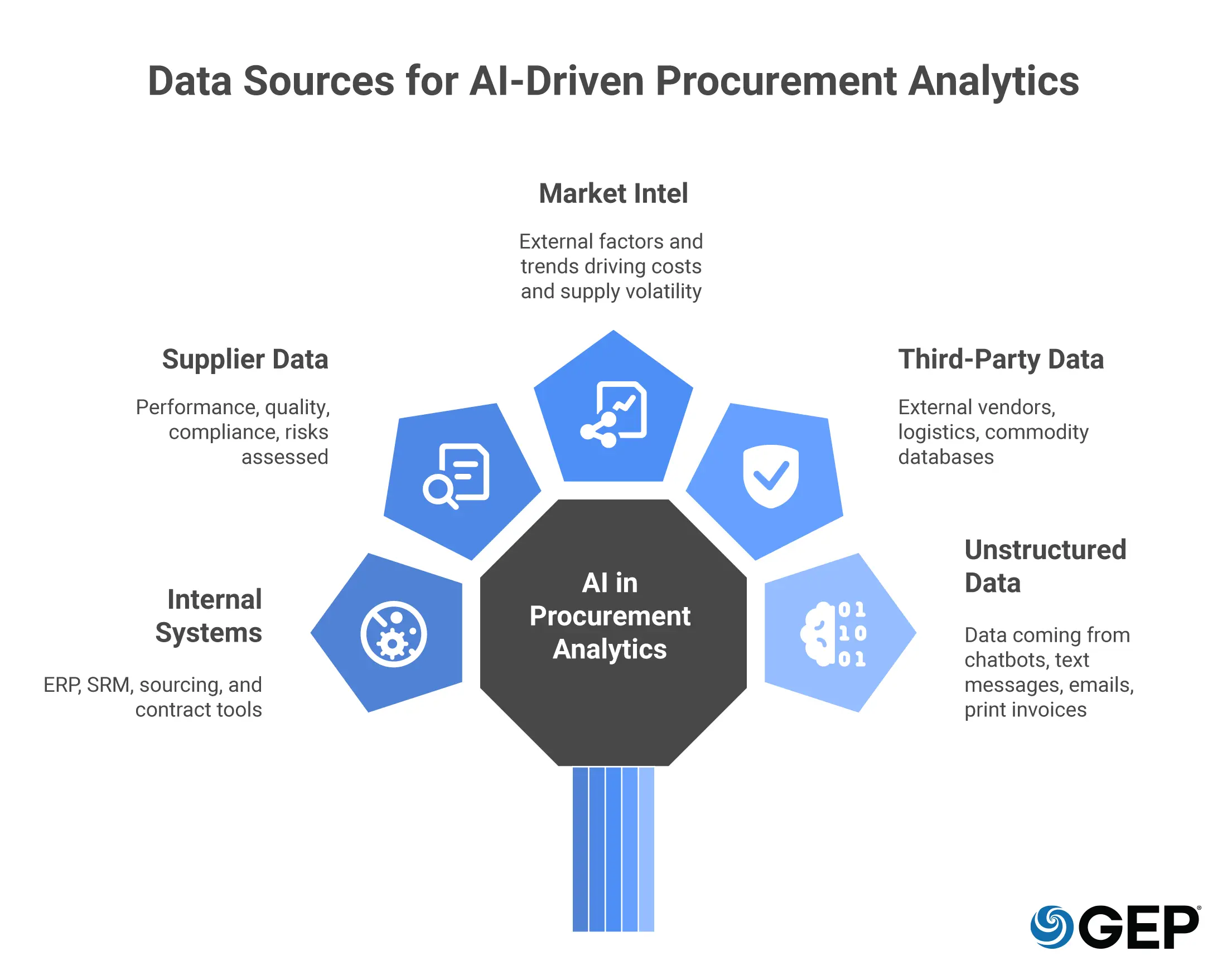
Within these systems, AI captures spend visibility, payment histories, and cycle-time patterns that reflect how procurement truly operates. The system reviews records, audits for reliability and compliance, and keeps performance data organized for comparison and insight.
Logistics data and commodity indexes reveal how external pressures shift prices and reshape supply chains over time. Together, these layers of data form the foundation of AI in procurement analytics.
By gathering, connecting, and interpreting information from multiple sources, AI helps you make better decisions and strengthen collaboration across teams and suppliers.
• How AI Processes and Interprets Information
Once the data is gathered, AI runs it through several steps of intelligent processing to turn information into insight.
• Data Cleansing and Standardization
The system eliminates duplicates, fixes syntax errors, and structures data so reports are always ready to use.
• Pattern and Trend Analysis
AI searches for recurring patterns in spend data or supplier performance that could point to risks or reveal new opportunities.
• Contextual Correlation
It links supplier KPIs with external factors like material prices or logistics delays to predict outcomes.
• Scenario Simulation
It lets leaders model sourcing choices and test cost or timeline impacts.
• Prescriptive Guidance
It suggests next steps such as supplier balancing or renegotiation.
• Turning Insights Into Action
AI goes a step further by acting on its insights. It feeds those insights straight into daily workflows so teams can keep improving with every decision.
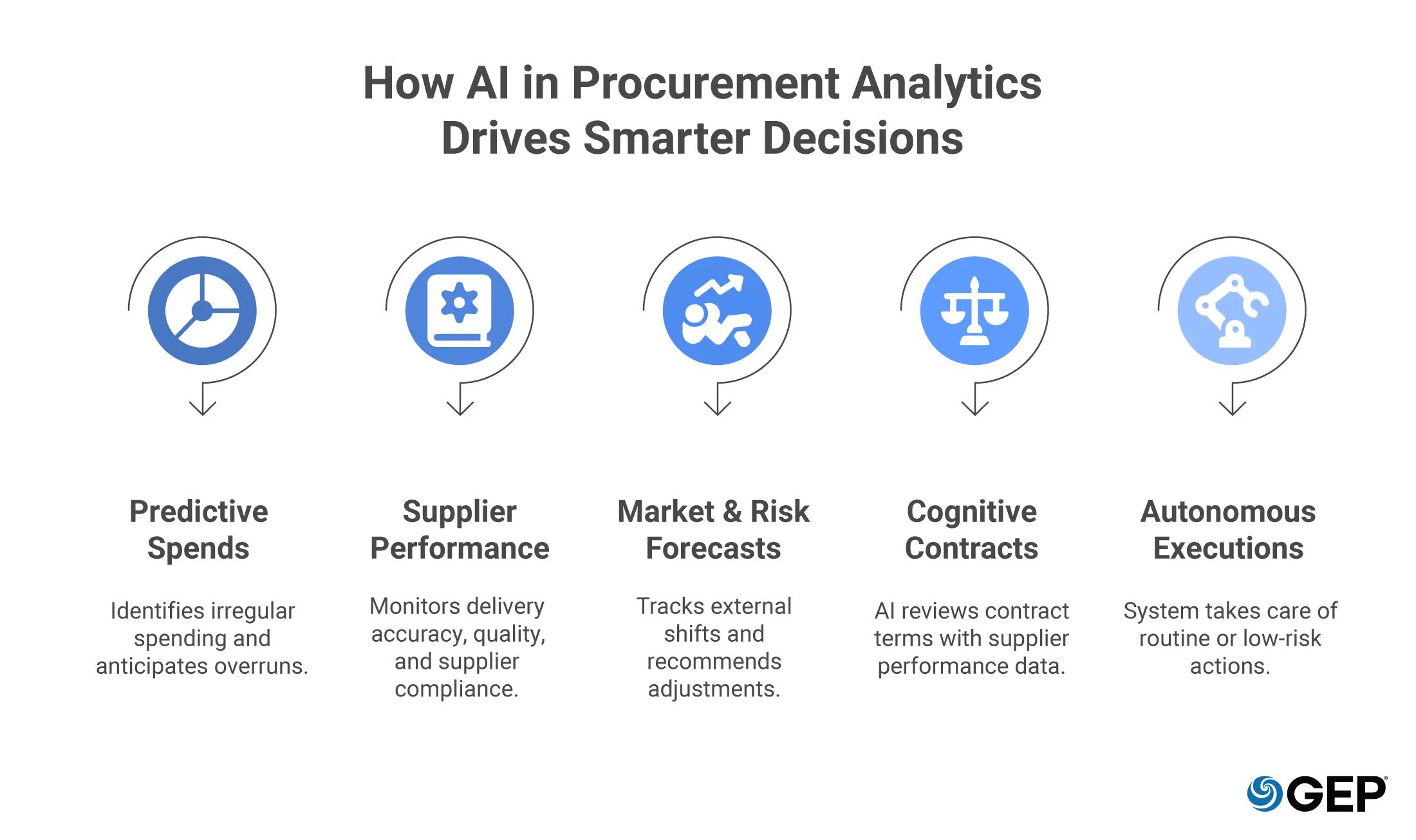
• Predictive Spend Intelligence
Identifies irregular spending and anticipates overruns before they appear.
• Supplier Performance Intelligence
Monitors delivery accuracy and quality while checking supplier compliance in real time.
• Market and Risk Forecasting
Tracks external shifts in currency, politics, or logistics and recommends adjustments.
• Cognitive Contract Management
AI reviews and compares contract terms with supplier performance data to confirm both stay aligned.
• Autonomous Execution
The system takes care of routine or low-risk actions after learning from past outcomes.
AI makes procurement a dynamic system that keeps learning from data gathered while keeping everything logged and structured.
Five Practical Gains from AI in Procurement Analytics
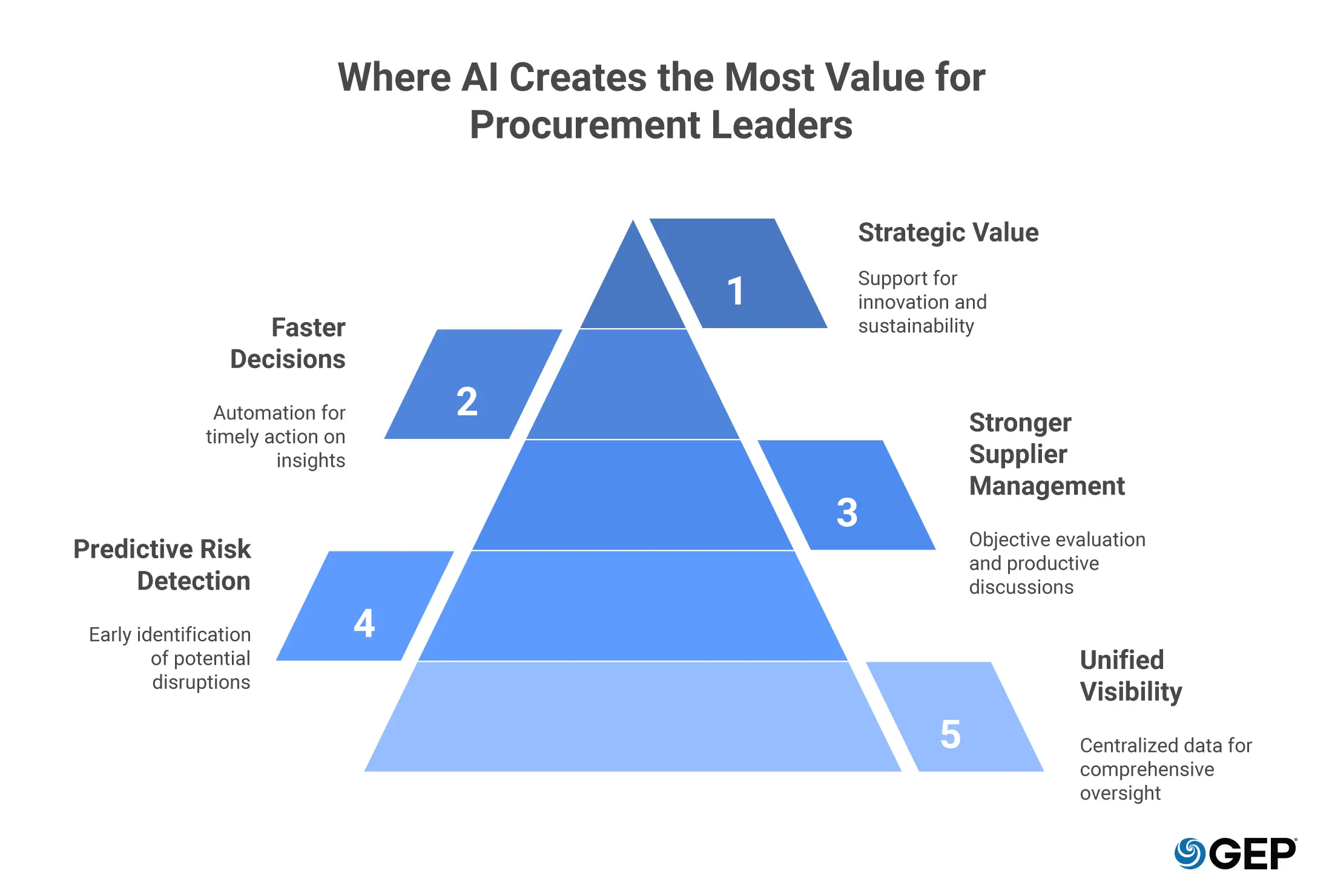
1. Unified Visibility Across Systems
AI pulls together your procurement data from every system so you can see spending and supplier activity in one place. Everyone in your team knows what’s going on at any given point. No more blind spots.
2. Predictive Risk Detection
Once you’ve built visibility, the next gain is foresight: seeing risks before they become disruptions. AI spots early warning signs in supplier behavior and market movements so leaders can predict where problems might begin to develop. That foresight gives procurement a clear view of risk and better control over how to manage it.
3. Stronger Supplier Management
AI evaluates supplier performance and flags results that fall short of expectations. That visibility, paired with evidence-based insights, helps you have open, objective discussions with suppliers. It replaces bias with facts and keeps conversations productive.
4. Faster and More Confident Decisions
Automation handles reporting and number crunching. That gives you time to act on insights instead of chasing reports. Decision speed finally keeps up with the business.
5. Strategic and Sustainable Value
AI in analytics creates value that extends well beyond cost reduction. It supports innovation, smarter sourcing strategies, and sustainability efforts aligned with long-term business goals.
The Agentic AI Playbook for Procurement Pros
Your roadmap to moving from pilots to production, with AI that adapts, learns, and delivers real impact
Tackling Hurdles in AI Implementation
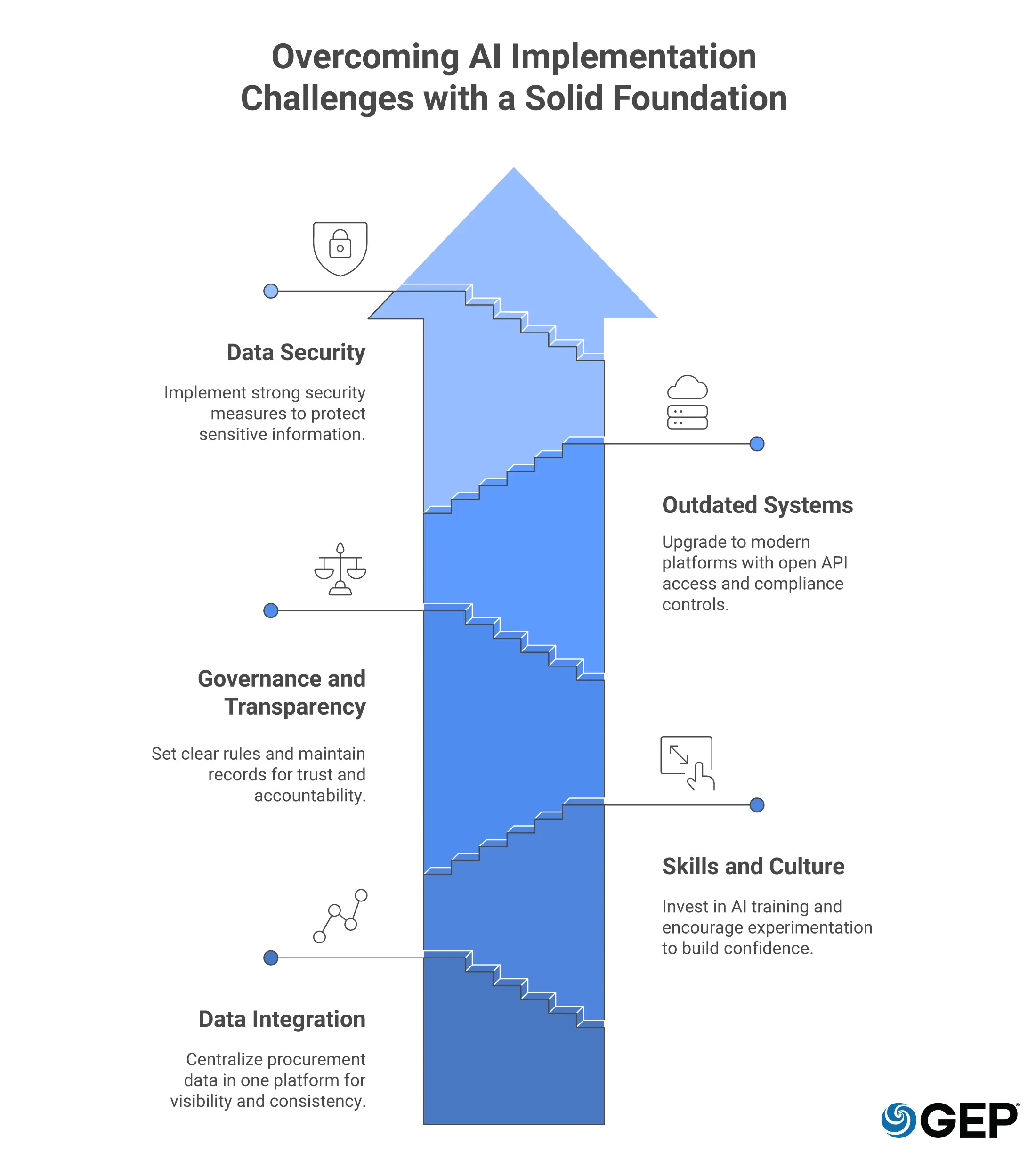
AI analytics delivers long-term impact only when the foundations are in place. Address this first, and the tech will scale.
1. Data Integration and Accuracy
Start by centralizing procurement data in one platform. Choose a platform that connects every function and brings stakeholders into the same space. Working from a shared real-time dashboard increases visibility and consistency, giving teams tighter control over outcomes.
2. Skills and Culture
Invest in AI training and give teams space to experiment and learn from practice. Change takes time. Keep expectations realistic and track what slows progress. Measure results and recognize teams that use AI effectively to improve outcomes.
This will build confidence, which over time reinforces AI culture. It’s always best to begin with a short pilot project that solves a specific problem.
Pilot approach
Pick a domain, measure baseline metrics, deploy a lightweight agentic model, and measure results over 60 to 90 days. If the model improves the metric, expand to adjacent categories.
3. Governance and Transparency
Set clear governance rules early on for both how AI is managed and how it’s used across teams. Teams should be able to clearly explain how decisions are made and who owns the outcome. For this to work, maintain a record of model inputs so you can trace recommendations back to data.
When stakeholders understand how outcomes are derived, they trust the system and act on its guidance.
4. Outdated Systems
If your procurement still runs on legacy systems, it’s time for a change. While cloud platforms simplify integration, choose vendors that match your needs.
Evaluate platforms for open API access, strong data lineage tracking, clear model explainability, and built-in compliance controls. Use middleware to keep integrations running smoothly.
5. Data Security
A strong security foundation keeps AI dependable and limits operational risk. Protect data through clear access controls, encryption, and regular audits to keep sensitive information safe.
The Shift Toward Predictive, AI-Driven Procurement
AI in procurement analytics is reshaping how organizations manage costs, risks, and performance. Instead of reacting to issues, teams gain a steady flow of intelligence that helps them plan and act with confidence. As AI systems continue to evolve, they will move beyond analysis and begin coordinating agentic outcomes with minimal human effort.
If your organization is looking to scale its procurement capabilities with AI, explore how GEP SMART™, our AI-powered Source-to-Pay platform, can help. It supports both direct and indirect procurement, brings all your data into a unified platform, and turns that information into clear, actionable insights.
With these capabilities in place, leaders can build predictive, value-focused strategies that keep the business ahead of change.
Get in touch to know more.


FAQs
AI in procurement analytics reduces costs by spotting inefficiencies and automating routine work across sourcing, purchasing, and invoicing. It forecasts demand changes early and streamlines workflows, so your team spends less time on manual follow-ups. That efficiency cuts waste, lowers Total Cost of Ownership (TCO), and helps you act faster when key decisions come up.
Yes. It can, and it does so with remarkable precision when the data foundation is strong. AI in procurement analytics uses predictive models and machine learning to study past transactions and understand supplier and market behavior.
Yes, it is. The technology scales easily to fit enterprise needs. AI analytics connects with core systems and manages large volumes of structured and unstructured data in real time.