  • login
  • contact
  • language
    • English
    • Français
    • Español
    • Português
    • Deutsch
    • Italia
    • 简体中文
    • 日本語
  • search
X
    GEP Logo GEP Logo
    • Company  
        • About Us 
        • Culture 
        • Careers 
        • Contact Us 
        • AI-First at GEP
        • Sustainability at GEP

        About Us

        • Leadership
        • Customers
        • Partners
        • News
        • GEP in the News
        • Events
        • Mission & Vision
        • Awards & Recognition
        • Contact Us
        GEP leads Gartner 2025 Magic Quadrant for Source-to-Pay Suites

        GEP Is a Leader in the 2026 Gartner® Magic Quadrant™ for Source-to-Pay Suites

        Read More
        A Procurement Software Platforms Leader — 4 Years Running

        Tariff Resource Center: Strategies and Action Plans 

        Read More

        Culture

        • Diversity
        • GEP Cares
        • GEP Core Values
        • Women at GEP
        A Procurement Software Platforms Leader — 4 Years Running

        GEP & Xylem Unite to Bring Clean Water to 1,800 in Maharashtra

        Mapping & Reducing Scope 3 Emissions: A Quickstart Guide for Procurement Pros

        GEP & Akshaya Patra: Partnering to Deliver 4 Billion Meals and Fight Hunger Worldwide

        Careers

        • Explore Global Careers Opportunties
        • North American
        • Europe
        • India
        • Latin America
        • Asia-Pacific
        • Join Us
        • GEP Per Se
        • Campus Connect
        TOP EMPLOYER 2025 - USA
        TOP EMPLOYER 2025 - UK
        TOP EMPLOYER 2025 - INDIA
        TOP EMPLOYER 2025 - Costa Rica

        Contact Us

        • Ask Us
        • Request for Proposal
        • Schedule a Demo
        • Share Feeback
        GEP - AMERICA

        GEP in the Americas

        GEP - EUROPE

        GEP in Europe

        GEP - ASIA

        GEP in Asia

        GEP - AFRICA

        GEP in Africa 

        GEP - Middle East

        GEP in the Middle East

        AI-First at GEP

        Sustainability at GEP

    • Solutions  
        • Software 
          • GEP QI
          • GEP SMART  
          • GEP NEXXE  
          • GEP FINA  
          • GEP QUANTUM  
          • GEP GREEN
        • Strategy 
          • Procurement Consulting  
          • Supply Chain Consulting  
        • Managed Services 
          • Procurement Outsourcing  
          • Supply Chain Outsourcing  

        Software

        GEP SMART

        • Procurement Software
        • Direct Procurement Software
        • Indirect Procurement Software
        • Midsize & High Growth Enterprises

        GEP NEXXE

        • AI-First Supply Chain Management
        • Supply Chain Visibility and Execution
        • Supply Chain Planning
        • Supply Chain Collaboration  

        GEP FINA

        GEP GREEN

        GEP QUANTUM

        GEP SMART

        • Procurement Software
        • Direct Procurement Software
        • Indirect Procurement Software
        • Unified Source-to-Pay
        • Source-To-Contract Software
        • Procure-to-Pay
        • GEP SMART for Midsize & High-Growth Enterprises
        • Key Capabilities
        • Spend Analysis
        • Sourcing
        • Contract Lifecycle Management
        • Supplier Lifecycle Management
        • Third-Party Risk Management
        • Purchasing
        • Payments
        • Data Analytics and Reporting
        • Do More With GEP SMART
        • Intake Management & Orchestration
        • Intelligent Category Management
        • Tail Spend Management
        • Cost Data & Analytics (GEP COSTDRIVERS)

        GEP NEXXE

        • AI-First Supply Chain Management
        • Supply Chain Visibility and Execution
        • Logistics Visibility  
        • Inventory and Warehouse Management
        • GEP Multienterprise Collaboration Network
        • Supply Chain Control Tower
        • Field Services  
        • Supply Chain Collaboration & Planning  
        • Supply Chain Planning
        • Purchase Order Collaboration  
        • Forecast Collaboration 
        • Capacity Collaboration  
        • Quality Management Software  
        • Should-Cost Modeling
        • Direct Material Sourcing
        GEP Is a Leader in the 2025 Gartner® Magic Quadrant™ for Source-to-Pay Suites

        GEP Is a Leader in the 2026 Gartner® Magic Quadrant™ for Source-to-Pay Suites

        Read More

        GEP FINA

        • E-Invoice Network
        • E-Invoice Receiving
        • E-Invoice Sending
        • E-Invoicing Compliance
        • Digital Supply Chain
        GEP Is a Leader in the 2025 Gartner® Magic Quadrant™ for Source-to-Pay Suites

        GEP Is a Leader in the 2026 Gartner® Magic Quadrant™ for Source-to-Pay Suites

        Read More

        GEP QUANTUM

        • AI, ML & Automated Technology
        • AI-Powered Data Analytics
        • Agentic Integration
        • Low-Code Application Development

        GEP QUANTUM

        Strategy

        Unrivaled supply chain and procurement expertise + the transformative power of AI

        Procurement Consulting

        • Procurement Transformation
        • Digital Procurement Transformation
        • Opportunity Assessment
        • M&A Services

        Supply Chain Consulting

        • Environmental, Social and Governance
        • Sustainability Consulting Services
        • Socially Responsible Sourcing
        • Scope 3
        A Procurement Software Platforms Leader — 4 Years Running

        Tariff Resource Center: Strategies and Action Plans 

        Read More

        Procurement Consulting

        • Procurement Transformation
        • Digital Procurement Transformation
        • Opportunity Assessment
        • M & A Services
        • Strategic Cost Management
        • Supply Risk Management
        6 Strategies for CPG Companies To Supercharge Sales and Operations Planning

        6 Strategies for CPG Companies To Supercharge Sales and Operations Planning

        Read More

        Supply Chain Consulting

        • Environmental, Social and Governance
        • Sustainability Consulting Services
        • Socially Responsible Sourcing
        • Supply Chain Strategy
        • Supply Chain Diagnostics
        • Inventory Optimization
        • Network Optimization
        • GEP Total Inventory Management Solution
        Mapping & Reducing Scope 3 Emissions: A Quickstart Guide for Procurement Pros

        10 Practical Steps To Reduce Scope 3 Emissions

        Read More

        Managed Services

        World-class skills, experience and know-how — amplified by the power of AI

        Procurement Outsourcing

        • Source-to-Contract
        • Spend Analysis 
        • Procure-to-Pay
        • Cost Recovery & Invoice Auditing

        Supply Chain Outsourcing

        • Planning & Forecasting
        • Inventory Management
        • Logistics Management
        • Supply Chain Data Management
        GEP Named a Leader in Procurement Outsourcing Services

        GEP Named a Leader in Procurement Outsourcing Services

        Read More

        Procurement Outsourcing

        • Source-to-Contract
        • Spend Analysis
        • Strategic Sourcing
        • Category Management
        • Tail-Spend Management
        • Procurement Support Services
        • Procure-to-Pay
        • Cost Recovery & Invoice Auditing
        • Accounts Payable
        GEP Named a Leader in Procurement Outsourcing Services

        GEP Named a Leader in Procurement Outsourcing Services

        Read More

        Supply Chain Outsourcing

        • Planning & Forecasting
        • Inventory Management
        • Logistics Management
        • Supply Chain Data Management
        • Supply Chain Risk Management
        GEP Named a Leader in Procurement Outsourcing Services

        Expanding the Possibilities for Procurement and Supply Chain Management by Using AI

        Read More
    • Industries  
        • Explore by Industry 

        Explore by Industry

        • Automotive
        • Chemicals
        • Consumer Packaged Goods
        • Energy & Utilities
        • Financial Services
        • Government & Nonprofit
        • Industrial Manufacturing
        • Life Sciences
        • Oil & Gas
        • Private Equity
        • Retail
        • Telecommunications, Media & Technology
        • High-Tech
        • Media & Entertainment
        • Software, Social & Platforms
        • Telecom
        • Travel & Hospitality
    • Knowledge Bank  
        • Explore by Topic 
        • Explore by Type 
        • Global Supply Chain Volatility Index

        Explore by Topic

        • Artificial Intelligence
        • Digital Transformation
        • Software & Technology
        • Strategy & Planning
        • Operations
        • Procurement
        • Sustainability
        • Inflation Strategies
        A Procurement Software Platforms Leader — 4 Years Running

        Tariff Resource Center: Strategies and Action Plans 

        Read More

        Explore by Type

        • White Papers
        • Research Reports
        • Bulletins
        • Case Studies
        • Webcasts
        • Blogs
        • Podcasts
        • Insights From the Top
        • Glossary
        Resilience: Delivering Value Amid Volatility

        Resilience: Delivering Value Amid Volatility

        Read More

        Global Supply Chain Volatility Index

    • Careers
      • Join Us
      • GEP Per Se
      • Campus Connect
    • Partners
       
    • GEP Software ›
      • GEP Software
      • ‹ Back
        • GEP QI
        • GEP SMART ›
          • GEP SMART
          • ‹ Back
            • Procurement Software
            • Direct Procurement Software ›
              • Direct Procurement Software
              • ‹ Back
                • Bill of Materials Management
                • Data Analytics & Reporting
                • Inventory Management
                • Master Data Management
                • Quality Management
                • Supplier Collaboration Portal
                • Supply Chain Operations
            • Indirect Procurement Software ›
              • Indirect Procurement Software
              • ‹ Back
                • Source-to-Contract
                • Savings Project Management
                • Savings Tracking
                • Guided Buying
                • Procurement Portal
                • Catalog Management
                • Order Processing
                • Invoice Management
            • Unified Source-to-Pay
            • Source-To-Contract Software
            • Procure-to-Pay
            • Midsize & High Growth Enterprises
            • Key Capabilities
            • Spend Analysis
            • Sourcing
            • Contract Lifecycle Management
            • Supplier Lifecycle Management
            • Third-Party Risk Management
            • Purchasing
            • Payments
            • Data Analytics and Reporting
            • Do more with GEP SMART
            • Intake Management & Orchestration
            • Intelligent Category Management
            • Tail Spend Management
            • Cost Data & Analytics (GEP COSTDRIVERS)
        • GEP NEXXE ›
          • GEP NEXXE
          • ‹ Back
            • AI-First Supply Chain Management
            • Supply Chain Visibility and Execution ›
              • Supply Chain Visibility and Execution
              • ‹ Back
                • Inventory and Warehouse Management
                • Control Tower
            • Logistics Visibility
            • Inventory and Warehouse Management
            • GEP Multienterprise Collaboration Network
            • Supply Chain Control Tower
            • Field Services
            • Supply Chain Collaboration & Planning ›
              • Supply Chain Collaboration & Planning
              • ‹ Back
                • Purchase Order Collaboration
                • Quality Collaboration
            • Supply Chain Planning ›
              • Supply Chain Planning
              • ‹ Back
                • Demand Planning
                • Supply Chain Bill of Materials
                • Supply Planning
            • Purchase Order Collaboration
            • Forecast Collaboration
            • Capacity Collaboration
            • Quality Management Software
            • Should-Cost Modeling
            • Direct Material Sourcing
        • GEP FINA ›
          • GEP FINA
          • ‹ Back
            • E-Invoice Network
            • E-Invoice Receiving
            • E-Invoice Sending
            • E-Invoicing Compliance
            • Digital Supply Chain
        • GEP QUANTUM ›
          • GEP QUANTUM
          • ‹ Back
            • AI, ML & Automated Technology
            • AI-Powered Data Analytics
            • Agentic Integration
            • Low-Code Application Development
            • GEP Qi
        • GEP GREEN
        • Innovation ›
          • Innovation
          • ‹ Back
            • Emerging Technologies
            • Native to Cloud
            • Native to Mobile
            • One Unified Platform
            • Security
            • User-Centric Design
    • GEP Strategy ›
      • GEP Strategy
      • ‹ Back
        • Procurement Consulting ›
          • Procurement Consulting
          • ‹ Back
            • Procurement Transformation ›
              • Procurement Transformation
              • ‹ Back
                • Procurement Strategy
                • Org. Design & Implementation
                • Capability Building
                • Change Management
                • Governance & Performance
                • Processes & Policies
                • S2P Operations
                • Sourcing & Category Management
                • Technology
            • Digital Procurement Transformation
            • Opportunity Assessment
            • M&A Services ›
              • M&A Services
              • ‹ Back
                • M&A Clean Room
            • Strategic Cost Management ›
              • Strategic Cost Management
              • ‹ Back
                • Zero-Based Budgeting
            • Supply Chain Risk Management
        • Supply Chain Consulting ›
          • Supply Chain Consulting
          • ‹ Back
            • Environmental, Social and Governance
            • Sustainability Consulting Services
            • Socially Responsible Sourcing
            • Scope 3
            • Demand and Supply Chain Planning
            • Collaborative Planning
            • Source To Contract
            • Procure To Pay
            • Inventory Strategy & Management
            • Operations & Manufacturing Excellence
            • GEP Total Inventory Management Solution
            • Network Strategy & Optimization
            • Warehousing & Transportation Management
    • GEP Managed Services ›
      • GEP Managed Services
      • ‹ Back
        • Procurement Outsourcing ›
          • Procurement Outsourcing
          • ‹ Back
            • Source-to-Contract
            • Spend Analysis
            • Strategic Sourcing ›
              • Strategic Sourcing
              • ‹ Back
                • MRO
                • CAPEX
                • Logistics
                • Packaging
                • IT & Telecom
                • Energy
                • Direct Materials
            • Category Management ›
              • Category Management
              • ‹ Back
                • Contract Management
                • Supplier Performance Management
                • Savings & Compliance Tracking
            • Supply Market Intelligence  
            • Tail-Spend Management Services
            • Procurement Support Services ›
              • Procurement Support Services
              • ‹ Back
                • eSourcing
                • Supplier Performance Management
                • Savings & Compliance Tracking
                • Sourcing Support
            • Procure-to-Pay
            • Cost Recovery & Invoice Auditing
            • Accounts Payable
        • Supply Chain Outsourcing ›
          • Supply Chain Outsourcing
          • ‹ Back
            • Planning & Forecasting
            • Inventory Management
            • Logistics Management
            • Supply Chain Data Management
            • Supply Risk Management
    • Industries ›
      • Industries
      • ‹ Back
        • Automotive
        • Chemicals
        • Consumer Packaged Goods
        • Energy & Utilities
        • Financial Services
        • Government & Nonprofit
        • Industrial Manufacturing
        • Life Sciences
        • Oil & Gas
        • Private Equity
        • Retail
        • Telecommunications, Media & Technology
        • High-Tech
        • Media & Entertainment
        • Software, Social & Platforms
        • Telecom
        • Travel & Hospitality
    • Knowledge Bank ›
      • Knowledge Bank
      • ‹ Back
        • Explore by Topic ›
          • Explore by Topic
          • ‹ Back
            • Artificial Intelligence
            • Digital Transformation
            • Operations
            • Procurement
            • Software & Technology
            • Strategy & Planning
            • Sustainability
            • Inflation Strategies
        • Explore by Type ›
          • Explore by Type
          • ‹ Back
            • Insights From the Top
            • White Papers
            • Research Reports
            • Bulletins
            • Case Studies
            • Webcasts
            • Blogs
            • Podcasts
            • Glossary
        • Global Supply Chain Volatility Index
    • Company ›
      • Company
      • ‹ Back
        • About Us
        • Leadership
        • Customers
        • Partners
        • AI-First at GEP
        • Sustainability at GEP
        • News
        • Events
        • Culture ›
          • Culture
          • ‹ Back
            • GEP Core Values
            • Women@GEP
            • Diversity
            • GEP Cares
        • Mission & Vision
        • Awards & Recognition
        • Contact Us
    • Global Presence ›
      • Global Presence
      • ‹ Back
        • Americas ›
          • Americas
          • ‹ Back
            • English
            • Español
            • Portugués
        • Europe ›
          • Europe
          • ‹ Back
            • English
            • Deutsch
        • Asia-Pacific ›
          • Asia-Pacific
          • ‹ Back
            • English
            • 中文
        • Middle East ›
          • Middle East
          • ‹ Back
            • English
            • العربية
    • Contact Us
    • Careers ›
      • Careers
      • ‹ Back
        • GEP Per Se
        • Campus Connect
    • Language ›
      • Language
      • ‹ Back
        • English
        • Français
        • Español
        • Deutsch
        • Italia
        • Português
        • 简体中文
        • 日本語
    • BLOGS
    • Strategy
    • Technology
    • MIND
     
    •  
    •  
    •  
    •  
    Blog Image

    7 Common Procure-to-Pay Automation Implementation Challenges (And How to Fix Them)

    • P2P automation is a critical lever for modernizing financial operations and strategic spend management.
    • Most projects fail not because the software is bad, but because the foundation is weak.
    • Implementation failures typically stem from three areas: adoption resistance, poor data management, and automating overly complex processes.

    February 12, 2026 | Procurement Software   6 minutes read

    You are under constant pressure to tighten financial controls without adding friction to the business. Yet even with increased investment in digital transformation, procure-to-pay automation remains one of the hardest initiatives to execute well at enterprise scale. 

    The challenges in implementing procure-to-pay automation rarely come from technology alone. They surface at the intersection of data, policy, suppliers, finance, and human behavior. When these elements fall out of alignment, automation increases complexity instead of removing it. 

    This guide breaks down the core challenges in P2P automation, explains why they persist even in mature organizations, and outlines how you can design automation that scales without sacrificing control. 

    What Procure-to-Pay Automation Actually Changes

    Procure-to-pay automation is not a faster version of existing workflows. It restructures how demand, approvals, supplier engagement, invoicing, and payments move across the enterprise. 

    When automation is applied correctly, you move from fragmented execution to coordinated, rules-driven orchestration.
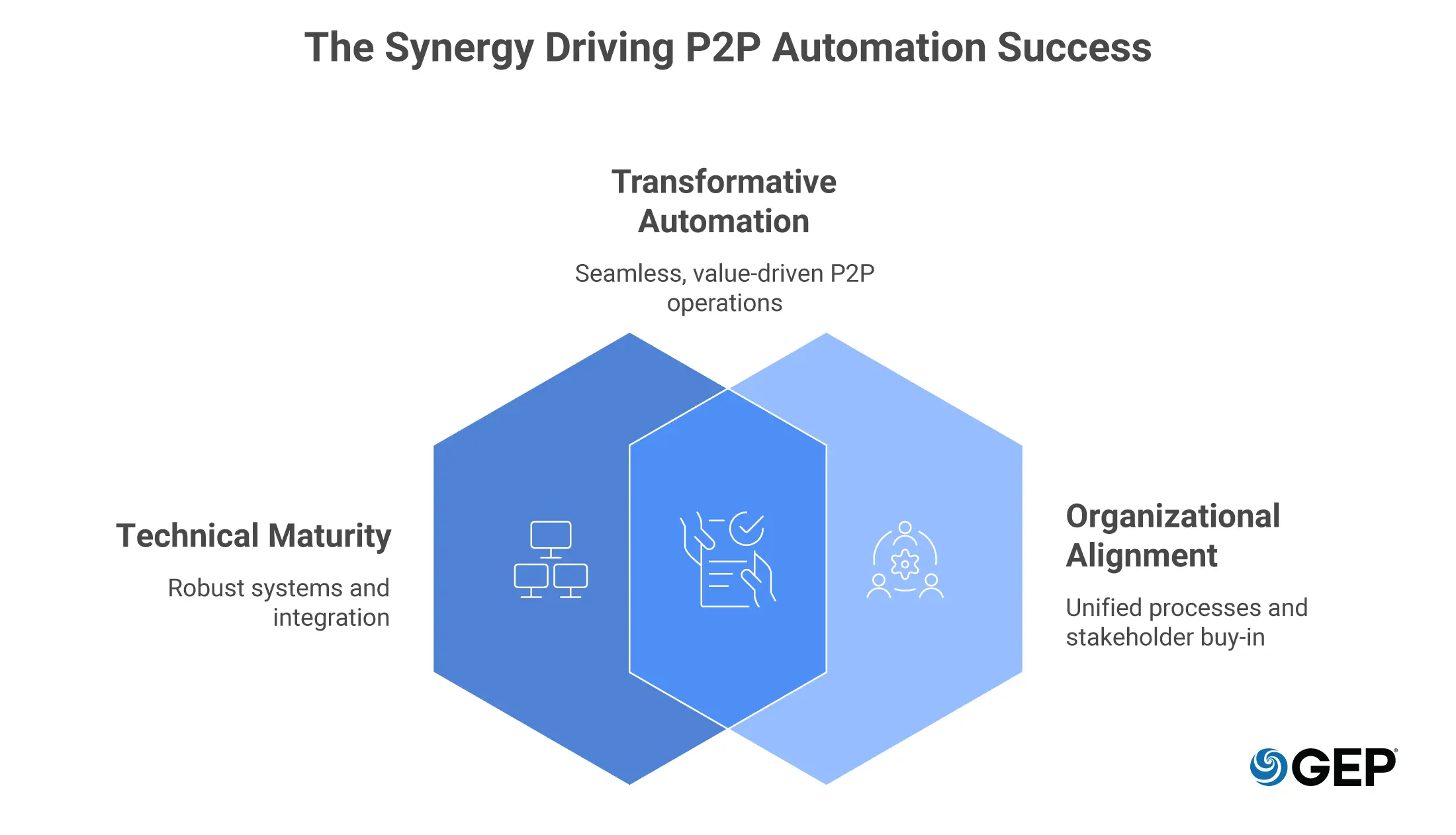
    Traditional P2P struggles because it depends on manual handoffs, disconnected ERP modules, and informal communication. These conditions increase error rates, stretch cycle times, and weaken policy enforcement. Automation replaces those weak links with structured data flows, embedded controls, and real-time visibility. 

    At scale, the real shift is collaboration. Procurement, finance, and suppliers begin operating from shared data models instead of parallel systems. That shift is powerful, but it also exposes structural weaknesses that manual processes previously masked. 

    Key Challenges in Implementing P2P Automation

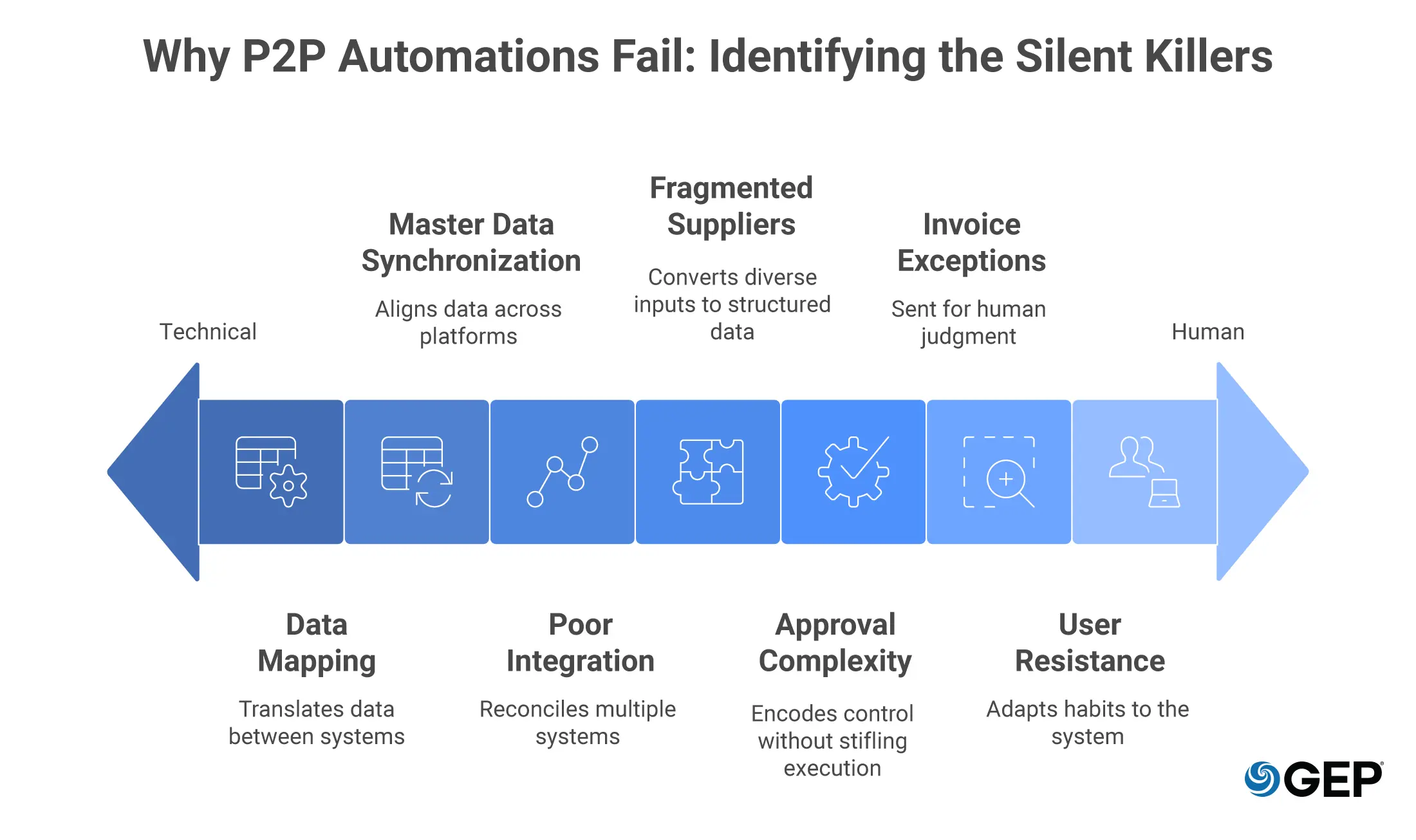
    P2P automation is an operational transformation. You see how money moves, risks are managed, and decisions are made. The most common challenges show up in six areas. 
    Why P2P Automations Fail

    1. Fragmented Supplier Ecosystems 

    No supplier base is ever uniform. Some suppliers operate digitally, while others still rely on email, PDFs, or local invoicing practices. The P2P platform must function as a universal translator, converting everything into structured data. Automation depends on these structured inputs. 

    But the problem is that supplier maturity varies widely across regions and tiers. And configuring this "translation layer" to handle every variation without losing data is a major engineering hurdle. 

    For the system to work efficiently, vendors must submit invoices and updates through the new digital channels. Without a carefully planned onboarding strategy, supplier integration becomes the single largest threat to automation delivering true value. 

    2. Approval and Compliance Complexity

    Enterprise approval structures reflect years of policy layering. Spend thresholds, category risk, regional regulations, and delegation rules intersect in ways rarely documented systematically. Translating these structures directly into rigid workflows results in automation that breaks. The challenge is having control without affecting execution. 

    3. Data Mapping and Transformation

    Different systems organize data differently. The automation software must be taught how to translate information so it fits perfectly into the existing financial system. If the data fields do not align exactly then the transfer will fail, causing transaction errors that require technical debugging. 

    4. Master Data Misalignment

    Automation forces your data to tell the truth. Vendor records, payment terms, tax attributes, and material definitions must align across procurement and finance. In many organizations, they do not. 

    The system must keep core databases identical across multiple platforms at the same time. Achieving real-time synchronization is technically difficult. 

    When a change occurs in one system but fails to trigger an update in the other, the systems drift apart, and transactions get blocked. What looks like a technology issue is usually accumulated data debt that automation surfaces immediately. 

    5. Poor Integration 

    Most enterprises operate across multiple ERPs, legal entities, and accounting structures. Automation must reconcile currencies, tax treatments, and financial hierarchies in real time. 

    Without a strong interoperability design, integrations become brittle. As more exceptions arise, processes slow down, and teams spend more time managing and double-examining AI outputs. This cancels the benefits of speed and efficiency, which is why automation was implemented in the first place. 

    6. User Adoption Resistance

    Automation changes how people work. Requestors lose informal shortcuts, while approvers face structured decision points. Accounting teams shift from processing volume to resolving exceptions. 

    If incentives, training, and accountability are unclear, users adapt the system to their habits instead of adapting their habits to the system. That is how email invoices reappear, off-system buying grows, and automation quietly stalls. 

    7. Invoice and Payment Exceptions

    Even mature environments face disputes, mismatches, and regulatory corrections. Automation does not eliminate exceptions. It concentrates them. 

    If exception handling is treated as an afterthought, operational load increases. If it is designed intentionally, automation becomes a filter that directs human effort where judgment actually matters. 

    How to Overcome Procure-to-Pay Automation Challenges 

    Automation does not fail because the system was configured incorrectly. It fails because the organization was not ready to operate differently. 

    Readiness Comes Before Configuration

    Before workflows scale, people need to know who owns decisions, who owns data, and where judgment still applies. When those answers come later, automation adds drag instead of speed. You see it immediately in approvals that stall, exceptions that multiply, and teams that quietly step outside the system to get work done. 

    Supplier Connectivity Is the First Stress Test

    If suppliers enter through a dozen different paths, automation spends its time reconciling variation instead of driving efficiency. Clear onboarding routes matter. So do consistent catalog formats and predictable invoicing rules. Once suppliers are grouped by business impact and transaction volume, effort stops being spread thin and starts producing results where it counts. 

    Data Discipline Determines Scale

    Procurement and finance often believe they are aligned, until automation forces precision. Category structures, payment terms, and tax logic either match or they don’t. When they don’t, transactions move faster than errors can be corrected. Fixing data foundations early prevents automation from scaling problems that were previously contained by manual checks. 

    Workflow Design Is Where Theory Breaks

    Static approval chains rarely survive real operating conditions. Spend varies. Risk shifts. Context matters. Workflows need to adjust without constant reconfiguration. This is where AI and agentic capabilities earn their place, by learning how decisions are actually made, routing work intelligently, and stepping in only when human judgment adds value. 

    Shared Ownership Keeps Automation Moving

    Ownership cannot be ambiguous. When procurement and finance split responsibility, automation slows down. When they share it, problems surface earlier and decisions stick. Policies, integrations, and outcomes work better when accountability is explicit and jointly held. 

    Adoption Is the Only Metric That Matters

    If people avoid the system, value never materializes. Expectations need to be clear. Training needs to reflect how work actually happens. Compliance needs to be enforced consistently. When the automated path is simpler than the workaround, behavior changes on its own.

    Security and Risk Are Designed, Not Added Later

    Automation pulls sensitive information into fewer places. Supplier banking details, commercial terms, and approval authority move through shared environments instead of scattered inboxes. Visibility improves, and so does exposure. The answer is not more after-the-fact review. It is control built directly into execution. 

    When access rules, audit trails, and risk checks operate in real time, problems surface while they are still small. Compliance stops being a clean-up exercise and starts functioning as part of day-to-day operations. 

    Effective P2P automation embeds access controls, audit trails, and compliance checks directly into execution. Organizations that invest in readiness, governance, and adoption unlock the full potential of P2P automation and position procurement as a strategic driver of enterprise performance. 

    Conclusion 

    The challenges in implementing procure-to-pay automation are structural. You are redesigning how the enterprise spends, manages, and collaborates across internal and external stakeholders. 

    Before deploying software, existing workflows must be mapped, simplified, and standardized. The goal is to automate a clean process, not a broken one. 

    Approaching automation as a platform rollout results in limited value. Treating it as an operational shift allows you to gain speed, accuracy, and control at scale. 

    Explore how next-generation systems improve compliance, accuracy, and financial control through advanced Procure-To-Pay Software Solutions.

     

    Tags: Procure-to-Pay Automation Challenges , Procurement , AI

    Add Comment +

    GEP Outlook 2026: Procurement & Supply Chain

    Read More

    FEATURED POST

    ...
    Procurement Software

    Don’t Just Automate Procurement. With GEP Qi, You Can Make It Autonomous

    ...
    Procurement Software

    How Procurement Can Unify Data, Tech and People With AI-Driven Orchestration

    ...
    Procurement Software

    Plan to Deploy AI in Procurement? Do These 3 Things First

      BLOG CATEGORIES

    • Procurement Software
    • Supply Chain Software
    • Accounts Payable
    • Contract Management
    • Inventory Management Software
    • Spend Management
    • Source to Pay
    • Supplier Management Technology
    • Operations
    • Purchasing
    • Sourcing Technology
    • Mobile and Cloud
    • Spend Analysis
    • Procure to Pay
    • e-Invoicing

    TAGS

    sustainability
    Procurement Software
    supply chain strategy
    Inflation
    Russia-Ukraine War

    By checking the box below, you consent to GEP using your personal information to send you thought leadership content – such as white papers, research reports, case studies – and other communications. GEP representatives may contact you to provide additional information or answer questions.

    If at any point in time you decide to withdraw your consent, you may unsubscribe by emailing your request to us at privacy@gep.com.

    Please refer to the GEP Privacy Statement to understand how we manage and protect your personal information.

    Terms of Use | Privacy Statement

    SEND US YOUR QUESTION(S)

    Terms of Use | Privacy Statement

    Breadcrumb

    1. HOME
    2. BLOGS
    3. TECHNOLOGY
    4. 7 COMMON PROCURE-TO-PAY AUTOMATION IMPLEMENTATION CHALLENGES (AND HOW TO FIX THEM)

    Contact Us

      Demo Schedule a live demo of our software
      RFP Request for a business proposal
      Ask Us Send us your question(s)
      Feedback Share your comments and suggestions
           
    STRATEGY
    Strategy
    •   Procurement Consulting
    •   Digital Procurement Transformation
    •   Strategic Cost Management
    •   Opportunity Assessment
    •   Supply Chain Risk Management
    •   Supply Chain Consulting
    •   Supply Chain Strategy
    •   Supply Chain Diagnostics
    •   Inventory Optimization
    •   Procurement Transformation
    •   Sustainability and ESG Consulting
    SOFTWARE
    Software
    •   Procurement Software
    •   Supply Chain Software
    •   Source-to-Contract
    •   Procure-to-Pay
    •   Supply Chain Planning
    •   Supply Chain Collaboration
    •   Supply Chain Visibility & Execution
    •   Supply Chain Control Tower
    •   Should-Cost Modeling
    •   Inventory & Warehouse Management Software
    •   Source-To-Pay Software
    •   Midsize & High Growth Enterprises
    MANAGED SERVICES
    Managed Services
    •   Procurement Outsourcing
    •   Strategic Sourcing
    •   Tail-Spend Management
    •   Category Management
    •   Procurement Support Services
    •   Supply Chain Outsourcing
    •   Supply Chain Planning & Forecasting
    •   Inventory Management
    •   Logistics Management
    COMPANY
    Company
    •   About Us
    •   Leadership
    •   Customers
    •   Sustainability at GEP
    •   Careers
    •   News
    •   Awards
    •   Partners
    •   Contact Us
    Stay Connected


    Download the GEP GO App

    Stay connected with cutting-edge procurement and supply chain insights – anytime, anywhere.

    app store
    play store
    © Copyright GEP 2026. All rights reserved. Terms of Use | Privacy Statement | Cookie Policy |  | Quality Policy | GEP Logo